What Is Shadowing and Why It's So Powerful
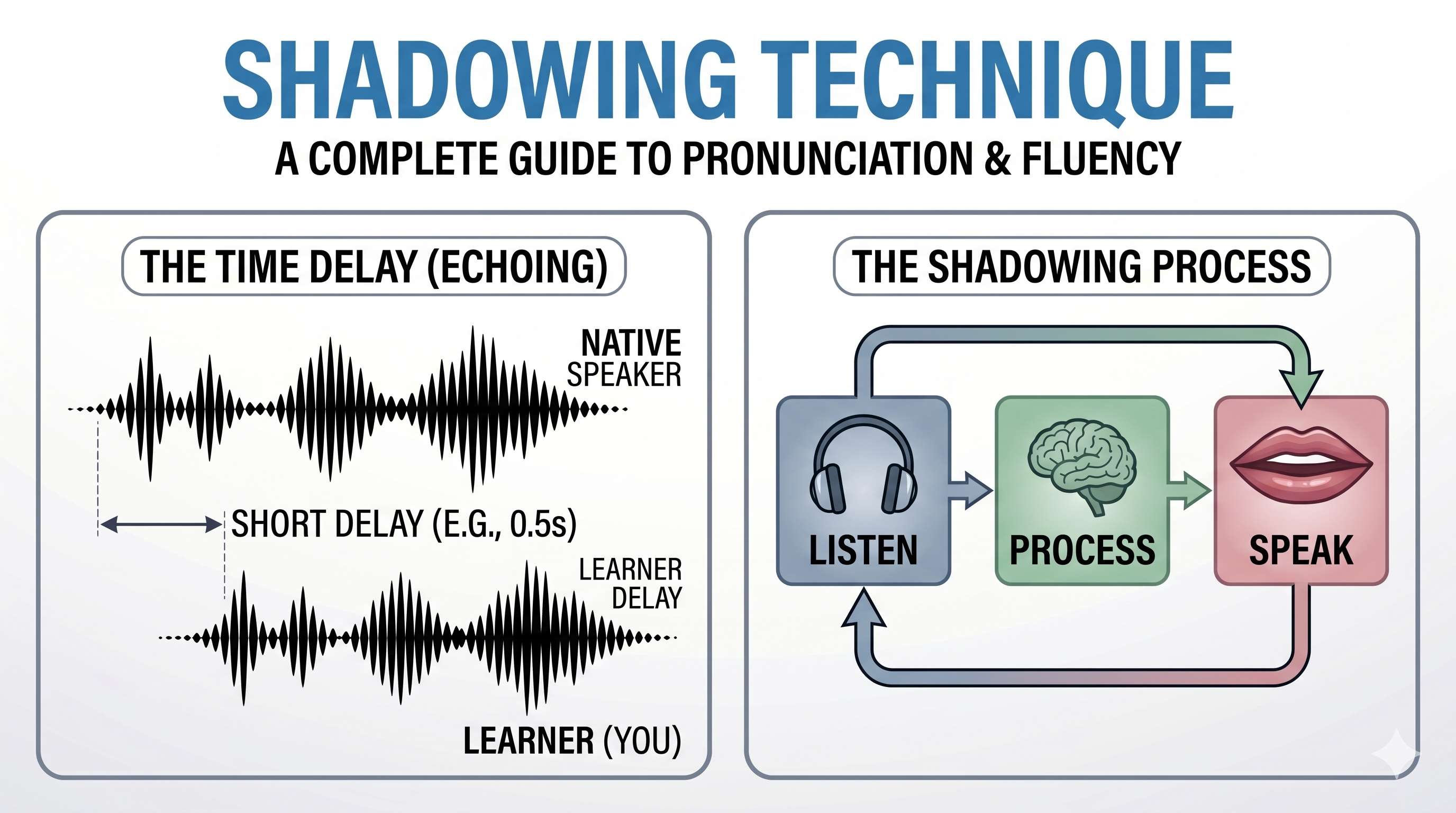
Shadowing is a technique where you listen to a native English speaker and simultaneously repeat what they're saying in real-time. You wear headphones and try to match their pronunciation, intonation, pace, and even emotional expression. It's called "shadowing" because you follow the speaker like a shadow.
This technique is remarkably effective because it combines multiple learning elements simultaneously: listening comprehension, pronunciation practice, rhythm acquisition, and natural speech patterns. You're not just practicing isolated sounds—you're learning how natural English actually flows.
Why Shadowing Works Better Than Other Methods
1. Develops Natural Rhythm and Intonation
The biggest weakness of most pronunciation practice is that it focuses on individual sounds in isolation. Real English has rhythm, stress patterns, and intonation. Shadowing trains these elements automatically as you listen and imitate.
2. Builds Automaticity
When you shadow regularly, English production becomes automatic. You're not consciously thinking about each sound—you're imitating and absorbing natural patterns. This automaticity is essential for fluent, natural-sounding speech.
3. Trains Listening and Speaking Together
Most learners practice listening and speaking separately. Shadowing integrates them. You develop the ability to understand English while simultaneously producing it—a critical skill for real conversation.
4. Provides Authentic Models
Instead of artificial textbook examples, you're learning from real native speakers in authentic contexts. You absorb real vocabulary, real pronunciation, and real speech patterns.
5. Improves Speech Fluency Dramatically
Shadowing forces you to speak at natural pace. This is challenging at first but develops the processing speed needed for real conversation. Most learners report fluency improvement within weeks of consistent practice.
The Three Levels of Shadowing
Level 1: Oral Shadowing (Beginner)
You listen to audio and repeat what you hear without a transcript. This is the basic form of shadowing. Benefits: Develops listening and pronunciation without relying on written text.
How to practice: Use simple, clear audio. Start with short segments (30 seconds to 1 minute). Focus on matching pronunciation and pace, even if you don't understand every word.
Duration: 10-15 minutes daily for beginners
Level 2: Transcript Shadowing (Intermediate)
You have a written transcript and follow along while shadowing. This helps comprehension and lets you check accuracy.
How to practice: Read the transcript silently first. Then listen and shadow with the transcript visible. After several repetitions, try shadowing without looking at the transcript.
Duration: 15-20 minutes daily for intermediate learners
Level 3: Shadowing with Pausing (Advanced)
You pause the audio frequently and repeat sections multiple times before continuing. This is more intensive and allows detailed attention to specific pronunciation challenges.
How to practice: Pause after every 1-2 sentences. Repeat 2-3 times focusing on specific pronunciation aspects. Then continue with the next section.
Duration: 20-30 minutes daily for advanced learners (more intensive but shorter segments)
Step-by-Step Shadowing Guide
Step 1: Choose Your Material
Select audio content that interests you:
- Beginner: Slow podcasts, children's stories, audiobooks designed for learners
- Intermediate: TED talks, podcasts, audiobooks, educational YouTube videos
- Advanced: Movies, TV shows, news broadcasts, podcasts on complex topics
Our interactive shadowing exercises provide curated dialogues and passages specifically designed for pronunciation practice.
Step 2: First Listen (Comprehension)
Listen to the audio 1-2 times without shadowing. Focus on understanding the content. Note words you don't recognize but don't worry about perfect comprehension.
Step 3: Shadow Slowly
Listen with headphones and begin shadowing. Start slowly. If the audio is too fast, slow it down (most players have speed controls). Your goal is clarity, not speed.
Step 4: Match the Speaker
Focus on matching:
- Pronunciation: Individual sounds and word-level accuracy
- Word stress: Which syllables are emphasized
- Intonation: Pitch rises and falls
- Pace: Overall speed of speech
- Connected speech: How words blend together
Step 5: Gradual Speed Increase
As you become comfortable, slowly increase the playback speed. Many learners start at 0.75x or 0.9x speed, then move to 1.0x (normal) speed over weeks of practice.
Step 6: Advanced Shadowing
Once comfortable at normal speed, try these advanced techniques:
- Emotion matching: Match the speaker's emotional expression and tone
- Accent imitation: Consciously imitate specific accent features
- Thought grouping: Follow the speaker's natural phrase boundaries
Shadowing Best Practices
Use Quality Headphones
Clear audio is essential. Poor audio makes shadowing frustrating and less effective. Invest in decent headphones that let you hear each sound clearly.
Practice Consistently, Not Sporadically
Daily shadowing for 10-15 minutes is more effective than occasional 2-hour sessions. Build it into your daily routine: morning commute, exercise time, lunch break.
Shadow With and Without Transcript
Use both approaches. Transcripts help with comprehension and accuracy. Shadowing without them forces deeper listening and ear training.
Record Yourself
Record your shadowing and compare it to the native speaker. This reveals discrepancies you might miss while shadowing. You might discover you're mispronouncing words or missing intonation patterns.
Start Slowly, Build Gradually
Begin with clear, slower material. As you improve, gradually increase difficulty and speed. This prevents frustration and builds confidence.
Don't Obsess Over Understanding Every Word
Focus on pronunciation and rhythm. If you miss some words, that's okay. You're training your mouth and ears, not memorizing vocabulary. Understanding will improve naturally.
How Long to See Results
With consistent daily shadowing (10-15 minutes):
- Week 1: You'll feel more confident with pronunciation and begin noticing intonation patterns
- Week 2-3: Noticeable improvement in listening comprehension and ability to follow at natural speed
- Week 4-6: Significant improvement in fluency and natural-sounding pronunciation
- Month 3+: Substantial accent improvement and ability to speak at near-native speed and rhythm
Individual variation is significant. Factors affecting timeline include: your starting level, amount of daily practice, quality of material, and overall language exposure.
Shadowing vs. Other Pronunciation Methods
Shadowing vs. Tongue Twisters
Tongue twisters build articulator strength and muscle control. Shadowing develops natural rhythm and fluency. Both are valuable—use them together for comprehensive pronunciation training.
Shadowing vs. Minimal Pairs
Minimal pairs train sound discrimination in isolation. Shadowing develops sound production in natural context. Together they provide complete sound training: first learning to distinguish and produce sounds, then integrating them into natural speech.
Shadowing vs. Conversation Practice
Real conversation with native speakers is invaluable but can be high-pressure. Shadowing is a lower-pressure way to build confidence and fluency before attempting difficult conversations. Use both approaches together.
Common Shadowing Mistakes to Avoid
Mistake 1: Going Too Fast Too Soon
Attempting normal-speed shadowing before you're ready leads to frustration and error reinforcement. Start slow and build gradually.
Mistake 2: Not Using Material at the Right Level
Too-easy material doesn't challenge you. Too-difficult material causes frustration. Choose material that's challenging but comprehensible.
Mistake 3: Not Recording Yourself
Without recording and comparison, you can't identify areas needing improvement. Recording reveals gaps between your perception and your actual speech.
Mistake 4: Pausing Too Frequently
While pausing helps with detailed practice, too much pausing disrupts the natural rhythm you're trying to develop. Balance detailed attention with continuous practice.
Mistake 5: Not Staying Consistent
Shadowing works through repetition and consistency. Sporadic practice doesn't build the automaticity needed for fluent speech. Commit to daily practice.
Interactive Shadowing Practice
Ready to master shadowing? Our interactive shadowing exercises feature:
- 6 carefully selected dialogues ranging from easy to advanced
- Native English speaker models at multiple difficulty levels
- Context information for each dialogue
- Recording capability to practice and compare to native speakers
- Accuracy feedback on your pronunciation
Start with easier dialogues and progress to more challenging ones. Spend 1-2 weeks on each dialogue before moving forward.
Combine Shadowing With Other Techniques
For maximum pronunciation improvement, combine shadowing with:
- Tongue twisters for articulation strength
- Minimal pairs for sound discrimination
- Stress and intonation practice for rhythm awareness
- Phrase practice for natural expression patterns
- Real conversation with native speakers for practical application
Conclusion
Shadowing is one of the most effective and natural ways to improve English pronunciation, listening comprehension, and speaking fluency. By imitating native speakers in real-time, you absorb authentic pronunciation patterns, rhythm, and intonation automatically.
Start with our interactive shadowing exercises and commit to 10-15 minutes of daily practice. Within a few weeks, you'll notice significant improvement in your accent, fluency, and overall speaking confidence.
Remember: consistency matters more than intensity. Steady daily practice produces faster results than sporadic long sessions. Make shadowing a regular part of your English learning routine, and watch your pronunciation and fluency transform.
Frequently asked questions
What is shadowing?
Speaking along with an audio recording almost simultaneously, trailing the speaker by a fraction of a second, without waiting for pauses. It differs from listen-and-repeat because there is no gap in which memory can normalise what you heard — memory keeps the words but discards the timing, reductions and pitch, which are exactly what you are trying to copy.
How long should I shadow for in one session?
Five to fifteen minutes, using a single clip of twenty to thirty seconds repeated many times. Ten repetitions of one clip produce far more benefit than one repetition each of ten clips, because the gain comes from the pattern becoming automatic. Shadowing is also physically tiring at first, so building up gradually is sensible.
What audio should I use?
Unscripted natural speech such as interviews, podcasts or documentary narration, at a level you already understand comfortably. Scripted news reading is unnaturally even, and graded classroom audio removes the reductions and linking you are trying to learn. Keep to one accent, since alternating models produces a mixture neither group recognises.
Will shadowing fix my individual sound errors?
Usually not. It is the most efficient exercise available for rhythm, linking, weak forms and intonation, because the model enforces the timing. But if you substitute /s/ for /θ/, shadowing will place that substitution in perfect rhythm. Individual sounds need targeted drills with explicit articulatory instructions alongside it.
Disclosure: this page links to Preply, a tutoring marketplace. If you book a lesson through that link we may earn a commission, at no extra cost to you. It does not change what is recommended here. See our disclaimer and privacy policy.
Start your first shadowing session
Listen to a native model, speak along with it, and record yourself to compare.
Open shadowing practice