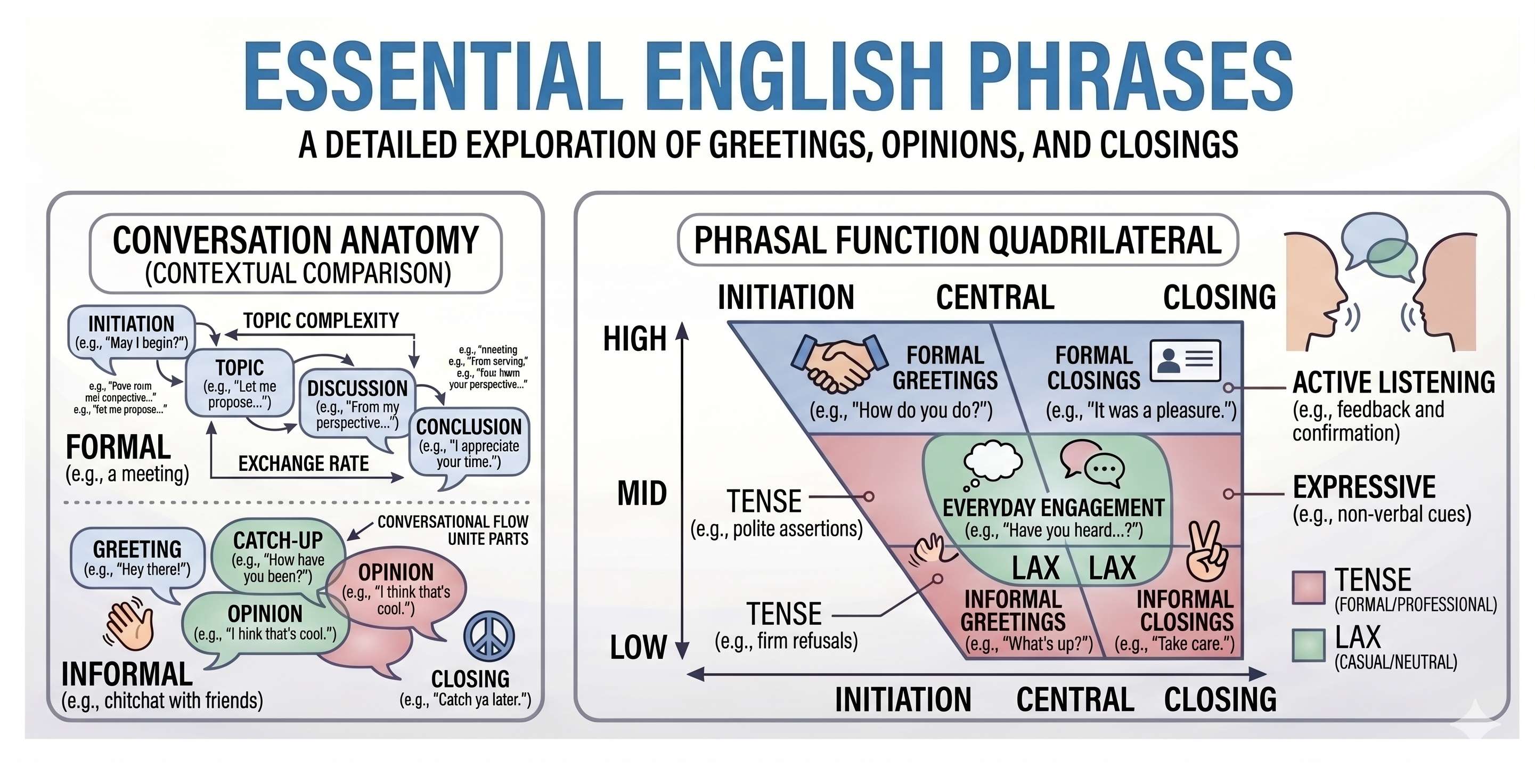
Why Phrases Matter More Than Individual Words
Many English learners spend years memorizing vocabulary lists, only to freeze in real conversations. Why? Because native speakers don't string random words together—they use established phrases and expressions.
When you learn phrases rather than individual words, you gain instant communicative ability. You learn which words naturally appear together, the correct word order, and appropriate contexts. This approach builds real conversation skills much faster than traditional vocabulary learning.
Essential Greetings and Introductions
Basic Greetings
- "Hello." / "Hi." — Standard greetings
- "How are you?" — Most common greeting in English
- "I'm doing well, thanks. How are you?" — Proper response with reciprocal question
- "What's up?" — Casual, friendly greeting
- "Good morning." / "Good afternoon." / "Good evening." — Time-appropriate greetings
- "It's nice to see you." — Warm greeting for someone you know
Introductions
- "My name is [name]." / "I'm [name]." — Introducing yourself
- "What's your name?" / "May I ask your name?" — Politely asking someone's name
- "Nice to meet you." / "It's a pleasure to meet you." — Standard introduction response
- "This is [name]." — Introducing someone else
- "Where are you from?" — Common introductory question
- "I'm from [country/city]." — Answering where you're from
- "What do you do?" — Asking about someone's profession
- "I work as a [profession]." — Answering about your job
Tips for Sounding Natural
When greeting, use appropriate intonation: rising tone on "How are you?" makes it sound like a genuine question. Say phrases smoothly without pausing between words. The phrase "How are you?" often sounds like "Howarya?" with connected speech.
Essential Politeness Phrases
Requests and Help
- "Could you help me?" — Polite request for assistance
- "Could you please...?" — Very polite request format
- "Would you mind...?" — Polite, slightly formal request
- "Can I help you?" — Offering assistance
- "Do you need any help?" — Another way to offer assistance
Thanking and Appreciating
- "Thank you." / "Thanks." — Basic appreciation
- "Thank you very much." / "Thanks a lot." — Strong appreciation
- "I really appreciate it." — Expressing deeper gratitude
- "You're welcome." — Standard response to thanks
- "That's very kind of you." — Appreciating someone's kindness
Apologies
- "I'm sorry." — Simple apology
- "I apologize." — More formal apology
- "I'm sorry for..." — Apologizing for specific action
- "My apologies." — Sincere, formal apology
- "That's okay." / "No problem." — Accepting an apology
Excusing Yourself
- "Excuse me." — Getting someone's attention
- "Pardon me." — Formal way to say "excuse me"
- "I beg your pardon?" — Politely asking someone to repeat
- "Could you repeat that?" — Less formal request to repeat
- "I don't understand." — Expressing comprehension problem
Essential Daily Conversation Phrases
Casual Conversation Starters
- "What have you been up to?" — Asking about recent activities
- "How's everything going?" — General status question
- "Anything new with you?" — Asking for updates
- "Long time no see." — Greeting someone you haven't seen recently
- "I heard that..." — Starting to share news or information
Expressing Opinions and Preferences
- "In my opinion..." — Formally introducing an opinion
- "I think that..." — Standard way to share thinking
- "I don't think..." — Disagreeing diplomatically
- "I prefer..." — Expressing preference
- "I'm not sure about that." — Expressing uncertainty
- "I have to disagree." — Diplomatic disagreement
- "That sounds interesting." — Positive response to ideas
Asking for Information
- "Where is...?" — Asking location
- "How do I get to...?" — Asking directions
- "What time is...?" — Asking about time/schedule
- "How much does this cost?" — Asking about price
- "Do you have...?" — Asking if something is available
- "Can you tell me...?" — Politely requesting information
Making Plans and Scheduling
- "When are you available?" — Asking about someone's schedule
- "Would you like to...?" — Inviting someone
- "I'd like to..." — Expressing your desire to do something
- "Let's meet at..." — Suggesting a meeting location
- "What time works for you?" — Asking for preferred time
- "I'm looking forward to..." — Expressing excitement about future event
Professional and Formal Phrases
Business Greetings
- "It's a pleasure to meet you." — Formal introduction
- "I'm impressed by your work." — Professional compliment
- "Let's discuss this further." — Moving a conversation forward
- "I'd like to propose..." — Formally suggesting an idea
Meetings and Discussions
- "Could we schedule a meeting?" — Requesting formal meeting
- "Let's table that discussion for now." — Postponing discussion of topic
- "That's a valid point." — Acknowledging good idea
- "I see where you're coming from." — Showing understanding
- "Let me get back to you on that." — Promising to respond later
Closing Conversations Professionally
- "It was great speaking with you." — Positive professional goodbye
- "Let's stay in touch." — Maintaining professional relationship
- "I look forward to our next meeting." — Expressing continued interest
- "Thanks for your time." — Appreciating someone's attention
Emergency and Urgent Phrases
- "Help!" — Calling for assistance in emergency
- "Call 911!" — Requesting emergency services
- "I need a doctor." — Expressing medical need
- "Where is the nearest hospital?" — Asking for medical facility location
- "I'm allergic to..." — Important health information
- "This is an emergency." — Emphasizing urgent situation
How to Practice Phrases Effectively
1. Listen First
Before speaking phrases, listen to native speakers use them. Notice the pronunciation, intonation, and speed. Our interactive phrase exercises provide native speaker models you can listen to and learn from.
2. Practice with Proper Pronunciation
Don't just memorize phrase words—learn to pronounce them naturally with correct stress, intonation, and connected speech. Record yourself and compare to native speakers.
3. Use Phrases in Context
Practice phrases in realistic dialogues and conversations, not in isolation. Understanding when and how to use phrases matters as much as knowing what they mean.
4. Vary and Adapt
Learn the core phrase, then practice variations. For example, "How are you?" can become "How's everything?" "How are things?" "How are you doing?" etc.
5. Get Real Feedback
Practice with native speakers when possible. If that's not available, use tools like our transcript tool to monitor your pronunciation and get feedback on how clearly you're speaking.
Common Mistakes When Using Phrases
Mistake 1: Wrong Pronunciation
Mispronouncing a phrase makes it unrecognizable. For example, "How are you?" must sound like "Howarya" or similar with connected speech, not "How Are You" with separate words.
Mistake 2: Unnatural Intonation
Using flat intonation or putting stress in wrong places makes even common phrases sound awkward. Native speakers use significant intonation variation.
Mistake 3: Using Phrases Out of Context
Using formal phrases in casual situations (or vice versa) sounds wrong. Match your phrase formality to the context and relationship.
Mistake 4: Over-Emphasis on Accuracy
Don't sacrifice communication for perfection. Native speakers value clear communication over perfect pronunciation. Speak with confidence even if you make small errors.
Mistake 5: Not Using Phrases in Real Conversation
Practicing phrases in isolation helps, but real learning happens when you use them in actual conversations. Push yourself to speak with native speakers regularly.
Building Your Personal Phrase Bank
Create a personal list of phrases relevant to your life and interests:
- Phrases related to your work or hobby
- Phrases needed for specific situations (travel, business, dating)
- Phrases your conversation partners frequently use
- Phrases you want to use but haven't learned yet
Study 5-10 new phrases per week, practice them extensively, then move on. After a few months of systematic phrase learning, you'll have a rich repertoire for real communication.
Interactive Phrase Practice
Ready to master essential phrases? Use our interactive phrase practice where you can:
- Hear native speakers pronounce each phrase
- Record yourself saying each phrase
- Get instant feedback on pronunciation accuracy
- Practice the most essential phrases systematically
- Track your improvement
Conclusion
Mastering essential English phrases is the fastest path to conversational ability. Rather than memorizing thousands of vocabulary words, focus on learning 50-100 key phrases used frequently in real English conversation.
Practice these phrases with correct pronunciation, natural intonation, and appropriate context. Use them in real conversations whenever possible. Within a few weeks of consistent phrase learning and practice, you'll notice significant improvement in your conversational fluency and confidence.
Start with our interactive phrase exercises today and begin building your conversational English skills.
Frequently asked questions
Why do common phrases sound so different from their written form?
Because high-frequency phrases reduce heavily in connected speech. What are you going to do commonly becomes three chunks rather than six words, and going to becomes gonna only when a verb follows. Learning these phrases as single units, with their reduced pronunciation, is far more efficient than assembling them from dictionary forms in real time.
Should I learn phrases or individual words?
Both, but fixed phrases give a better return in conversation. Native speakers rely heavily on stored multi-word units, which is why fluent speech is faster than word-by-word assembly would allow. Learning a phrase with its rhythm and its reduction attached also solves the pronunciation and the grammar at the same time.
How do I sound polite rather than blunt in English?
Often it is intonation rather than wording. English uses a fall-rise pitch pattern to signal reservation and politeness, and speakers whose first language has a narrower pitch range are frequently perceived as blunt or bored even when their words are perfectly courteous. Widening the pitch movement usually changes the impression more than adding please does.
Which phrases are worth learning first?
The ones that buy you time and repair misunderstandings, since those keep a conversation going when vocabulary runs out: sorry, could you say that again, what do you mean by, I'm not sure how to say this, and let me think for a second. Learners often prioritise greetings, but greetings are short and predictable, whereas repair phrases are what prevent a conversation from stalling.
Disclosure: this page links to Preply, a tutoring marketplace. If you book a lesson through that link we may earn a commission, at no extra cost to you. It does not change what is recommended here. See our disclaimer and privacy policy.
Say the phrases, not just read them
Each phrase has audio and a record button so you can compare your rhythm with the model.
Practise the phrases