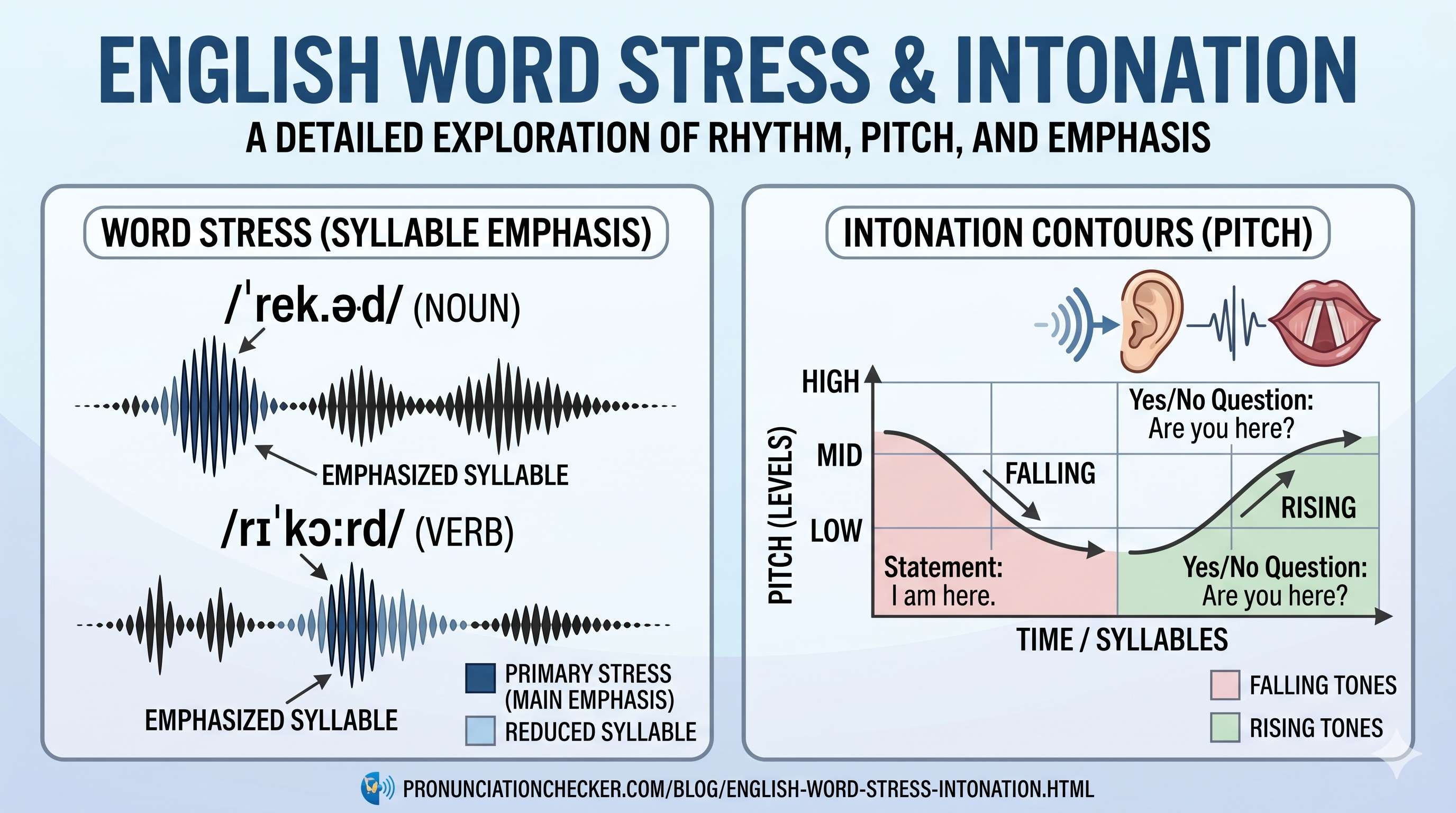
Why Word Stress and Intonation Matter More Than Perfect Pronunciation
Many English learners focus intensely on pronouncing individual sounds correctly. But here's the truth: you can pronounce every single sound perfectly and still sound unnatural. Why? Because you're missing the prosody—the music of English.
Word stress and intonation are the rhythm and melody of English. Native speakers use them to convey meaning, emotion, and attitude. Without proper stress and intonation, your English will sound mechanical and foreign, even if individual sounds are perfect.
Understanding Word Stress in English
What Is Word Stress?
Word stress is the emphasis placed on one syllable in a word. The stressed syllable is pronounced:
- Louder than other syllables
- Longer in duration
- Higher in pitch than unstressed syllables
- Often with a clear vowel (unstressed syllables often use the schwa sound)
Word Stress Changes Meaning
This is crucial: In English, word stress changes the meaning of words. Consider these examples:
- RECord (noun) vs reCORD (verb)
- PRESent (noun/adjective) vs preSENT (verb)
- CONduct (noun) vs conDUCT (verb)
- INsult (noun) vs inSULT (verb)
- PERmit (noun) vs perMIT (verb)
Getting the stress wrong means you're literally saying a different word!
Common Word Stress Patterns
1. Two-Syllable Nouns
Most two-syllable nouns have stress on the first syllable:
- TAblet, TAble, BOttom, STUdent, TEacher, SYstem
But there are exceptions: hoTEL, comPUter, aVOid, diVIDE
2. Two-Syllable Verbs
Most two-syllable verbs have stress on the second syllable:
- exPLAIN, reMEMber, reGRET, buILD, preVENT
3. Words Ending in Common Suffixes
- -tion: Stress on the syllable before -tion: inFORmation, transPORtation, eduCAtion
- -ity: Stress on the syllable before -ity: unIVERsity, reSPONsibility, possiVILity
- -ous: Stress on the syllable before -ous: DANgerous, FAMous, SERious
- -ive: Stress on the syllable before -ive: aCTive, CREative, exPLOsive
4. Three-Syllable Words
The pattern is often: STRESSED-unstressed-unstressed
- PHOtograph, MUltiple, REVolution, DEvelop, INteresting
Understanding Intonation in English
What Is Intonation?
Intonation is the rise and fall of your voice pitch across a phrase or sentence. It's the melody of English. English speakers use intonation to:
- Indicate whether a sentence is a statement or question
- Show emotions (excitement, sarcasm, frustration)
- Emphasize important information
- Express attitude (certainty, doubt, surprise)
- Mark sentence boundaries
The Four Main Intonation Patterns
1. Falling Intonation (↘)
Your pitch goes down at the end of the phrase. Used for:
- Statements: "I'm learning English." ↘
- Wh-questions: "What's your name?" ↘
- Commands: "Close the door." ↘
- Finished thoughts
2. Rising Intonation (↗)
Your pitch goes up at the end. Used for:
- Yes/No questions: "Are you ready?" ↗
- Uncertainty: "I think it's Tuesday?" ↗
- Incomplete thoughts
- Requests for confirmation
3. Rising-Falling Intonation (↗↘)
Your pitch rises then falls. Used for:
- Emphasis and strong emotions: "That's FANTASTIC!" ↗↘
- Surprise: "You won the lottery?" ↗↘
- Sarcasm
4. Falling-Rising Intonation (↘↗)
Your pitch falls then rises. Used for:
- Expressing doubt or reservation: "It might work..." ↘↗
- Contrast: "I like coffee, but not tea." ↘↗
- Unfinished thoughts or continuations
How Intonation Changes Meaning
Consider the simple sentence: "You're leaving."
- Falling tone: "You're leaving." (stating a fact) ↘
- Rising tone: "You're leaving?" (expressing surprise/doubt) ↗
- Rising-falling: "You're LEAVING?!" (expressing shock/outrage) ↗↘
Same words, completely different meanings!
How to Practice Word Stress
1. Learn the Patterns
Start by learning the common stress patterns listed above. While English stress isn't entirely predictable, these patterns cover the majority of words.
2. Use the Dictionary
Most dictionaries mark word stress with a symbol before the stressed syllable. Look up new words and note where the stress falls. Over time, you'll develop intuition for stress patterns.
3. Listen and Imitate
The most important step: listen to native English speakers and imitate their stress patterns. Pay attention to which syllables sound longer and louder.
4. Practice with Minimal Pairs
Use minimal pairs practice to drill the difference between words that differ only in stress. Recording yourself and comparing to native speakers reveals stress differences clearly.
5. Try Our Interactive Stress Exercises
Use our interactive stress and intonation exercises to practice recognizing and producing correct stress patterns. Get real-time feedback on your pronunciation.
How to Practice Intonation
1. Recognize Intonation Patterns in Native Speech
Listen to English movies, podcasts, and conversations. Pay attention to how pitch rises and falls. Can you hear when someone asks a question versus makes a statement?
2. Exaggerate at First
When learning new intonation patterns, exaggerate them. Make the rises and falls very obvious. Once you have the pattern down, you can use more subtle, natural intonation.
3. Practice with Dialogues
Read simple dialogues aloud, focusing on intonation. Start with the intonation patterns above, then gradually apply them to longer sentences and conversations.
4. Record and Compare
Record yourself speaking and compare your intonation to a native speaker. Are your pitch changes in the same places? Is your range similar? The transcript tool helps you monitor your speech patterns.
5. Practice with Shadowing
Shadowing is one of the most effective ways to absorb intonation patterns naturally. You imitate native speakers' intonation as you listen, training your ear and mouth to produce natural English rhythm.
Common Mistakes with Stress and Intonation
Mistake 1: Even Stress
Stressing every syllable equally makes English sound robotic. English is a stress-timed language—unstressed syllables are reduced and sometimes seem to disappear.
Mistake 2: Wrong Stress Placement
Putting stress on the wrong syllable can make words sound foreign or unintelligible. For example, saying phOTOgraph instead of PHOtograph.
Mistake 3: Flat Intonation
Speaking with almost no intonation variation makes your English sound monotonous and unnatural. Native speakers use significant pitch variation to convey emotion and meaning.
Mistake 4: Not Matching Intonation to Grammar
Failing to use rising intonation for yes/no questions or falling intonation for statements sounds unnatural and can cause misunderstandings.
Mistake 5: Ignoring Connected Speech
In natural speech, syllables blend together and stress patterns affect how sounds connect. Practicing isolated words is helpful, but transition to phrases and sentences for realistic practice.
Advanced Stress and Intonation Patterns
Sentence Stress
Just as individual words have stressed syllables, sentences have stressed words. Usually, content words (nouns, main verbs, adjectives) are stressed, while function words (articles, prepositions, auxiliaries) are unstressed.
Example: "I love learning English" (stressed) vs "i LOVE learning ENGLISH" (some words less important)
Emphatic Stress
You can emphasize unexpected words by stressing them. "I didn't SAY she stole the money" (implying someone else said it) versus "I didn't say SHE stole the money" (implying someone else stole it).
Contrastive Stress
Use stress to highlight contrasts: "I prefer coffee, not tea" (stressing what you prefer) versus "I prefer coffee, not tea" (emphasizing what you don't prefer).
How Long to Master Stress and Intonation
With consistent practice (20-30 minutes daily):
- Week 1-2: Understanding basic patterns and recognizing them in native speech
- Week 3-4: Beginning to produce correct stress and basic intonation patterns
- Month 2-3: Natural-sounding stress and intonation in prepared speech
- Month 4+: Mostly natural stress and intonation in spontaneous conversation
Note: This is one of the harder aspects of English pronunciation, so be patient with yourself.
Integrate Stress and Intonation into Your Routine
Combine stress and intonation practice with other pronunciation work:
- Practice tongue twisters while maintaining natural stress patterns
- Use interactive stress exercises 3-4 times per week
- Practice shadowing to absorb natural intonation
- Record yourself speaking and compare to native speakers
- Watch English movies with subtitles and focus on intonation patterns
Conclusion
Word stress and intonation are the keys to sounding natural in English. They're at least as important as individual sound pronunciation, and many learners overlook them in favor of perfecting individual sounds.
Start by learning common stress patterns and recognizing intonation patterns in native speech. Practice consistently with our interactive exercises, and actively imitate native speakers' stress and intonation patterns.
Within a few weeks of consistent practice, you'll notice your English sounding more natural and native-like. Your listeners will understand you better, and you'll communicate with greater confidence and clarity.
Two systems that are often confused
Word stress and intonation are frequently taught together and just as frequently conflated. They operate at different levels and fail in different ways, so it is worth separating them before practising either.
| Word stress | Intonation | |
|---|---|---|
| Domain | Inside a single word | Across a phrase or sentence |
| Fixed or variable | Fixed — a property of the word, listed in dictionaries | Variable — chosen by the speaker for each utterance |
| What it signals | Which word this is | Attitude, focus, sentence type, turn-taking |
| Effect of an error | The word may not be recognised | You are understood but may seem rude, bored or uncertain |
| Example | PHOtograph vs phoTOGraphy | You're leaving. ↘ vs You're leaving? ↗ |
The practical consequence: word stress errors cost you intelligibility, while intonation errors cost you social impression. Both matter, but if you must choose a starting point, word stress gives the faster return.
English has three levels of stress, not two
Longer words carry a primary stress, a secondary stress and unstressed syllables. Learners who work with only two levels produce long words that sound broken up or hesitant.
- international
/ˌɪntərˈnæʃənəl/— secondary on in, primary on na - pronunciation
/prəˌnʌnsiˈeɪʃən/— secondary on nun, primary on a - university
/ˌjuːnɪˈvɜːrsɪti/— secondary on u, primary on ver - characteristic
/ˌkærəktəˈrɪstɪk/— secondary on char, primary on ris
In IPA the mark ˈ indicates primary stress and ˌ indicates secondary, both placed before the syllable they apply to. Secondary-stressed syllables keep a full vowel but do not take the pitch movement.
How the two systems interact
Intonation does not override word stress; it attaches to it. The main pitch movement of a phrase lands on the stressed syllable of the word being focused. This means that if the word stress is wrong, the intonation lands in the wrong place too, and the two errors compound.
In I studied at UNIversity the fall begins on ver, because that is where the word stress is. A speaker who says UNiversity will place the fall on U, producing a phrase that is wrong at both levels simultaneously. This is why correcting word stress often improves intonation without any separate work.
A practical rule. Fix word stress on your most frequent vocabulary first. Intonation attaches itself correctly far more often once the underlying stress pattern is right, because you are no longer fighting two problems at once.
Moving the focus
Within a sentence you choose which word carries the main pitch movement, and that choice communicates what is new or contrastive. The default is the last content word; departures from the default are meaningful.
- I bought a red CAR. — neutral, everything new.
- I bought a RED car. — the colour is the point; a car was expected.
- I BOUGHT a red car. — I did not rent or borrow it.
- I bought a red car. with the fall on I — somebody else did not.
A combined practice routine
- Mark a text. Take a paragraph you would plausibly say aloud. Underline the stressed syllable of every content word, then circle the one word in each phrase that carries the main pitch movement.
- Read the marks, not the words. Hum the paragraph using only the marked pattern. Fix any point where the hum sounds wrong before adding words back.
- Record and compare. Record yourself reading the marked paragraph, then compare against a native recording of the same text. Listen specifically for the length of your unstressed syllables, which is where learners diverge most.
- Test long words separately. Build a list of the twenty longest words you use regularly in your work or study. Look up each transcription, note the primary and secondary stress, and drill them in isolation and then in a sentence.
The twenty-word list is the highest-value exercise in this routine. Technical vocabulary is where learners most often carry stress errors, because these words are typically learned by reading rather than by hearing, and they are exactly the words you need listeners to recognise first time.
Frequently asked questions
What is the difference between word stress and intonation?
Word stress operates inside a single word, is a fixed property listed in dictionaries, and tells listeners which word you are saying. Intonation operates across a phrase, is chosen freshly for each utterance, and signals attitude, focus and sentence type. A word stress error can make a word unrecognisable, while an intonation error usually leaves you understood but may make you seem rude, bored or unsure.
What is secondary stress and does it matter?
Longer English words have a primary stress, a secondary stress and unstressed syllables. In pronunciation, transcribed /prəˌnʌnsiˈeɪʃən/, the secondary stress falls on nun and the primary on a. Secondary-stressed syllables keep a full vowel but do not take the pitch movement. Learners who use only two levels tend to produce long words that sound broken up or hesitant.
Should I work on word stress or intonation first?
Word stress, for two reasons. It costs more in intelligibility when wrong, and intonation attaches to it — the main pitch movement of a phrase lands on the stressed syllable of the focused word. If the word stress is misplaced, the intonation lands in the wrong place too, so correcting stress frequently improves intonation with no separate work.
Which words should I check the stress on first?
The twenty longest words you use regularly in your own work or study. Technical and professional vocabulary is where stress errors concentrate, because those words are usually learned by reading rather than hearing, and they are precisely the words you most need a listener to recognise immediately. Look up each transcription and note both the primary and secondary stress.
Disclosure: this page links to Preply, a tutoring marketplace. If you book a lesson through that link we may earn a commission, at no extra cost to you. It does not change what is recommended here. See our disclaimer and privacy policy.
Practise stress with audio
Guided examples of word and sentence stress, with speaking practice.
Open stress practice