Recording yourself is the cheapest pronunciation feedback there is. Most learners either skip it because they dislike hearing their own voice, or do it in a way that teaches them little: recording a long passage, listening once, and feeling vaguely discouraged.
Done properly, it takes about ten minutes and tells you things no app can. The method below explains why your recorded voice sounds strange, a setup that takes two minutes, three kinds of recording that each reveal a different problem, and a way of listening in which each pass checks one thing only.
Why your recorded voice sounds wrong to you
Almost everyone dislikes their recorded voice, and there is a physical reason. When you speak, you hear yourself through two paths at once: air conduction through the outside world, and bone conduction through the skull. Bone conduction emphasises low frequencies, so your internal voice sounds deeper and fuller than the signal anyone else receives. A recording removes that second path, which is why it sounds thinner and higher than you expect.
The useful consequence: the recording is what your listeners actually hear. Your internal monitoring is the unreliable version, which is precisely why self-correction without recording plateaus so quickly.
The delay that matters. Do not evaluate a recording immediately. Wait at least a few hours, ideally until the next day. Listening straight away, you hear what you intended to say, because the intention is still in working memory. After a delay you hear what is actually there. The same recording yields noticeably different notes on day one and day two.
A setup that takes two minutes
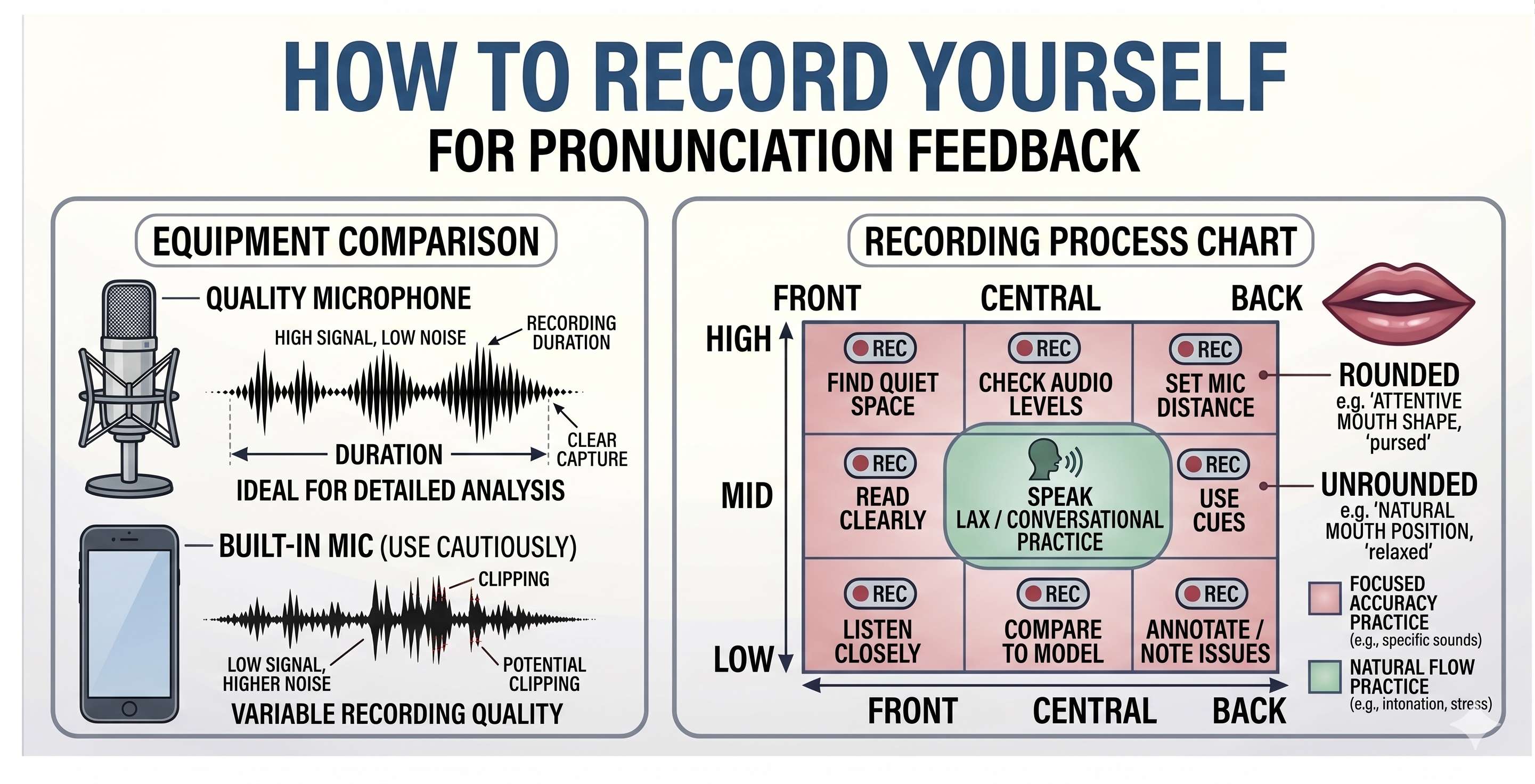
You do not need equipment beyond a phone, but a few choices materially affect what you can hear back.
- Distance. Hold the phone about 20 cm from your mouth and slightly to one side, not directly in front. Speaking straight into a microphone produces plosive bursts on
/p/and/b/that mask the sounds around them. - Room. A room with soft furnishings is better than a bathroom or an empty office. Reverberation blurs exactly the consonant detail you are trying to assess.
- Format. Use the plain voice recorder rather than a messaging app. Voice notes in messaging apps apply aggressive compression tuned for speech intelligibility, which removes some of the detail you want to evaluate.
- Consistency. Use the same distance, room and app every time. Comparing recordings across months only works if the conditions are stable.
Record three different things
Each type reveals a different class of problem, and using only one gives a misleading picture.
| Type | Length | What it reveals |
|---|---|---|
| A fixed passage read aloud | 60–90 sec | Segments and word stress; comparable across months because the text never changes |
| Free speech on a familiar topic | 2–3 min | What you actually do when attention is on meaning — the realistic picture |
| Shadowing a native clip | 30 sec | Rhythm and intonation, since the model constrains your timing |
Keep the fixed passage the same forever. Choose something with a range of sounds and about 150 words. Six months of the same passage recorded monthly is the clearest evidence of progress you can generate, and it costs ninety seconds a month.
Listen four times, for one thing each time
Listening once and noting everything that sounds wrong produces a vague list you cannot act on. Instead make four passes with a single question each.
- Rhythm only. Ignore the words. Are some syllables clearly longer and louder than others, or is everything even? If you cannot tell, hum along with your own recording — the hum makes the rhythm audible on its own.
- Pitch only. Does the melody move? Where does each sentence end, high or low? Flat pitch is the error learners are least likely to notice unaided.
- Word stress. Follow the text and mark the stressed syllable you actually produced on every word of three syllables or more. Then check the dictionary. This pass finds more real problems than any other.
- Individual sounds. Only now listen for consonants and vowels, and only for the two or three you are currently working on.
Comparing against a model
Record a native speaker reading the same passage, or use a text-to-speech voice, then listen to short alternating segments: one sentence of the model, the same sentence of yours, repeated. Differences that are inaudible across a whole passage become obvious in direct alternation.
A free audio editor makes this considerably easier, because you can see the waveform. Two things are visible rather than merely audible: the relative length of stressed and unstressed syllables, which shows up directly as the width of each burst, and pauses, which learners consistently misjudge. If your waveform shows evenly spaced bumps and the model's shows a pattern of tall wide peaks with compressed material between them, you have identified a rhythm problem without needing to hear it.
Keeping a log that is worth keeping
Write three lines after each session: the date, one thing that improved, and one thing to work on next. Nothing longer, because longer logs stop being written.
The value appears at around three months. Pronunciation change is slow enough that you cannot perceive it week to week, and learners frequently conclude they are not improving when the log shows clearly that they are. Having evidence of progress is not a motivational nicety here; it is what prevents people from abandoning a method that is working.
Frequently asked questions
Why does my voice sound so different in a recording?
When you speak you hear yourself through two paths: air conduction and bone conduction through the skull, and the second emphasises low frequencies so your internal voice sounds deeper and fuller. A recording contains only the air-conducted signal, which is exactly what your listeners hear. Your internal monitoring is the unreliable version, which is why self-correction without recording plateaus quickly.
How soon should I listen back to a recording?
Not immediately. Wait at least a few hours, ideally until the next day. Listening straight away you hear what you intended to say, because the intention is still in working memory. After a delay you hear what is actually on the recording, and the same file will produce noticeably different notes on the second day.
What should I listen for when I review a recording?
Make four separate passes with one question each: first rhythm alone, ignoring words; then pitch movement; then word stress on every word of three syllables or more, checked against a dictionary; and only then individual consonants and vowels. Listening once for everything produces a vague list you cannot act on, while the word stress pass typically finds the most real problems.
How do I tell whether I am actually improving?
Record the same fixed passage of about 150 words once a month, under the same conditions, and keep it forever. Pronunciation change is too slow to perceive week to week, so learners frequently conclude they are not improving when they are. Six months of the same passage is the clearest evidence you can generate, and it costs about ninety seconds a month.
Disclosure: this page links to Preply, a tutoring marketplace. If you book a lesson through that link we may earn a commission, at no extra cost to you. It does not change what is recommended here. See our disclaimer and privacy policy.
Record with instant comparison
The accent coach records you and highlights the words that did not match the target.
Open the accent coach