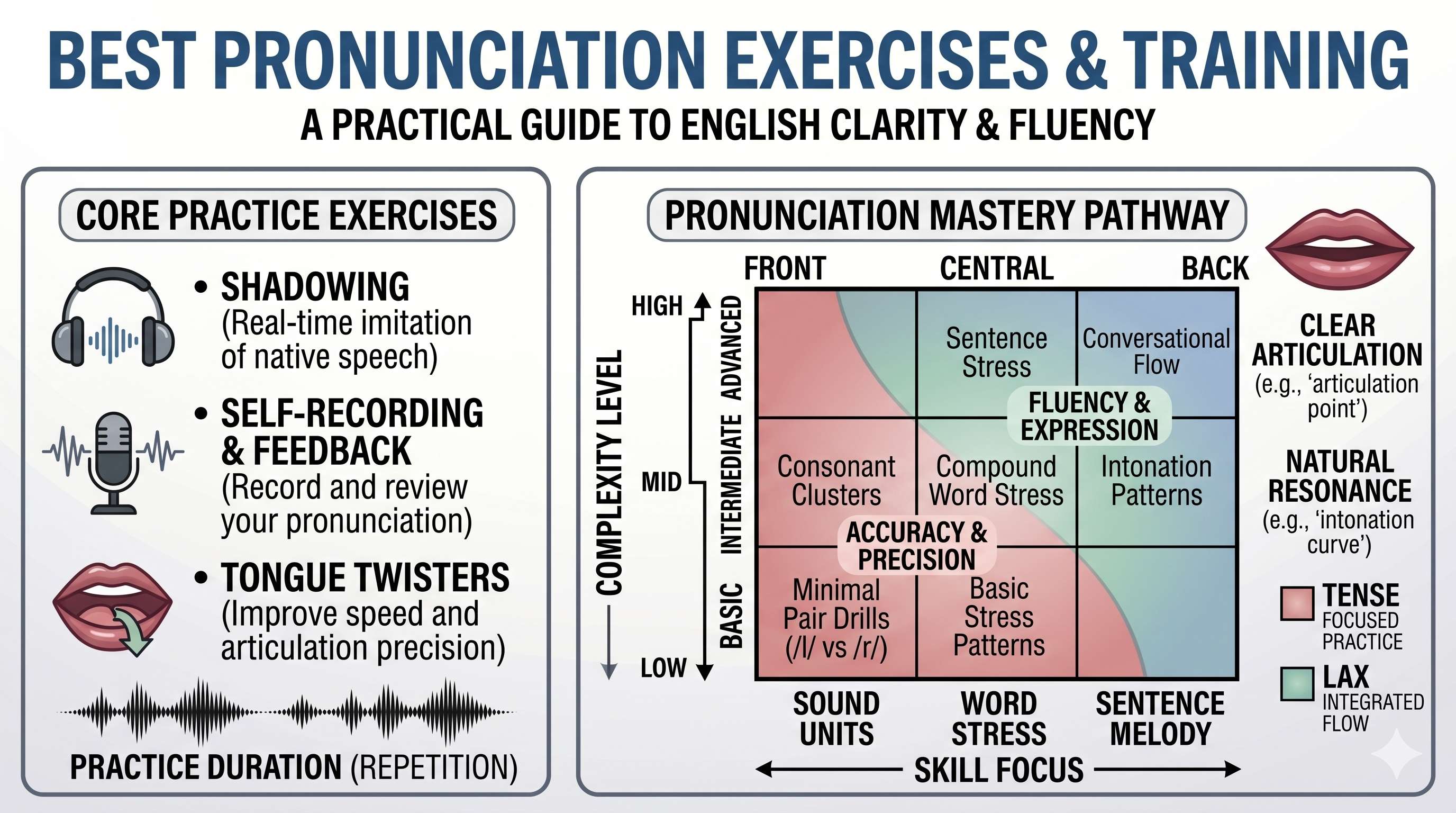
Why Exercise-Based Pronunciation Training Works
Many English learners hope that just speaking with natives will naturally improve their pronunciation. While conversation is important, targeted pronunciation exercises are essential for accent reduction and clarity. Here's why:
- Muscle Memory Development: Specific exercises build the muscle memory needed for English articulation patterns
- Focused Skill Building: Targeted exercises let you isolate and improve specific sounds or features
- Measurable Progress: Exercises provide feedback and metrics for tracking improvement
- Efficient Learning: Research shows structured practice is more efficient than random conversation
- Confidence Building: Success in exercises builds confidence for real conversation
The most effective approach combines multiple types of exercises, each targeting different aspects of English pronunciation.
The 6 Types of Pronunciation Exercises You Need
1. Sound Discrimination Exercises (Minimal Pairs)
What they do: Train your ear to distinguish between similar English sounds. Essential for learners whose native languages don't have certain English sound distinctions.
Examples:
- ship vs sheep (/ɪ/ vs /iː/)
- pit vs pet (/ɪ/ vs /ɛ/)
- lice vs lies (/s/ vs /z/)
Practice method: Listen to sound pairs, identify which you hear, then record yourself saying the sounds. Our interactive minimal pairs exercises provide guided practice with instant feedback.
Time commitment: 10 minutes, 4-5 times per week
Timeline: 2-3 weeks to notice improvement in sound discrimination
2. Articulation Drills (Tongue Twisters and Articulation Exercises)
What they do: Build strength and precision in the mouth muscles used for English speech. Improve articulation clarity and speaking speed.
Examples:
- "She sells seashells by the seashore"
- "Red lorry, yellow lorry"
- "How much wood would a woodchuck chuck?"
Practice method: Start slowly and clearly, gradually increasing speed. Focus on precision over speed. Record yourself and compare to native speakers. Our interactive tongue twister exercises provide native speaker models and accuracy feedback.
Time commitment: 10 minutes, 3-4 times per week
Timeline: 2-4 weeks to notice speaking speed and clarity improvement
3. Stress and Intonation Practice
What they do: Develop natural English rhythm, word stress patterns, and sentence intonation. Essential for sounding natural and being easily understood.
Key concepts:
- Word stress: Which syllable is emphasized (RECord vs reCORD)
- Sentence stress: Which words are emphasized in sentences
- Intonation: How pitch rises and falls
- Rhythm: The overall timing and flow
Practice method: Listen to native speakers, exaggerate stress and intonation patterns, record yourself, compare to models. Our interactive stress and intonation exercises teach stress patterns explicitly.
Time commitment: 15 minutes, 4-5 times per week
Timeline: 4-6 weeks for noticeable naturalness improvement
4. Shadowing (Real-Time Imitation)
What they do: Develop fluency, natural speech speed, and automatic pronunciation through simultaneous listening and speaking.
How it works: You listen to native speakers with headphones and repeat what they say in real-time, matching pace and intonation.
Unique benefits: Combines listening, speaking, rhythm, and intonation in one integrated activity. Develops fluency at natural speaking pace.
Practice method: Start with slow, clear audio. Shadow without a transcript. Gradually increase speed. Our interactive shadowing exercises provide curated dialogues for guided practice.
Time commitment: 15-20 minutes daily
Timeline: 3-4 weeks for noticeable fluency improvement
5. Phrase and Expression Practice
What they do: Develop natural pronunciation of common phrases and expressions used in real conversation. Build muscle memory for frequently used expressions.
Examples:
- "How are you?"
- "Nice to meet you"
- "Could you help me?"
- "What's your name?"
Practice method: Listen to native speakers, repeat with matching pronunciation and intonation, use in conversations. Our interactive phrase exercises teach 8 essential phrases with full pronunciation training.
Time commitment: 10 minutes, 4-5 times per week
Timeline: 1-2 weeks to develop natural-sounding phrase delivery
6. Self-Recording and Comparison
What they do: Develop self-awareness of your pronunciation and track progress objectively. Essential for identifying specific areas needing improvement.
How it works: Record yourself speaking and compare to native speakers. Listen for differences in sounds, stress, intonation, and flow.
Tools: Our transcript tool provides real-time transcription and pronunciation monitoring. You can also record yourself on your phone and compare to online models.
Time commitment: 5-10 minutes weekly
Timeline: Ongoing—this should be integrated into all other practice
The Complete Pronunciation Training Schedule
Weekly Schedule for Comprehensive Pronunciation Training
Monday & Thursday:
- 15 minutes: Minimal pairs exercises (sound discrimination)
- 10 minutes: Tongue twisters (articulation)
Tuesday & Friday:
- 15 minutes: Shadowing practice (fluency and natural rhythm)
- 10 minutes: Word stress and intonation exercises
Wednesday & Saturday:
- 10 minutes: Common phrases practice
- 10 minutes: Self-recording and comparison
- 5 minutes: Real conversation (if possible)
Sunday: Rest or light practice (optional)
Total weekly commitment: 85-95 minutes
This schedule provides balanced training of all pronunciation aspects while being realistic for working adults. Adjust based on your available time, but try to maintain consistent practice.
Beginner-Specific Pronunciation Exercise Plan
If you're just starting:
- Weeks 1-2: Focus on basic sound recognition. Do minimal pairs exercises 4 times per week, 10 minutes each.
- Weeks 3-4: Add articulation drills. Tongue twisters 3 times per week.
- Weeks 5-6: Add phrase practice. Essential phrases 4 times per week.
- Weeks 7+: Add shadowing and stress/intonation practice. Transition to the full schedule above.
This gradual progression prevents overwhelm while building foundational skills first.
Advanced Pronunciation Exercise Plan
If you're already intermediate/advanced:
- Focus more on stress, intonation, and natural rhythm (80% of exercise time)
- Emphasize shadowing and extended conversations
- Use more challenging material (movies, podcasts, native content)
- Practice accent imitation of specific dialects or speakers
- Record yourself frequently and compare to advanced native models
Advanced learners benefit less from isolated sound exercises and more from integrated, natural speech practice.
The Science Behind Pronunciation Improvement
Neuroplasticity and Muscle Memory
When you practice pronunciation exercises, you're literally retraining your brain. New neural pathways develop for English phoneme production. This takes consistent, focused practice—the same principle as learning any physical skill.
The Power of Repetition
Research shows that 20+ exposures to a sound or pattern begin creating lasting memory. 50+ repetitions create stable long-term memory. This is why daily practice beats occasional long sessions.
Transfer to Real Speech
The goal isn't perfect exercises—it's transferring improved pronunciation to real conversation. The combination of targeted exercises + real conversation practice is most effective.
Individual Variation
Some learners improve faster than others due to natural ability, age, language background, and motivation. Don't compare your progress to others. Focus on your own consistent improvement.
Common Pronunciation Exercise Mistakes
Mistake 1: Inconsistent Practice
Sporadic practice shows slower results than consistent daily practice. Even 10 minutes daily beats 2 hours once per week.
Mistake 2: Not Recording Yourself
Without self-monitoring, you often can't identify areas needing improvement. Recording reveals gaps between your perception and your actual speech.
Mistake 3: Speed Over Accuracy
Going too fast makes mistakes and builds poor habits. Always prioritize clarity and correctness. Speed will develop naturally.
Mistake 4: Using Wrong Difficulty Level
Material that's too easy doesn't challenge you. Material that's too hard causes frustration. Choose exercises at your level.
Mistake 5: Ignoring Prosody (Stress, Intonation, Rhythm)
Many learners focus only on individual sounds and ignore the "music" of English. Stress and intonation are at least as important as sound accuracy.
Mistake 6: Giving Up Too Soon
Real pronunciation improvement takes weeks and months. Results aren't usually visible in the first few days. Stick with consistent practice.
Tracking Your Progress
Objective Metrics
- Accuracy scores on interactive exercises (aim for 80%+ consistently)
- Timing improvement (faster shadowing, more fluent speech)
- Reduction in hesitations and pauses in conversation
- Increased ability to handle natural-speed speech
Subjective Indicators
- Native speakers ask you to repeat less often
- People tell you your accent is improving
- You feel more confident speaking
- You notice your own improvements when recording
- Conversation feels less mentally taxing
Tracking System
Keep a simple log of your practice:
- Exercise type and date
- Duration and difficulty level
- Accuracy score (if available)
- Subjective notes (how it felt, what improved, challenges)
Review monthly to see overall progress trends. This motivates continued practice.
Your Complete Exercise Resource Center
Access all the exercises you need through our comprehensive exercises hub:
- Tongue Twisters Exercise — 5 exercises for articulation and speaking speed
- Minimal Pairs Exercise — 8 exercises for sound discrimination
- Common Phrases Exercise — 8 essential phrases for real conversation
- Numbers Exercise — 5 exercises for numbers, dates, times, and prices
- Stress & Intonation Exercise — 6 exercises for natural rhythm
- Shadowing Exercise — 6 dialogues for fluency practice
- Transcript Tool — Real-time transcription and pronunciation monitoring
Visit our complete exercises hub to access all resources.
Conclusion
Consistent pronunciation exercise training is the fastest path to accent reduction and natural-sounding English. The most effective approach combines multiple types of exercises targeting different aspects of pronunciation: sound discrimination, articulation, stress, intonation, fluency, and self-monitoring.
Start with the beginner exercise schedule if you're new to pronunciation training. Commit to 15-20 minutes of daily practice for at least 4-6 weeks. Use our interactive exercises for guided, measurable practice. Track your progress and celebrate improvements along the way.
Within a few weeks of consistent exercise-based training combined with real conversation practice, you'll notice significant improvement in your accent clarity, confidence, and overall English communication ability.
Start your comprehensive pronunciation training today with our complete exercise resource library.
Frequently asked questions
Which pronunciation exercise gives the fastest results?
It depends on whether your problem is perception or production, and that is worth testing first. Have someone read twenty words from a minimal pair set while you write down what you hear. Below about 70% correct, listening drills are the fastest route. Above 90%, the problem is motor and recorded production practice will move faster. Choosing the wrong one wastes weeks.
How long should a practice session be?
Fifteen to twenty minutes daily beats ninety minutes once a week. Both motor learning and perceptual learning consolidate during sleep, so the number of nights between sessions matters as much as total hours. Six short sessions across six nights produce more change than one long session even when the total time is smaller.
Do tongue twisters actually help?
They help with articulatory agility and with sounds you can already produce slowly but lose at speed. They are much less useful for sounds you cannot produce at all, because repeating an incorrect articulation quickly simply entrenches it. Use them after a sound is accurate in isolation, not before.
How do I know an exercise is working?
Record the same fixed passage of about 150 words once a month under the same conditions, and compare specific items rather than your general impression. Pronunciation change is too slow to perceive week to week, which is why learners often abandon methods that are working. Item-level comparison shows an error pattern disappearing well before the overall impression changes.
Disclosure: this page links to Preply, a tutoring marketplace. If you book a lesson through that link we may earn a commission, at no extra cost to you. It does not change what is recommended here. See our disclaimer and privacy policy.
Start with one exercise today
Pick a set from the exercise library and record yourself before and after ten minutes of practice.
Browse the exercises