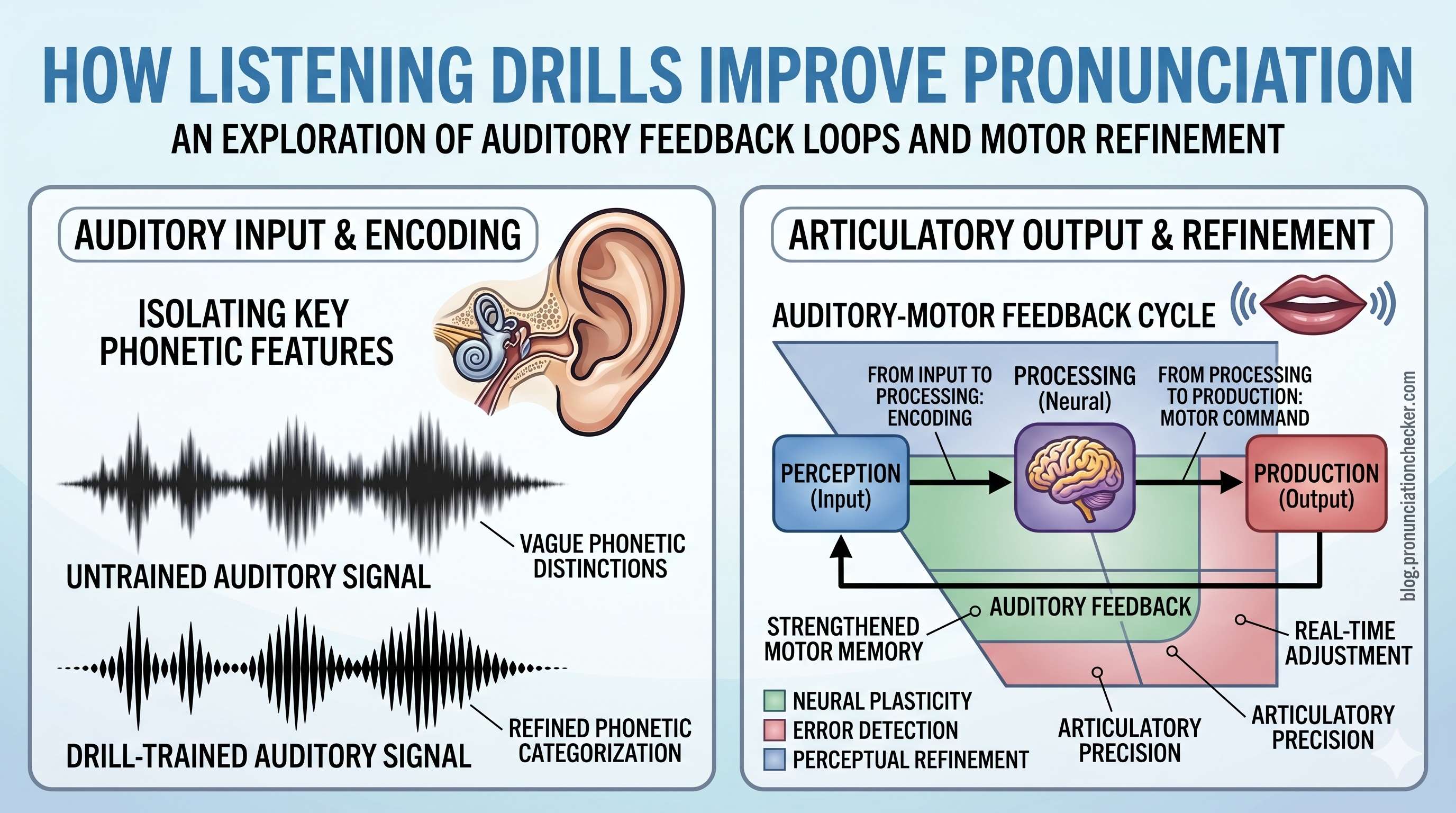
If you cannot hear the difference between two sounds, you will not produce it reliably. Repetition will not fix that, because you have no way of telling when you got it right. Listening drills repair the problem at its source.
That sounds obvious, but most learners do the opposite. They practise saying a contrast they cannot yet perceive, judge their own speech by ear, and conclude that it is correct. This article explains why perception comes first, what kind of listening practice research actually supports (it is not simply "listen to more English"), and then gives four drills in order of difficulty, ending with the one that pays back the most: dictation.
The reason listening changes speaking
It seems indirect to improve pronunciation by listening, but the mechanism is well established. Infants begin life able to distinguish the sound contrasts of every language. Within the first year, exposure to a specific language narrows that ability: contrasts that matter in the surrounding language sharpen, and contrasts that do not are progressively ignored.
By adulthood you have a highly efficient sorting system tuned to one language. When English uses a contrast your first language does not, your perceptual system files both sounds into a single category. You are not failing to concentrate — you are applying a system that works extremely well for your first language.
The consequence for practice. If two English sounds fall into one category for you, you cannot monitor your own production of them, because the difference is inaudible to you. Speaking practice under those conditions rehearses the error rather than correcting it. This is the specific situation where listening training is not merely helpful but necessary.
High variability training
The most effective listening method in the research literature is high variability phonetic training. The principle is that training must include many voices, many phonetic contexts and varied speaking rates.
| Single-speaker training | High variability training | |
|---|---|---|
| Initial gains | Faster | Slower |
| Transfer to new speakers | Poor | Strong |
| Transfer to new words | Limited | Strong |
| Retention after months | Weak | Durable |
| Effect on production | Small | Measurable, without production practice |
The last row is the striking one. Studies on the /r/ and /l/ contrast with Japanese speakers have found that perceptual training alone improved production, even though participants did not practise speaking during the training. The perceptual category has to exist before the motor system can aim at it.
Four drills, in order of difficulty
- Same or different. Hear two words, decide whether they are identical. This requires no labelling and is the easiest entry point. Useful when a contrast is completely inaudible to you at the start.
- Which word. Hear one word, choose between two options. This requires a stable category and is where most learners plateau. Aim for 90% across twenty items on three separate days before moving on.
- Odd one out. Hear three words, identify which differs. Harder because it loads working memory as well as perception.
- Dictation of natural speech. Write down exactly what you hear from unscripted audio. This tests perception under realistic conditions including reduction, linking and elision, and it is where most remaining problems surface.
Why dictation is the most valuable drill
Minimal pair drills train individual contrasts in clean conditions. Dictation from natural speech tests everything at once and, crucially, produces a list of exactly what you failed to hear.
The procedure: take thirty seconds of unscripted audio, transcribe it without looking at anything, then compare with the real transcript. Every mismatch is diagnostic. In practice the mismatches cluster into recognisable types:
- Missing function words — you did not recognise the weak form. He must have gone heard as He must gone.
- Wrong word boundaries — linking confused you. an aim heard as a name.
- Wrong vowel — a genuine contrast problem. lived heard as leaved.
- Missing grammatical endings — you did not hear a final
/s/or/t/in a cluster.
Thirty seconds worked through this way yields more actionable information than an hour of passive listening, because passive listening produces no record of what you missed.
The limits of passive listening
Listening to podcasts while commuting is genuinely useful for vocabulary, familiarity with accents and general comprehension. Its effect on pronunciation is small, for a straightforward reason: there is no comparison between the input and your own output, and no moment at which an error is identified.
The distinction worth holding onto is between exposure and training. Exposure is comfortable, unlimited and slow-acting. Training is uncomfortable, time-limited and produces measurable change. A sensible ratio is a few minutes of focused training per day alongside as much passive exposure as you enjoy — but do not substitute the second for the first and expect the results of the first.
Frequently asked questions
Why should I listen more if I want to speak better?
Because if two English sounds fall into a single category for you, you cannot monitor your own production of them — the difference is inaudible to you, so speaking practice rehearses the error rather than correcting it. Infants can distinguish every language's contrasts, and exposure during the first year narrows that ability to the ones that matter locally. Adults therefore need to rebuild a category before they can aim at it.
Does listening practice alone actually improve speaking?
Yes, measurably. Studies training Japanese speakers on the English /r/ and /l/ contrast found that perceptual training improved their production even though participants did not practise speaking during the training. The perceptual category has to exist before the motor system has a target, which is why perception-first sequencing tends to reach accurate production faster overall.
What is high variability phonetic training?
Listening practice that deliberately uses many different voices, phonetic contexts and speaking rates rather than one speaker. Initial gains are slower than with single-speaker training, but the results transfer to new speakers and new words and remain durable months later, whereas single-speaker gains largely do not. It is the best-supported listening method in the research literature.
What is the most useful listening exercise?
Dictation from unscripted natural speech. Transcribe thirty seconds without looking at anything, then compare with the real transcript. Every mismatch tells you something specific: missing function words mean you did not recognise a weak form, wrong word boundaries mean linking confused you, and missing endings mean you lost a consonant in a cluster. Passive listening produces no such record.
Disclosure: this page links to Preply, a tutoring marketplace. If you book a lesson through that link we may earn a commission, at no extra cost to you. It does not change what is recommended here. See our disclaimer and privacy policy.
Do a five-minute listening drill
Play confusable sounds back to back on the interactive chart and listen for what separates them.
Open the sound chart