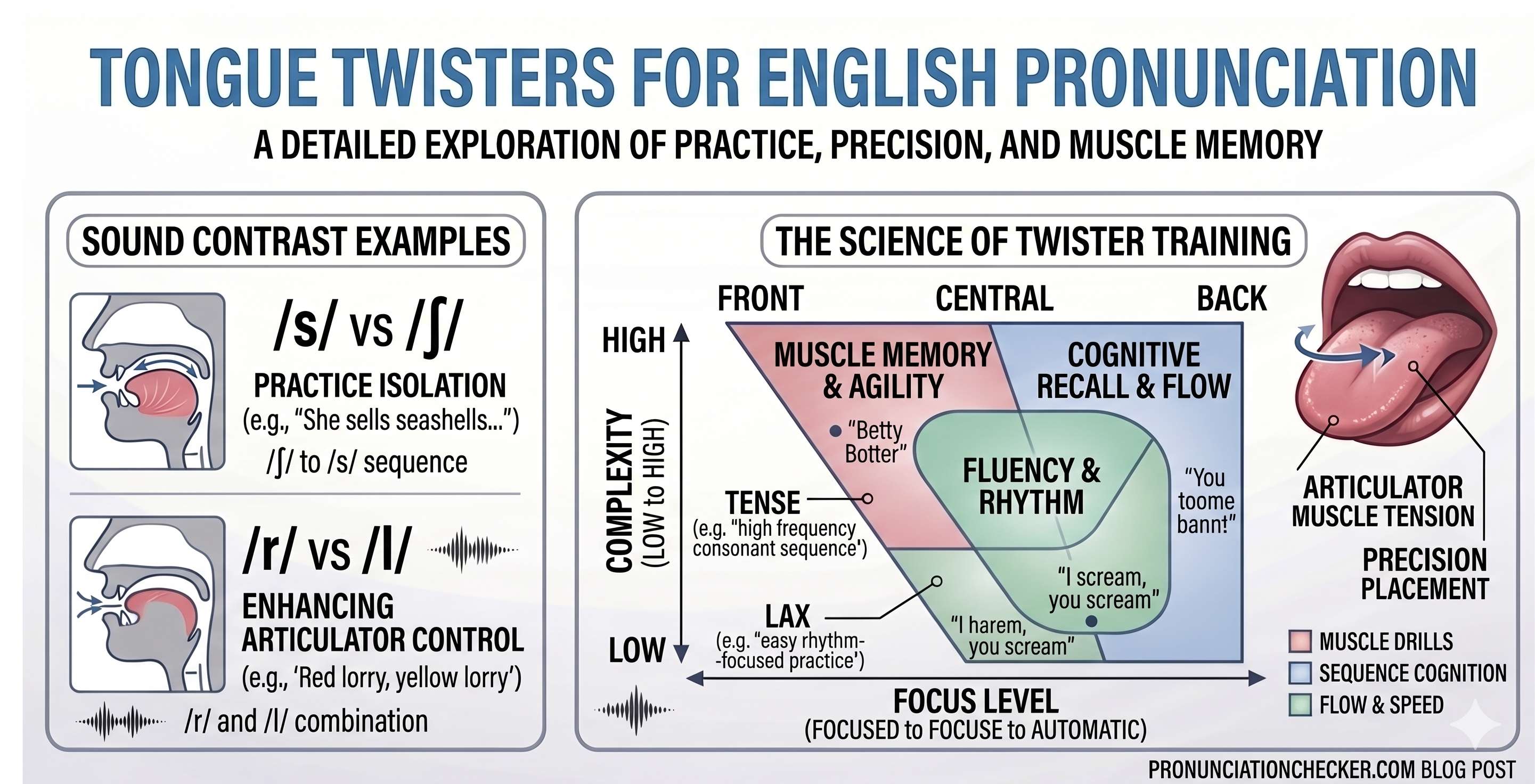
Tongue twisters are not a shortcut to a good accent, and anyone who says they are is overselling them. What they are good for is narrower but still useful: they force rapid switching between two sounds you can already make, which is exactly where many learners break down at normal speaking speed.
If you can say ship and sip correctly one at a time but mix them up in a sentence, tongue twisters are the right tool. If you cannot yet make one of the sounds at all, work through the minimal pairs guide first and come back here afterwards.
Why Tongue Twisters Work for English Pronunciation
Build Articulator Control: Your articulators (lips, teeth, tongue, jaw) must work precisely to form English sounds. Tongue twisters force these muscles to move quickly and accurately, building strength and coordination.
Practice Difficult Sound Combinations: English contains consonant clusters and sound sequences that don't exist in many languages. Tongue twisters isolate these challenging combinations so you can practice them intentionally.
Increase Speaking Speed: Many learners can pronounce words correctly at a slow speed but struggle at natural pace. Tongue twisters train your mouth to produce rapid, clear speech.
Improve Listening Skills: To say a tongue twister well, you must hear the subtle differences between similar sounds. This strengthens your auditory discrimination.
Boost Confidence: Successfully saying a tricky tongue twister feels great and motivates continued practice. The achievement builds confidence in your speaking ability.
The 5 Most Effective English Tongue Twisters for Learners
1. "She Sells Seashells by the Seashore"
This classic tongue twister targets the /ʃ/ (sh) and /s/ (s) sounds, which are often confused by learners. The repetition of "s" and "sh" sounds helps develop precise articulation and the ability to distinguish between similar sounds.
Difficulty: Easy | Best for: Beginners
Start by saying it slowly and clearly. Focus on the difference between "sells" and "seashells." Once you can say it slowly and accurately, gradually increase your speed.
2. "Red Lorry, Yellow Lorry"
Arguably the trickiest tongue twister, this one challenges the /r/, /l/, and /ɪ/ (short i) sounds. It's particularly helpful for learners whose native languages don't have the distinct English /r/ and /l/ distinction.
Difficulty: Medium | Best for: Intermediate learners
The key is keeping your tongue in the right position for each sound. Listen carefully to a native speaker before attempting this one.
3. "How Much Wood Would a Woodchuck Chuck?"
This tongue twister features the /w/ and /tʃ/ (ch) sounds repeated throughout. It helps develop the precision needed for these consonants while maintaining rapid speech.
Difficulty: Medium | Best for: Intermediate learners
The repetition of "wood" and "chuck" requires consistent tongue placement. Great for building muscle memory.
4. "Irish Wristwatch"
Simple in concept but deceptively difficult, this two-word tongue twister combines several challenging sounds: /aɪ/ (long i), /r/, /ɪ/ (short i), /w/, and /tʃ/ (ch). It's the perfect test of whether you can produce these sounds accurately at natural speed.
Difficulty: Hard | Best for: Advanced learners
This is often used as an accent assessment tool. Native speakers can say it quickly and easily, while non-native speakers often struggle.
5. "Unique New York"
This tongue twister targets the /j/ (y) sound at the beginning of words and the /u/ (oo) vowel. It's excellent for practicing rhythm and stress patterns in English.
Difficulty: Hard | Best for: Advanced learners
Pay attention to the stress on "Unique" and "York." This helps develop natural intonation alongside pronunciation.
How to Practice Tongue Twisters Effectively
Step 1: Listen First
Before attempting to say a tongue twister, listen to a native English speaker pronounce it. This gives you the target model to imitate. Pay attention to speed, intonation, and how sounds blend together.
Step 2: Say It Slowly
Speak the tongue twister very slowly at first, exaggerating each sound. Focus on clarity and correct articulation rather than speed. Make sure every sound is precise.
Step 3: Increase Speed Gradually
Once you can say it slowly and clearly, gradually increase your speed. The goal isn't to say it as fast as possible while slurring; it's to maintain clarity while speaking at natural pace.
Step 4: Record Yourself
Record your practice sessions and compare them to a native speaker. Listen for differences in pronunciation, timing, and intonation. The transcript tool can help you monitor your pronunciation progress in real-time.
Step 5: Practice Regularly
Consistency is key. Practice 3-5 times per week for 10-15 minutes. Many learners see significant improvement within 2-3 weeks of regular practice.
Common Mistakes When Practicing Tongue Twisters
Mistake 1: Going Too Fast Too Soon
Speed without accuracy builds bad habits. Always prioritize clear articulation over speed. Quality practice matters more than quantity of repetitions.
Mistake 2: Not Listening to Native Speakers First
Attempting a tongue twister without hearing a native speaker model can reinforce incorrect pronunciation. Always listen first.
Mistake 3: Practicing Alone Without Feedback
Self-monitoring is difficult. Use tools like our transcript tool or ask a native speaker for feedback to identify areas for improvement.
Mistake 4: Irregular Practice
Sporadic practice shows slower results. Consistent daily or 3-5 times per week practice produces faster improvement than occasional marathon sessions.
Mistake 5: Giving Up Too Soon
Tongue twisters are challenging by design. Don't expect to master them immediately. Stick with regular practice and you'll see continuous improvement.
How Long to See Results
With consistent practice (3-5 times per week, 10-15 minutes per session):
- Week 1-2: You'll become familiar with the muscle movements and start recognizing patterns
- Week 3-4: Noticeable improvement in articulation clarity and ability to say them at faster speeds
- Week 5-8: Significant improvement in overall English pronunciation as these skills transfer to regular speech
- Month 3+: Sustained improvement and often a more neutral accent in everyday conversation
Integrating Tongue Twisters into Your Pronunciation Routine
For maximum benefits, combine tongue twisters with other pronunciation activities like minimal pairs exercises for sound discrimination, stress and intonation practice to develop natural rhythm, and real conversation practice with native speakers.
Frequently asked questions
Do tongue twisters actually improve pronunciation?
They help with articulatory agility and with sounds you can already produce slowly but lose at speed. They are much less useful for sounds you cannot produce at all, since repeating an incorrect articulation rapidly entrenches it. Use them after a sound is accurate in isolation rather than as a way of learning it.
How should I practise a tongue twister?
Start far slower than feels necessary and increase speed only while accuracy holds. The moment an error appears, slow down again. The goal is many correct repetitions, not fast incorrect ones, because motor learning consolidates whatever you actually produce rather than what you intended.
Which tongue twisters target which sounds?
She sells seashells targets /s/ against /ʃ/. Red lorry, yellow lorry targets /r/ against /l/. The thirty-third thief thought that through targets the interdentals. Peter Piper picked a peck of pickled peppers targets aspirated /p/. Choosing one that matches your actual error is what makes the exercise useful rather than merely entertaining.
Are tongue twisters useful for rhythm as well as sounds?
Some are, and limericks and nursery rhymes are better still, because they have a fixed stress pattern that will not tolerate even timing. For learners transferring from a syllable-timed language such as Spanish, French or Italian, verse with a rigid metre forces the compression that English rhythm depends on and makes errors immediately audible.
Disclosure: this page links to Preply, a tutoring marketplace. If you book a lesson through that link we may earn a commission, at no extra cost to you. It does not change what is recommended here. See our disclaimer and privacy policy.
Pick a twister for your sound
Interactive twisters with audio and speaking feedback.
Practise tongue twisters