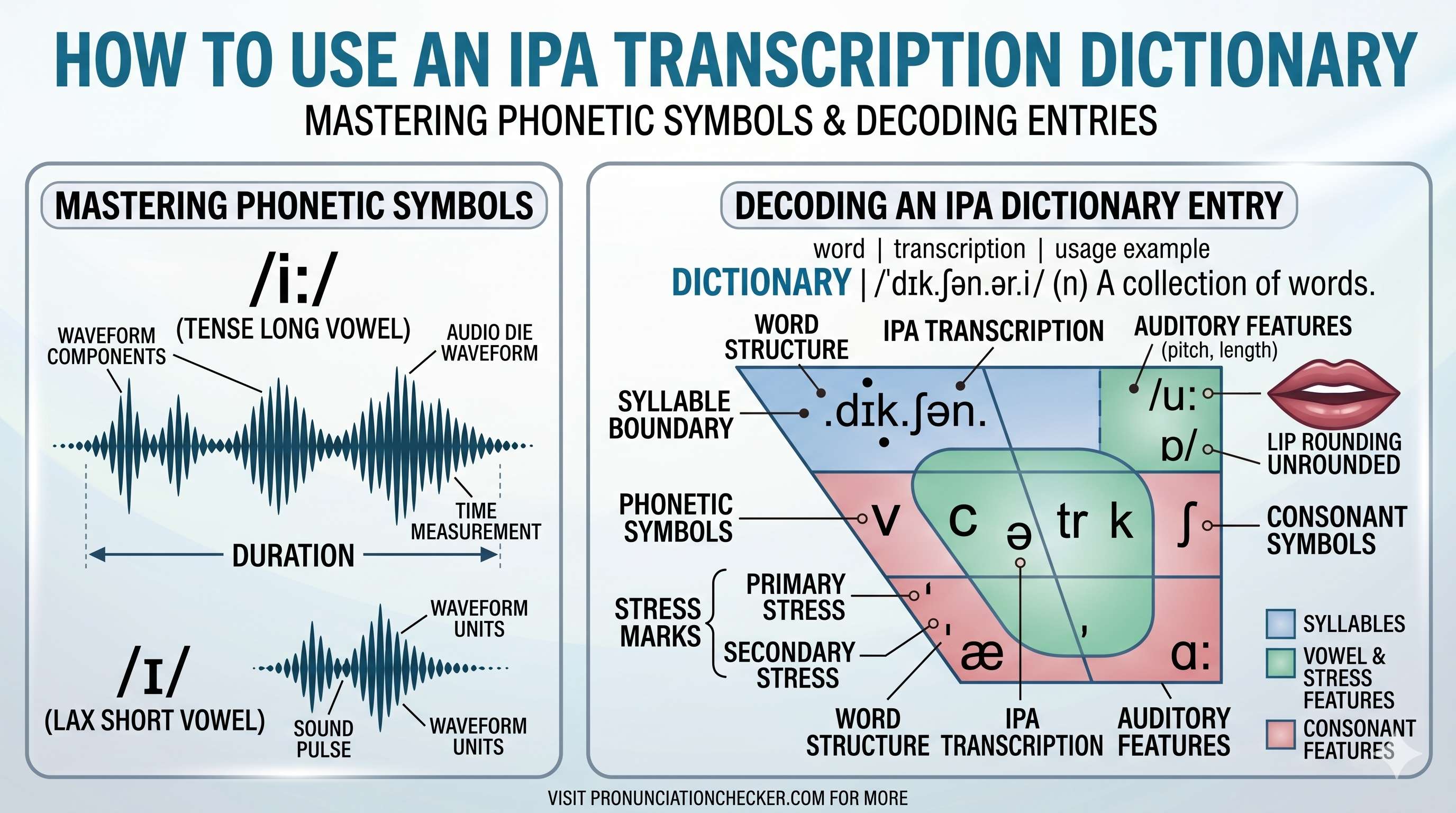
A dictionary transcription such as comfortable /ˈkʌmf.tə.bəl/ tells you more than any "sounds like" respelling. It shows which syllable is stressed, which vowels reduce, and in this case that one of the written syllables is not pronounced at all in normal speech.
Dictionaries differ in their conventions, though, and a few marks confuse almost everyone: slashes and square brackets, the stress marks ˈ and ˌ, and the length mark ː. As you read, look up photograph, photography, information and dictionary, and compare what the transcription tells you with what you expected from the spelling.
Phonemic and phonetic transcription
Dictionaries use two different kinds of transcription, and mixing them up causes a lot of confusion.
| Phonemic — slashes | Phonetic — square brackets | |
|---|---|---|
| Notation | /pɪn/ | [pʰɪ̃n] |
| Shows | Which categories, not their exact realisation | Physical detail of one actual production |
| Used in | Learner dictionaries, almost always | Phonetics research and detailed description |
| Aspiration, nasalisation | Not shown — they are predictable | Shown explicitly |
Virtually every dictionary you will use gives phonemic transcription, which means that some of what you need to produce is not written down. /pɪn/ does not show aspiration, but the /p/ is aspirated, because English aspirates /p t k/ at the start of a stressed syllable. Phonemic transcription assumes you know the automatic rules.
The marks that are not letters
ˈ— primary stress, placed before the stressed syllable:/ˈwɔːtər/. Learners frequently read it as belonging to the preceding syllable.ˌ— secondary stress:/ˌɪntərˈnæʃənəl/.ː— long:/iː/. A tendency rather than the defining property of the vowel.( )— an optional sound, which may or may not be produced:/ˈfæk(t)ri/.əraised or in italics — a sound that is usually deleted: every as/ˈevəri/or/ˈevri/..— a syllable boundary, shown in some dictionaries.
Two transcription systems for the same language
British and American dictionaries use different symbol conventions, and the same word can look quite different in each. Neither is wrong; they describe different accents and follow different traditions.
| Word | British convention | American convention |
|---|---|---|
| go | /ɡəʊ/ | /ɡoʊ/ |
| thought | /θɔːt/ | /θɔt/ |
| bird | /bɜːd/ | /bɝd/ |
| teacher | /ˈtiːtʃə/ | /ˈtitʃɚ/ |
| hot | /hɒt/ | /hɑt/ |
| cat | /kæt/ | /kæt/ |
Some American dictionaries also omit the length marks entirely, writing /i/ rather than /iː/, on the grounds that the quality difference is what matters. Decide which accent you are learning and use a dictionary that transcribes it, rather than switching between sources.
Beware of respelling systems. Many dictionaries, particularly American ones, offer a pronunciation key using ordinary letters — WAW-ter, kuhm-FER-tuh-buhl. These are easier to read at first but they are not standardised, they differ between publishers, and they rely on you already knowing how English spelling maps to sound, which is the original problem. IPA takes an afternoon to learn and works in every dictionary and every language.
A workflow for new words
- Find the stress first. Locate
ˈbefore anything else. Stress errors cost more than segment errors, and the stress also tells you which vowels will be reduced. - Read the schwas. Every
/ə/confirms an unstressed syllable. Count them against the written syllables. - Check your known problem sounds. Scan for the two or three symbols you are currently working on, rather than reading the whole transcription carefully.
- Listen to the audio. Transcription and audio together are far more effective than either alone: the audio gives you the target, the transcription tells you what to attend to in it.
- Write the transcription in your notes. Store it alongside the spelling from the start. Correcting a fossilised stress error later costs many times more than recording it correctly once.
What transcription cannot tell you
A dictionary gives the citation form: the word said alone, carefully, in isolation. That is not how it behaves in a sentence. And is transcribed /ænd/ but is usually /ən/ in speech. To is /tuː/ in the dictionary and /tə/ in nearly every real utterance.
Dictionaries also cannot show you linking across word boundaries, assimilation between adjacent words, or where the sentence stress falls. For those you need natural audio, and transcription is best understood as a tool for individual words rather than a description of connected speech.
Frequently asked questions
What is the difference between slashes and square brackets in transcription?
Slashes indicate phonemic transcription, which shows which sound categories a word contains without their exact realisation. Square brackets indicate phonetic transcription, which records the physical detail of an actual production, including aspiration and nasalisation. Learner dictionaries use slashes almost exclusively, which means predictable details such as the aspiration in pin are not written down.
Where does the stress mark go in IPA?
Before the stressed syllable, not after it and not on the vowel. In /ˈwɔːtər/ the mark shows that the first syllable is stressed. A lower mark, ˌ, indicates secondary stress, as in /ˌɪntərˈnæʃənəl/. Reading the mark as belonging to the preceding syllable is one of the most common errors when learners first start using transcriptions.
Why do British and American dictionaries use different symbols?
Because they transcribe different accents and follow different conventions. Go is /ɡəʊ/ in British and /ɡoʊ/ in American transcription, bird is /bɜːd/ against /bɝd/, and hot is /hɒt/ against /hɑt/. Some American dictionaries also omit length marks entirely. Decide which accent you are learning and use one dictionary consistently rather than switching sources.
Should I use IPA or the simplified pronunciation respellings?
IPA. Respelling systems such as WAW-ter look easier but are not standardised, differ between publishers, and depend on you already knowing how English spelling maps to sound, which is the problem you are trying to solve. IPA takes about an afternoon to learn and then works in every dictionary and for every language.
Disclosure: this page links to Preply, a tutoring marketplace. If you book a lesson through that link we may earn a commission, at no extra cost to you. It does not change what is recommended here. See our disclaimer and privacy policy.
Look up your first five words
Search any English word for its IPA transcription, stress marks and audio.
Open the IPA dictionary