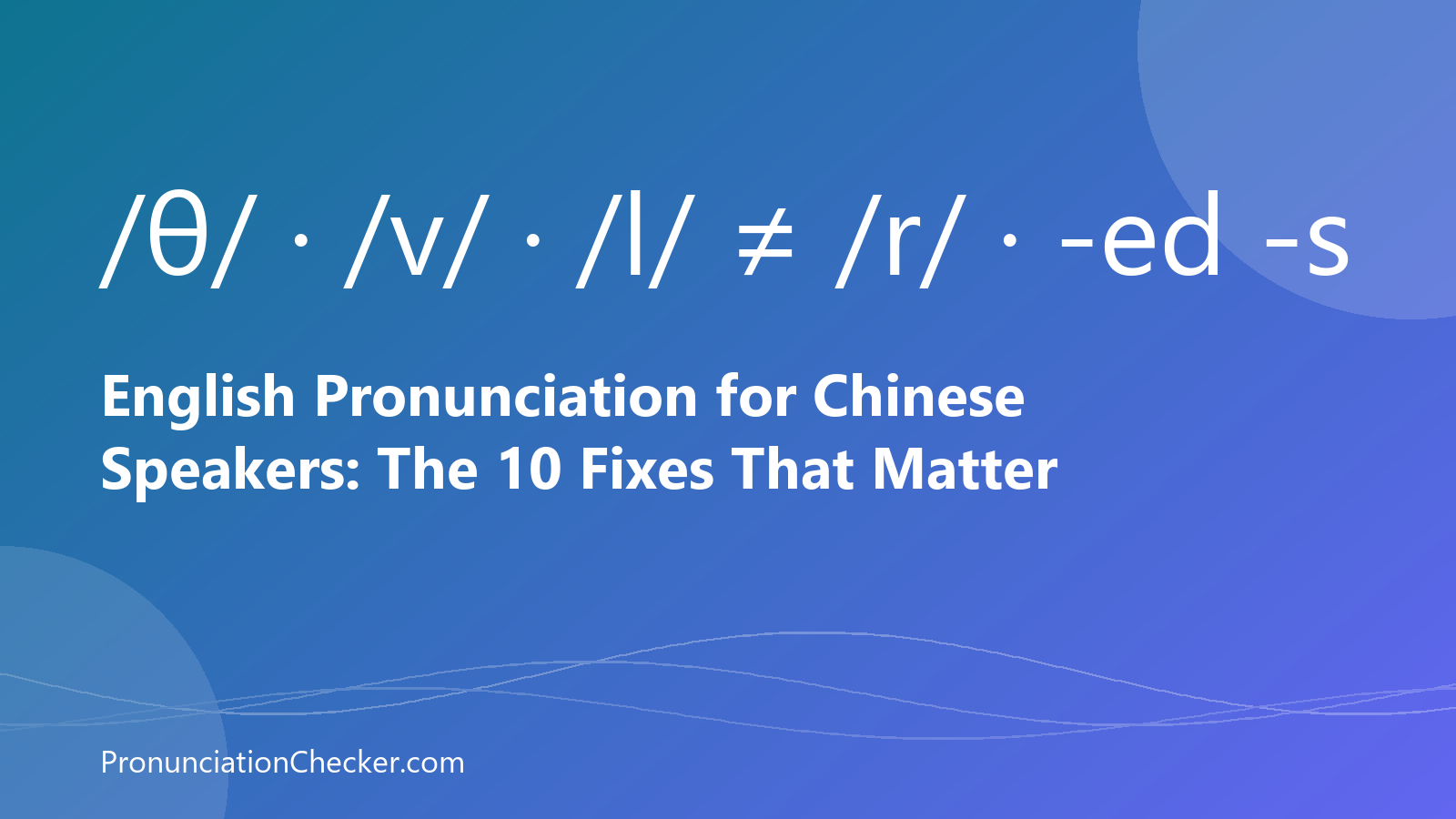
Mandarin and English sound systems are organised very differently. Mandarin syllables are simple, ending only in a vowel, n, ng or r, and pitch distinguishes words. English piles up consonants (texts, strengths), has many short vowels, and uses stress and sentence intonation instead of tones. These ten fixes are ordered by their effect on being understood, and they apply to most speakers of Mandarin and other Chinese varieties.
1. Final consonants
This is the most important. English words end in almost any consonant, and many pairs differ only there: bed/bet/beg, life/like/light, rope/robe/road. Mandarin speakers tend to drop final stops or add a vowel: "goo" or "good-uh". Practise holding the final consonant without releasing a vowel. For stops, it is fine to leave them unreleased, as native speakers often do, but the mouth must close.
2. Consonant clusters
Mandarin has no clusters. English has them at both ends of syllables: street, spring, splash, texts, sixths, asked. Speakers often insert vowels ("sut-reet") or delete consonants ("tex"). Both change the word. Build clusters from the end: -ts, -xts, texts. See consonant clusters.
3. -ed and -s endings
These endings are grammar: past tense, plural, third person. Dropping them makes He walked sound like He walk. Because they create clusters (walked = /wɔːkt/, books = /bʊks/), they need special attention. See -ed and -s endings.
4. TH
Mandarin has no /θ/ or /ð/. Common substitutes are [s] for think and [z] or [d] for this. Put the tongue tip lightly between the teeth. Pairs: think/sink, three/tree, they/day.
5. L and R, and L and N
Mandarin r [ʐ] is similar to English R, but at the start of words some speakers merge English /l/ and /r/: light/right, long/wrong. Speakers from southern China, where n and l merge in many dialects, may also confuse night/light, no/low. At the end of words, English dark L (feel, ball) is often dropped or turned into a vowel. See r vs l.
6. V and W
Mandarin has /w/ but no /v/. Speakers often use [w] for both: very as "wery", vine as wine. For /v/, the upper teeth touch the lower lip, and the voice buzzes. See v vs w.
7. Short and long vowels
Mandarin does not distinguish vowel length. English pairs like ship/sheep, full/fool, bed/bad and cut/cart are often merged. English short vowels /ɪ ʊ e æ ʌ/ are lax and brief; long vowels /iː uː ɑː/ are tense and held longer. See short vowels.
8. Voicing
Mandarin distinguishes consonants by aspiration, not voicing, so English /b d g/ and /p t k/ are heard mainly by the puff of air. That works at the start of words, but at the end English relies on voicing and vowel length: cab/cap, bad/bat. Lengthen the vowel before voiced finals.
9. Word stress and weak forms
Each Mandarin syllable carries a full tone, and all syllables tend to be similar in length. English makes stressed syllables long and loud and reduces the rest: BA-na-na is wrong, ba-NA-na with schwas is right. Function words like to, for, and, of, can are usually reduced: fish and chips is "fish'n'chips". See weak forms.
10. Intonation instead of tones
English pitch works at sentence level. It rises or falls on the most important word and signals questions, surprise or finality. Some Chinese speakers transfer tone-like pitch patterns to individual English words, or use falling pitch on every stressed syllable, which can sound abrupt. Practise English sentences with one clear pitch movement: I'd like a COFfee↘, Are you COMing↗?
Where to start
Focus first on final consonants, clusters and endings (issues 1–3). Research on English as an international language (Jenkins 2000) identifies these as among the features that most affect intelligibility between speakers of different backgrounds. Then work on v/w, th and vowel length.
Phrases in this drill:
- She asked me to send the texts.
- He walked six streets to the bank.
- I think the light is on the right.
- Please give me a cup of black coffee.
- We visited very old villages.
Frequently asked questions
Why do Chinese speakers add a vowel after final consonants?
Mandarin syllables can only end in a vowel, n, ng or r. Speakers therefore add a short vowel to make English final consonants pronounceable, so "good" becomes "good-uh", or drop the consonant altogether, so "good" becomes "goo".
Do tones affect how Chinese speakers speak English?
Sometimes. Some speakers give English words a tonal pattern, or put a falling pitch on every stressed syllable, which makes English sound choppy. English uses pitch across the whole sentence to show emphasis and questions, not word by word.
Is the Chinese accent in English hard to understand?
Final consonants and clusters are the main issue for intelligibility, because they carry grammar (-ed, -s) and distinguish many words. Vowel and th differences are more noticeable than they are confusing.
Sources and further reading
- Chang, J. (2001). Chinese speakers. In M. Swan and B. Smith (eds.), Learner English: A Teacher's Guide to Interference and Other Problems (2nd ed.). Cambridge University Press.
- Deterding, D. (2006). The pronunciation of English by speakers from China. English World-Wide, 27(2), 175–198.
- Duanmu, S. (2007). The Phonology of Standard Chinese (2nd ed.). Oxford University Press.
- Jenkins, J. (2000). The Phonology of English as an International Language. Oxford University Press.
Disclosure: this page links to Preply, a tutoring marketplace. If you book a lesson through that link we may earn a commission, at no extra cost to you. It does not change what is recommended here. See our disclaimer and privacy policy.
Check your final consonants
Say a sentence and see, word by word, what the speech recogniser understood.
Open the accent coach