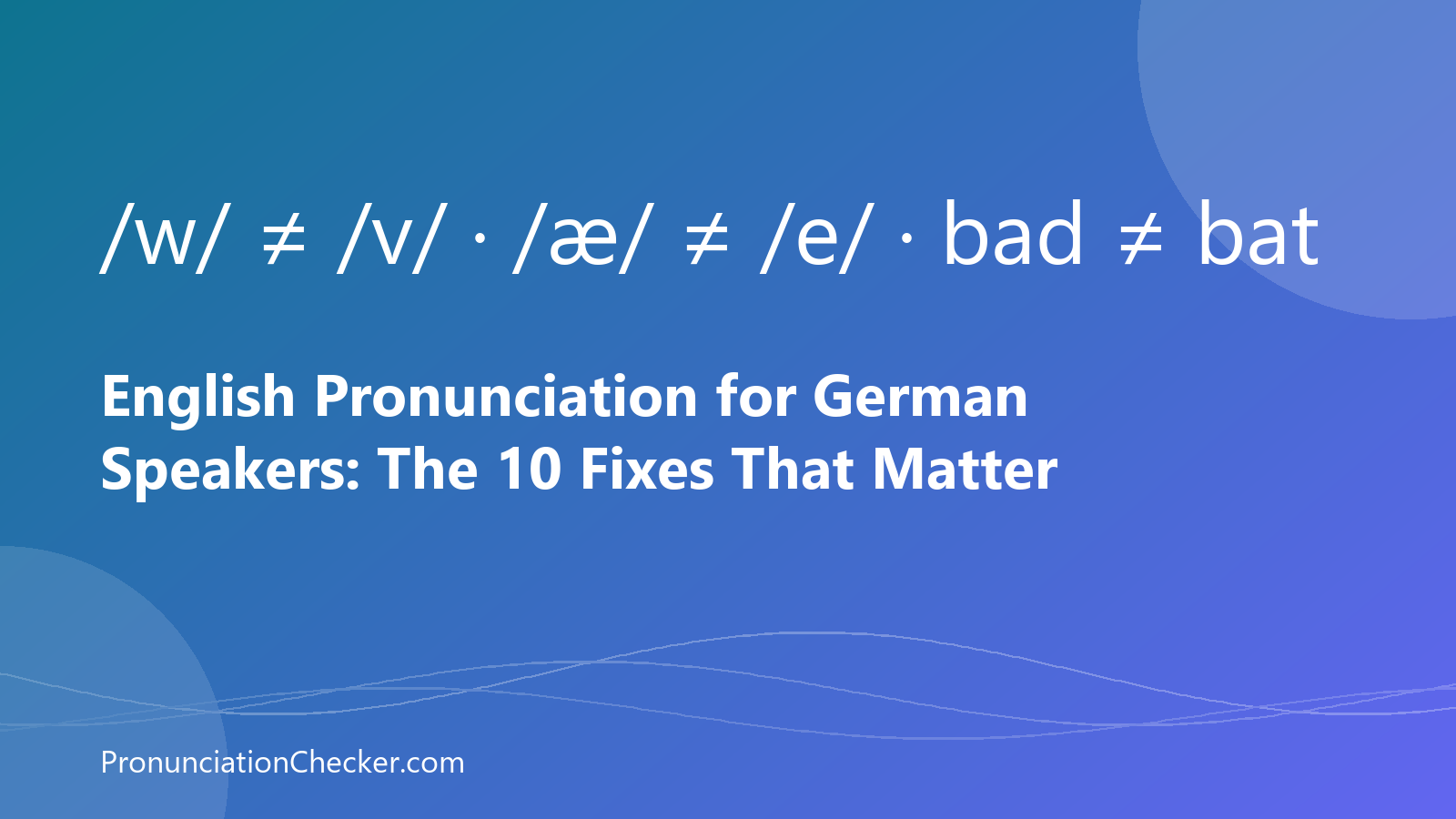
German and English are close relatives, and German speakers often reach a high level of English. The German accent is recognisable mainly through a handful of features that come directly from German phonology: final devoicing, the w/v switch, a missing /æ/, and th. These ten fixes are ordered by their effect on intelligibility.
1. Final devoicing
German pronounces final b, d, g, s, v as p, t, k, s, f (Auslautverhärtung). In English, final voicing distinguishes many words: bad/bat, bag/back, rise/rice, prize/price, leave/leaf, his/hiss. The key cue for English listeners is actually vowel length: vowels are noticeably longer before voiced consonants. Lengthen the vowel in bad, bag, rise and you will be understood even if the final consonant is partly devoiced. See voiced and voiceless consonants.
2. W and V
German w is [v], and German has no [w]. English /w/ is made with rounded lips and no contact with the teeth, like a quick oo: we, well, what, one. /v/ uses the teeth on the lower lip: very, voice, love. Pairs: wine/vine, west/vest, wet/vet. See v vs w.
3. /æ/ vs /e/
German has no /æ/, the vowel of cat, bad, man. German speakers often use the German [ɛ], merging bad/bed, man/men, sad/said, had/head. Open your mouth wider and spread your lips: /æ/ is lower than /e/.
4. TH
German speakers typically replace /θ/ with [s] and /ð/ with [z] or [d]: "I sink zat...". Put the tongue tip between the teeth and let air flow. The substitution affects think/sink, thumb/sum, they/day.
5. S at the start of words
In northern German, initial s before a vowel is [z] (Sonne). English initial s is always [s]: sun, see, sing. A German [z] makes sink sound like zinc and Sue like zoo.
6. The R
The German uvular R at the start of words, and the vocalised R after vowels, both differ from English. English R, at the start of a word, is made with the tongue tip or body raised in the middle of the mouth, never at the back. After vowels, British English is non-rhotic like German, so car and here end in a vowel; American English pronounces the R. See linking R.
7. Dark L
German L is always "clear". English L at the end of a syllable is "dark", with the back of the tongue raised: full, feel, milk, table. A clear L in these words sounds foreign, though it does not cause misunderstandings. See clear and dark L.
8. Glottal stops before vowels
German inserts a glottal stop before words that begin with a vowel. English links instead: an apple is "a-napple", turn it off is "tur-ni-toff". Excessive glottal stops make English sound choppy. See connected speech.
9. J and CH
German speakers sometimes devoice English /dʒ/ to [tʃ], so jeep sounds like cheap and Jane like chain. Keep voice going through the sound.
10. Stress in loanwords and compounds
German stresses the first element of compounds and many loanwords at the end. English stress patterns in similar-looking words often differ: English ho-TEL matches German, but DEM-o-crat vs German De-mo-KRAT, and phi-LOS-o-phy vs German Phi-lo-so-PHIE.
Where to start
The biggest wins are final voicing with vowel length, w vs v, and /æ/. Together they cover most minimal-pair confusions for German speakers.
Phrases in this drill:
- We went to the west side very early.
- My bad dog has a bag.
- The man had a black cat.
- I think they have three brothers.
- His prize was a nice surprise.
Frequently asked questions
Why do German speakers say "bet" for "bad"?
Two reasons combine. German has no /æ/, so bad tends to become bed; and German devoices final consonants, so bed becomes bet. Practise /æ/ with a wider mouth, and lengthen the vowel before voiced final consonants.
Why do German speakers mix up v and w?
German w is pronounced [v], and German has no /w/ sound. Speakers either use [v] for both or, overcorrecting, use [w] for v: "wery vell" or "very well" become confused.
Is the German accent in English hard to understand?
Generally not; German speakers are among the most intelligible non-native English speakers. But final devoicing, v/w and th can cause genuine misunderstandings in minimal pairs.
Sources and further reading
- Swan, M. (2001). German speakers. In M. Swan and B. Smith (eds.), Learner English: A Teacher's Guide to Interference and Other Problems (2nd ed.). Cambridge University Press.
- Kohler, K. (1990). German. Journal of the International Phonetic Association, 20(1), 48–50.
- Smith, B. L., Hayes-Harb, R., Bruss, M. and Harker, A. (2009). Production and perception of voicing and devoicing in similar German and English word pairs by native speakers of German. Journal of Phonetics, 37(3), 257–275.
Disclosure: this page links to Preply, a tutoring marketplace. If you book a lesson through that link we may earn a commission, at no extra cost to you. It does not change what is recommended here. See our disclaimer and privacy policy.
Check your English endings
Say a sentence and see, word by word, what the speech recogniser understood.
Open the accent coach