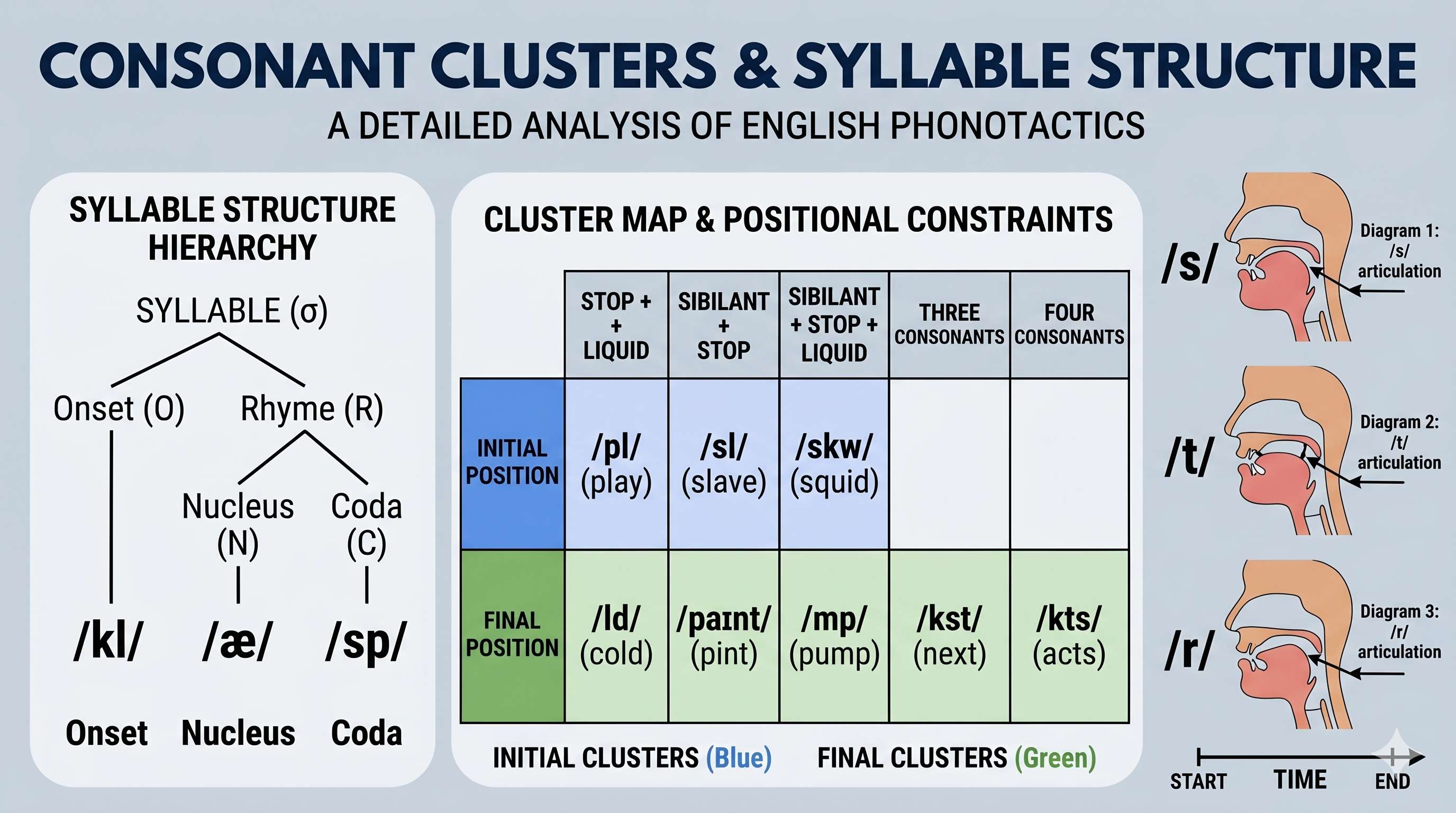
Say sixths out loud: /sɪksθs/. That is four consonants after a single vowel, and native speakers produce it without noticing. For speakers of Japanese, Spanish, Portuguese, Korean, Arabic or Mandarin, which allow far fewer consonants in a row, words like strengths, texts and asked are some of the hardest in English.
The natural reaction is to repair the cluster, either by adding a vowel (estreet, textsu) or by deleting a consonant (tex, ass for asked). Both repairs can change the word a listener hears. The good news is that English clusters follow a small set of rules, and the two repair habits need different fixes. Both are covered below.
Three test words to try before reading on: street (a cluster at the start), helped (at the end) and twelfths (the extreme case). Notice which one is hardest for you.
What English actually permits
English tolerates more consonants in a row than most languages, and the permitted combinations follow strict rules. Knowing the rules turns an apparently endless list of difficult words into a small number of patterns.
At the start of a syllable English allows up to three consonants, and a three-consonant onset is always built the same way: /s/ + /p t k/ + /l r w j/. There are no exceptions.
| Pattern | Words |
|---|---|
/spl/ | splash, split, splendid, splinter |
/spr/ | spring, spread, sprint, spray |
/str/ | street, strong, stress, strange, straight |
/skr/ | screen, scratch, scream, script |
/skw/ | square, squeeze, squirrel, squash |
/spj/, /skj/, /stj/ | spew, skewer, student (British) |
At the end of a syllable English goes further, permitting up to four consonants. Almost all four-consonant codas are created by grammar rather than existing in root words: texts /teksts/, sixths /sɪksθs/, twelfths /twelfθs/, glimpsed /ɡlɪmpst/, prompts /prɒmpts/.
Two ways of simplifying, and they need opposite fixes
When a cluster is not permitted in your first language, you repair it automatically. Which repair you use depends on your language, and the correction differs completely between the two groups.
| Strategy | Languages | What happens to street | What to practise |
|---|---|---|---|
| Epenthesis — inserting a vowel | Spanish, Portuguese, Japanese, Korean, Turkish, Persian | estreet, sutoriito | Moving between consonants without any vowel; start the word on the /s/ itself |
| Deletion — dropping a consonant | Mandarin, Cantonese, Vietnamese, Thai | sreet, street → sree | Releasing every consonant in the cluster, especially final ones |
Identify your own pattern first. Record yourself saying She asked for six texts about the strongest strategies. Play it back slowly. If you hear extra vowels, you epenthesise. If consonants are missing, you delete. The drills below diverge at that point, and doing the wrong one wastes weeks.
If you insert vowels
Spanish speakers characteristically add /e/ before word-initial /s/ + consonant, because Spanish does not permit that onset — compare escuela, España, estudiante. The fix is to isolate the /s/ and attach it forward rather than backward.
- Hold a long ssssss for three seconds.
- Without breaking the airflow, move straight into the rest of the word: sssss-pain, sssss-tudy, sssss-kool.
- Gradually shorten the
/s/while keeping it attached: Spain, study, school, street, sport, speak, spell, state.
Japanese and Korean speakers insert vowels between all consonants, not only after /s/. The same technique applies at each junction: sustain the first consonant and glide into the second without letting the vocal folds start.
If you delete consonants
Mandarin permits only /n/ and /ŋ/ at the end of a syllable, so English final clusters are reduced heavily. The most efficient drill builds the cluster backwards, which prevents your mouth from simplifying at speed.
- Say the final consonant alone: ...ts.
- Add one segment to the left: ...ksts.
- Continue: ...eksts, then texts.
- Put it in a phrase: I sent the texts.
Work through: asked, desks, worlds, films, helped, sixths, months, clothes, lengths, strengths, twelfths, costs, tasks, risks, facts, acts.
What native speakers simplify — and what they do not
Native speakers reduce clusters too, but according to consistent rules, and copying those rules makes your speech sound more natural rather than less accurate.
- Regular:
/t/and/d/drop between two consonants. Next day becomes nexday; old man becomes olman; must be becomes musbe. This happens in almost all conversational speech. - Regular: -sts often reduces to -ss. Costs becomes coss, tests becomes tess.
- Not permitted: dropping the
/s/of a plural or third person ending, which removes grammatical information. Desks may lose its/k/in fast speech but never its/s/.
That last distinction is the one worth internalising. The consonants that native speakers drop are the ones that carry no meaning; the ones learners drop are frequently the grammatical endings, which is why the effect on a listener is so different.
Frequently asked questions
What is the longest consonant cluster English allows?
Three consonants at the start of a syllable and four at the end. Three-consonant onsets always follow the same template: /s/ plus /p t k/ plus /l r w j/, as in splash, spring, street, screen and square. Four-consonant endings are nearly always produced by grammar rather than by root words, as in texts, sixths, twelfths and glimpsed.
Why do I add a vowel before words like school and street?
Because your first language does not permit /s/ plus a consonant at the start of a word. Spanish is the clearest case — compare escuela, España and estudiante — and Portuguese, Japanese, Korean, Turkish and Persian have similar restrictions. The fix is to hold a long sssss and glide directly into the rest of the word without letting the vocal folds start, then shorten the /s/ gradually.
Do native speakers pronounce every consonant in words like asked and texts?
Often not, but the simplification follows rules. In conversational speech /t/ and /d/ drop between two other consonants, so next day becomes nexday and old man becomes olman. What native speakers do not drop is a grammatical ending: desks may lose its /k/ at speed but never its /s/, because that would remove the plural. Learners frequently drop the ending instead, which is why the effect on listeners differs so much.
How should I practise a difficult final cluster?
Build it backwards. Start with the last sound alone, then add one segment at a time to the left: ts, then ksts, then eksts, then texts, then the full phrase I sent the texts. Working from the end prevents your mouth from simplifying the cluster as soon as speed increases, which is what happens when you practise the whole word repeatedly from the start.
Disclosure: this page links to Preply, a tutoring marketplace. If you book a lesson through that link we may earn a commission, at no extra cost to you. It does not change what is recommended here. See our disclaimer and privacy policy.
Check your clusters with speech recognition
Say words like texts, asked and strengths and see whether the recogniser hears every consonant.
Open the pronunciation quiz