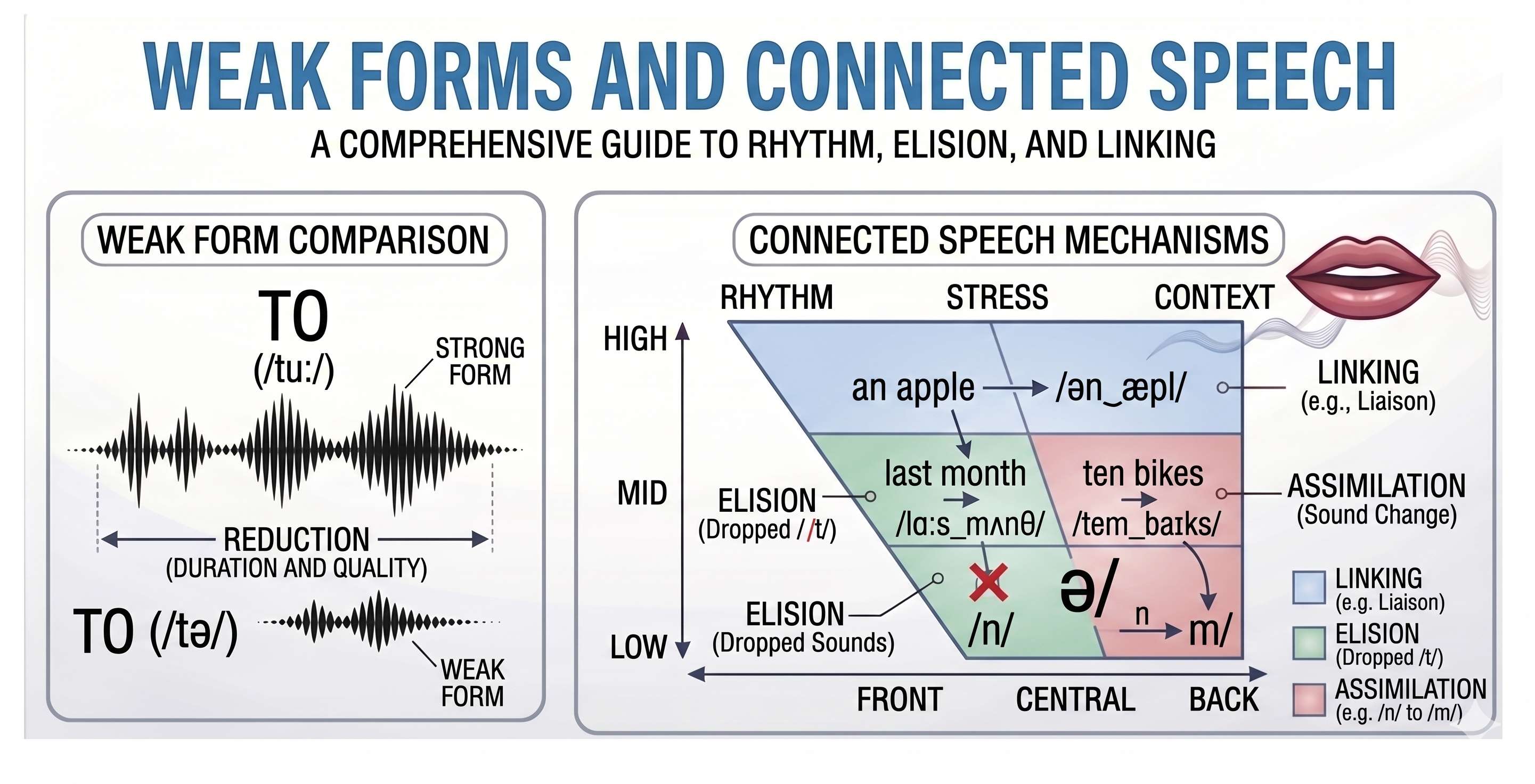
In careful speech, What do you want to do? is six clear words. In ordinary conversation it is closer to "Whaddaya wanna do?" That is not slang or laziness. It is how English is normally spoken, by teachers, newsreaders and presidents alike.
Around forty short grammar words, such as a, and, to, of, for, can, was, have and them, have a strong form used when they are stressed and a weak form, usually with schwa, used the rest of the time. Weak forms explain most of the gap between the English you understand in class and the English you struggle with in films. A few examples:
| Word | Strong form | Weak form | In a sentence |
|---|---|---|---|
| to | /tuː/ | /tə/ | I want to go. |
| of | /ɒv/ (UK), /ʌv/ (US) | /əv/, /ə/ | a cup of tea |
| and | /ænd/ | /ən/, /n/ | fish and chips |
| can | /kæn/ | /kən/ | I can swim. |
| was | /wɒz/ (UK), /wʌz/ (US) | /wəz/ | It was late. |
| for | /fɔː(r)/ | /fə(r)/ | This is for you. |
Why you understand the textbook but not the conversation
Learners who can read English comfortably and follow classroom audio frequently find real conversation incomprehensible. The reason is not speed and not vocabulary. It is that words in connected speech do not sound like their dictionary forms, and a learner listening for dictionary forms is matching against the wrong targets.
What are you going to do? is a sequence of six clearly-separated words on the page. In speech it is commonly /ˈwɒtʃə ˈɡʌnə ˈduː/ — three chunks. The information is all there, but only if your ear expects the reduced form.
This is a listening skill before it is a speaking skill. You do not have to produce heavily reduced speech to sound good. You do have to recognise it, or you will keep missing the small grammatical words that carry tense, number and modality.
The four processes, with examples
| Process | What happens | Written | Spoken |
|---|---|---|---|
| Linking | A final consonant joins the next vowel | an apple; turn it off; pick it up | a-napple; tur-ni-toff; pi-ki-tup |
| Elision | A sound disappears | next day; must be; friendship | nexday; musbe; frenship |
| Assimilation | A sound changes to match its neighbour | ten bikes; good boy; that person | tem bikes; goob boy; thap person |
| Intrusion | A sound appears between two vowels | go on; I am; law and order | go-w-on; I-y-am; law-r-and order |
The weak forms worth memorising
These are the highest-frequency function words in English. In normal connected speech they almost never appear in their strong form, and recognising them accounts for a disproportionate share of listening comprehension.
| Word | Weak form | Sounds like |
|---|---|---|
| and | /ən/, /n̩/ | fish 'n' chips, rock 'n' roll |
| of | /əv/, /ə/ | a lot 'v people, cup 'a tea |
| to | /tə/ | want tə go, have tə leave |
| you | /jə/ | see yə later, d'yə know |
| have | /əv/, /v/ | should 've, could 've, must 've |
| him, her, them | /ɪm/, /ər/, /ðəm/ | tell 'im, ask 'er, give 'em |
| are, was, were | /ər/, /wəz/, /wər/ | they'r here, he wəz late |
Note that should've sounds identical to should of, which is why native speakers so often write the latter by mistake. Hearing why that error exists is a useful confirmation that you have understood the reduction.
The high-frequency chunks
Certain sequences reduce so consistently that they function as single units. Learning them as chunks is far more efficient than deriving each one from its components in real time.
- going to → gonna — only before a verb. I'm gonna leave is fine; I'm gonna the shop is not English.
- want to → wanna • got to → gotta • have to → hafta • has to → hasta
- what do you → whaddaya • what are you → whatcha • did you → didja • would you → wouldja
- kind of → kinda • sort of → sorta • a lot of → alotta • out of → outta
- let me → lemme • give me → gimme
How much should you produce?
A reasonable target for most learners is full recognition and partial production. Use linking and weak forms, which are obligatory in natural English and sound wrong when omitted. Be more selective with the heavily contracted chunks, which are informal and can sound incongruous in a professional register if the rest of your speech is careful.
Linking in particular is not optional. Saying an apple as two separate words with a gap sounds distinctly foreign; a-napple is simply how English works.
A training method that produces results
- Take thirty seconds of natural speech — a podcast or an unscripted interview, not graded classroom audio.
- Listen without the transcript and write down exactly what you hear, including sounds you cannot identify.
- Compare with the transcript. Every mismatch is a reduction you did not recognise, and that list is your syllabus.
- Mark the linking, elision and assimilation points on the transcript.
- Shadow the clip until you can speak along with it in time.
Thirty seconds properly worked through in a session is worth more than twenty minutes of passive listening. The mismatch list is the valuable output, because it tells you precisely which reductions your ear is not yet expecting.
Frequently asked questions
Why can I read English well but not understand conversation?
Because words in connected speech do not sound like their dictionary forms, and if you are listening for dictionary forms you are matching against the wrong targets. What are you going to do is six separate words on the page but typically three chunks in speech. The information is all present, but only if your ear expects linking, elision, assimilation and weak forms.
Do I have to say gonna and wanna to sound natural?
Not necessarily. A sensible target is full recognition and partial production. Linking and weak forms are effectively obligatory in natural English and sound wrong when omitted — saying an apple as two separate words with a gap is noticeably foreign. The heavily contracted chunks such as gonna, whaddaya and lemme are informal, and using them in careful professional speech can sound incongruous.
What is the difference between elision and assimilation?
In elision a sound disappears entirely: next day becomes nexday and must be becomes musbe. In assimilation a sound changes to resemble its neighbour without disappearing: ten bikes becomes tem bikes because the /n/ takes on the lip position of the following /b/. Both happen constantly in native speech and both are regular rather than careless.
What is the most effective way to train my ear for connected speech?
Take thirty seconds of unscripted natural speech, write down exactly what you hear without the transcript, then compare. Every mismatch is a reduction your ear did not expect, and that list is your personal syllabus. Thirty seconds worked through this way is worth considerably more than twenty minutes of passive listening, because it identifies exactly which patterns you are missing.
Disclosure: this page links to Preply, a tutoring marketplace. If you book a lesson through that link we may earn a commission, at no extra cost to you. It does not change what is recommended here. See our disclaimer and privacy policy.
Hear weak forms in real speech
Speak along with native audio and notice how to, of and and shrink.
Start shadowing