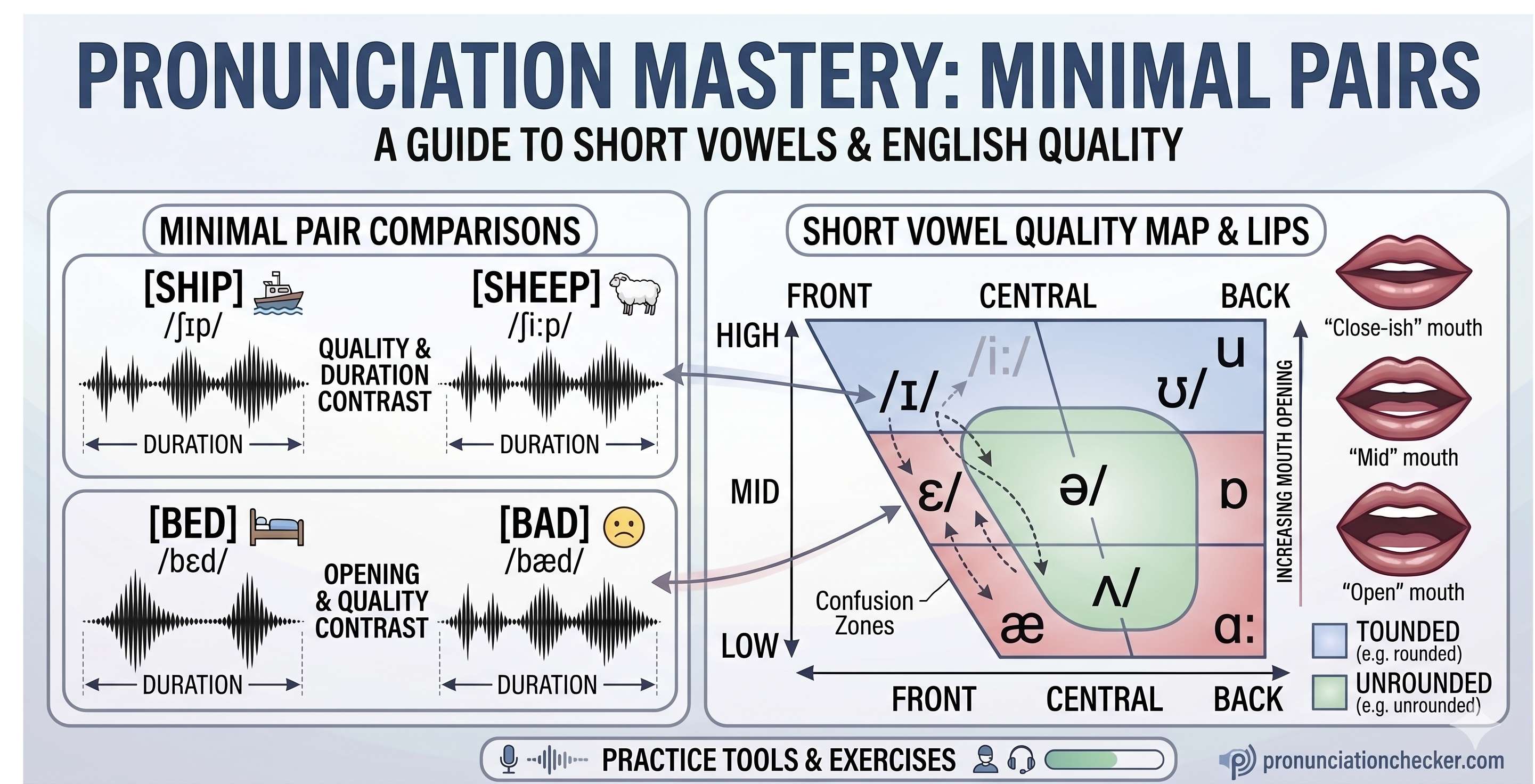
Bit, bet, bat, but, pot, put. English has six short vowels in the space where Spanish, Italian, Japanese and many other languages have two or three. Learners usually hear some of them as one vowel, and so pronounce bed and bad, or cup and cap, the same way.
The pairs below cause the most misunderstandings. Try them before reading on and note which rows sound identical to you. That tells you which of the following sections to focus on.
| Contrast | Pairs |
|---|---|
| /ɪ/ and /e/ | bit, bet · sit, set · pin, pen · did, dead · lift, left |
| /e/ and /æ/ | bed, bad · men, man · pen, pan · said, sad · head, had |
| /æ/ and /ʌ/ | cap, cup · cat, cut · bag, bug · ran, run · match, much |
| /ʌ/ and /ɒ/ (British) or /ɑ/ (American) | cut, cot · luck, lock · duck, dock · nut, not · cup, cop |
| /ʊ/ and /uː/ | full, fool · pull, pool · look, Luke · soot, suit |
Note that pin and pen sound the same in parts of the southern United States. That is a regional feature, not an error, but most learners are better served by keeping them apart.
Why "short" and "long" is the wrong description
The pair /ɪ/ and /iː/ is taught almost everywhere as short i against long ee. That description causes a specific and very persistent error: learners lengthen their existing vowel and expect the contrast to appear. It does not, because the two vowels differ primarily in quality — where the tongue sits — and only secondarily in duration.
/iː/ is tense and peripheral: the tongue is high and far forward, the muscles are tight, and the sound is often slightly diphthongised towards [ɪi]. /ɪ/ is lax and centralised: the tongue is lower and pulled towards the centre of the mouth, and the articulation is relaxed. A lengthened /ɪ/ is still /ɪ/, just slower.
The proof. English shortens vowels before voiceless consonants, a process called pre-fortis clipping. The /iː/ in beat is physically shorter than the /ɪ/ in bid. Duration alone therefore cannot be what tells these vowels apart, since it sometimes runs in the opposite direction, and native listeners still identify the words correctly every time.
The five-vowel problem
Spanish, Italian, Japanese, Greek and Swahili operate with five vowel phonemes. General American English uses around fourteen, and British English around twenty including diphthongs. A speaker arriving from a five-vowel system is not learning a few new sounds; they are subdividing regions of vowel space that their first language treats as single categories.
| English contrast | Merged into | Pairs that collapse |
|---|---|---|
/iː/ vs /ɪ/ | a single i | sheep/ship, beat/bit, leave/live, feel/fill, heat/hit |
/æ/ vs /e/ | a single e | bad/bed, man/men, sat/set, had/head, bat/bet |
/ʌ/ vs /ɑː/ | a single a | cup/cop, luck/lock, nut/not, bug/bog, hut/hot |
/uː/ vs /ʊ/ | a single u | fool/full, pool/pull, Luke/look, cooed/could |
/æ/ vs /ʌ/ | a single a | cat/cut, ran/run, bat/but, match/much, ankle/uncle |
Physical instructions that actually work
Vowels are hard to correct by listening alone because there is no contact point to feel. Use body position instead.
/æ/in cat — drop the jaw much further than feels natural. Two fingers stacked should fit between your teeth. The tongue is low and forward. Most learners under-open this vowel and produce/e/./ʌ/in cup — central and relaxed, with the jaw about half open. A useful starting point is to say uh as though you were hesitating, then shorten it./ɪ/in ship — begin from/iː/and let the tongue fall slightly and drift back towards the centre while relaxing the lips. Do not shorten it; relax it./ʊ/in foot — the lips are only slightly rounded, much less than for/uː/. Over-rounding is what turns full into fool./e/in bed — mid-front, jaw roughly one finger open. This is the anchor vowel between/ɪ/and/æ/.
Practise in threes, not pairs
Two-way pairs allow you to alternate mechanically without ever locating either vowel accurately. Three-way sets remove that possibility, because each item has to be placed on a scale.
/iː/ | /ɪ/ | /e/ | /æ/ |
|---|---|---|---|
| beat | bit | bet | bat |
| peak | pick | peck | pack |
| seat | sit | set | sat |
| heed | hid | head | had |
| leak | lick | — | lack |
And for the back series: pool / pull / pole, fool / full / fall, cooed / could / cod, Luke / look / lock.
Carrier sentences
Vowel accuracy collapses first in unstressed positions and in fast speech, so test at sentence level before assuming the contrast is secure.
- The ship's sheep are on the cheap seats.
- He had a bad bed in a red bat cave.
- I can't put the full pool in the book.
- My uncle's ankle hurt when he ran around the run.
- Don't sit on the seat until I've filled the field.
A realistic benchmark: most learners reach reliable perception of one new vowel contrast in two to three weeks of focused daily listening, and reliable production in running speech a month or two after that. Work on one contrast at a time. Attempting all five simultaneously produces a vowel system that is uniformly vague rather than four correct contrasts and one remaining error.
Frequently asked questions
Is the difference between sheep and ship really about length?
No, and this is the most common misconception about English vowels. The two differ mainly in tongue position: /iː/ is tense with the tongue high and far forward, while /ɪ/ is lax with the tongue lower and more central. Duration is a secondary cue and can even reverse — the vowel in beat is physically shorter than the vowel in bid, because English clips vowels before voiceless consonants, yet native listeners never confuse the two.
Why are English vowels so difficult for Spanish and Italian speakers?
Spanish and Italian have five vowel phonemes; General American English has about fourteen and British English about twenty including diphthongs. The task is not learning a few extra sounds but subdividing areas of vowel space that your first language treats as single categories. That is why several English pairs collapse at once — sheep and ship, bad and bed, cup and cop, fool and full.
How do I produce the vowel in cat correctly?
Open your jaw considerably further than feels natural — roughly two stacked fingers should fit between your teeth — and keep the tongue low and forward. The most frequent error is under-opening, which produces the vowel of bed instead, so cat becomes indistinguishable from the vowel in ket. Exaggerating the jaw opening during practice is usually necessary before it settles at the right degree.
Should I practise several vowel contrasts at the same time?
No. Work on one contrast until perception is reliable, which typically takes two to three weeks of daily listening, then move to the next. Practising several simultaneously tends to produce a vowel system that is uniformly imprecise rather than a set of individually accurate distinctions, and it also makes it impossible to tell which drill is producing results.
Disclosure: this page links to Preply, a tutoring marketplace. If you book a lesson through that link we may earn a commission, at no extra cost to you. It does not change what is recommended here. See our disclaimer and privacy policy.
Train the short vowels by ear
Play the short vowel symbols side by side and listen to how bit, bet, bat and but differ.
Start ear training