Speakers of German, Russian, Turkish, Hindi and Punjabi often say wine for vine, or vine for wine, or something in between. Usually the first language has a single sound in this area, often a light /ʋ/ that is neither English /v/ nor English /w/.
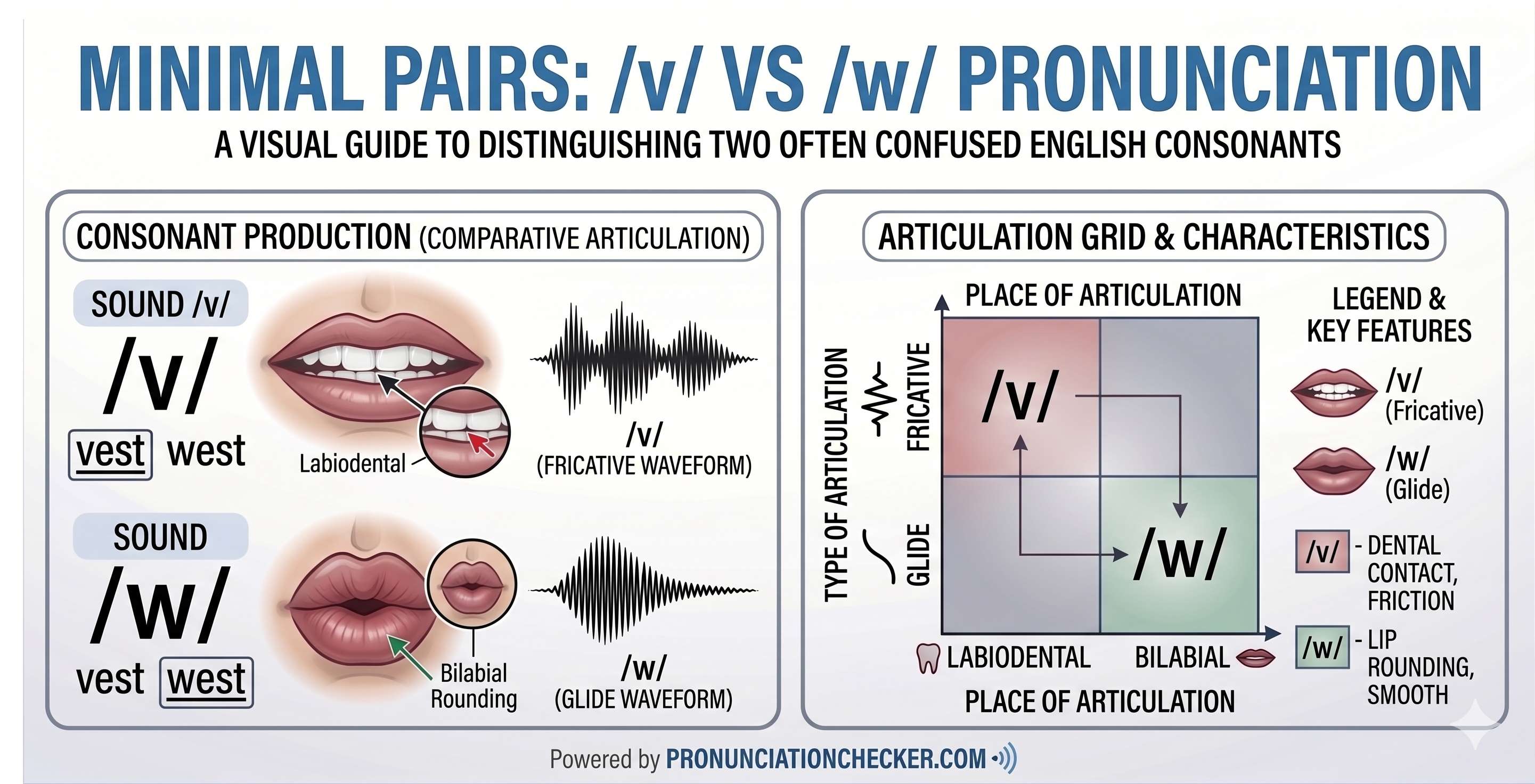
The difference between the two English sounds is purely physical and easy to check in a mirror. /v/ needs your upper teeth touching your lower lip. /w/ needs rounded lips and no contact at all. Everything below builds on that one fact. Pairs to test yourself with:
- Word pairs: vine, wine · vest, west · vet, wet · vary, wary · verse, worse · veil, whale
- Mixed phrases: a very wet vest, we've visited Wales twice, wave the white van away
Contact against rounding
These two sounds are produced in completely different ways, which is good news: the correction is mechanical rather than acoustic, and you can verify it visually.
/v/ as in vine | /w/ as in wine | |
|---|---|---|
| Articulators | Lower lip against upper front teeth | Both lips rounded, nothing touching |
| Manner | Fricative — audible friction | Approximant — no friction at all |
| Tongue | Not involved | Back of tongue raised towards soft palate |
| Can be held? | Yes, indefinitely | No, it glides into the next vowel |
| Visible check | Teeth resting on lip | Small circular lip opening |
The bite-and-hold drill. Bite gently on your lower lip and hold it there. Now say very, very, very without releasing the bite until the vowel begins. Then release the lip entirely, round it into a small circle, and say wary, wary, wary. Alternating between these two physical settings builds the distinction far faster than listening practice does, because the error is motor rather than perceptual for most learners.
Three different problems that look the same
Learners who confuse /v/ and /w/ are not all making the same mistake, and the fix differs for each group.
| First language | Underlying cause | Direction of the error |
|---|---|---|
| Hindi, Urdu, Gujarati, Punjabi | A single phoneme [ʋ] covers the whole range | Both directions, unpredictably |
| German, Polish, Russian | The letter w is pronounced /v/ in the first language | wine → vine; often over-corrected to wery |
| Spanish, Catalan | No /v/ phoneme; b and v are the same sound | vote → boat rather than wote |
| Japanese, Korean | /v/ absent; nearest form is [b] | very → berry |
| Mandarin | /w/ exists; /v/ does not | vest → west |
German and Polish speakers frequently over-correct. Having learned that English w is not /v/, they begin producing /w/ in words that genuinely contain /v/, so very becomes wery. If that describes you, the useful practice is not more /w/ but mixed lists that force a decision on every word.
If you speak Spanish, your pair is different
Spanish speakers rarely confuse /v/ with /w/. The real difficulty is /v/ against /b/, because Spanish spells two letters, b and v, with a single sound. The relevant pairs are therefore: berry / very, boat / vote, ban / van, bat / vat, curb / curve, marble / marvel, rebel / revel, bury / very.
The physical instruction is the same bite-and-hold: for /v/ the lips must never touch each other. If your two lips meet, you have produced /b/.
Pairs, mixed lists and sentences
Minimal pairs: vine / wine, vest / west, veil / whale, verse / worse, vet / wet, viper / wiper, vary / wary, veered / weird, V / we, vile / while.
Mixed lists — these matter more than pairs if you over-correct, because each word requires an independent decision: we, very, wait, vote, win, visit, water, voice, welcome, village, weather, vehicle, wonder, value, white, view, walk, victory.
Words containing both sounds — the strongest test, since you must switch settings mid-word: vowel, wave, weave, we’ve, view, worldview, waiver, velvet wallet, wolverine, universal wisdom.
Sentences:
- The vet went west in a white van.
- We visited the village every winter.
- Victor waved while the wave covered the vessel.
- Very few of us were worried about the view.
- The wine from that vine is worth the wait.
Record the sentence set once a week rather than daily. Weekly recordings make progress audible; daily recordings mostly capture noise.
Frequently asked questions
What is the physical difference between V and W?
For /v/ the lower lip touches the upper front teeth and air is forced through with audible friction, and the sound can be held indefinitely. For /w/ nothing touches: both lips form a small rounded circle, the back of the tongue rises towards the soft palate, and the sound glides straight into the following vowel. You can verify both positions in a mirror.
Why do I say wery instead of very after correcting my pronunciation?
This is over-correction, and it is very common among German, Polish and Russian speakers. Having learned that English w is not pronounced /v/, the correction gets applied to words that genuinely contain /v/. The remedy is not more /w/ practice but mixed word lists, where each item requires an independent decision, rather than minimal pairs that let you alternate mechanically.
I speak Spanish and I confuse V with B, not with W. Is that normal?
Yes, and it is the expected pattern. Spanish writes b and v but pronounces them identically, so the English contrast that matters for you is /v/ against /b/: berry and very, boat and vote, ban and van, curb and curve. The instruction is the same in both cases — for /v/ the two lips must never meet, only the lower lip and the upper teeth.
What is a good daily drill for this contrast?
Bite gently on your lower lip, hold it, and say very three times without releasing until the vowel starts. Then release, round the lips into a small circle, and say wary three times. Alternating between those two physical settings for two minutes trains the motor pattern directly, which is what most learners need, since the difficulty here is usually production rather than perception.
Disclosure: this page links to Preply, a tutoring marketplace. If you book a lesson through that link we may earn a commission, at no extra cost to you. It does not change what is recommended here. See our disclaimer and privacy policy.
Record yourself on video
The video test lets you watch your own lips, the quickest way to check teeth-on-lip contact for /v/.
Open the video test