For many speakers of Japanese, Korean and Chinese languages, light and right can sound like the same word, because in their first language they would be. Japanese has a single liquid consonant that falls between English /r/ and /l/. Korean has one liquid with two positional variants. Many Cantonese speakers merge the two as well.
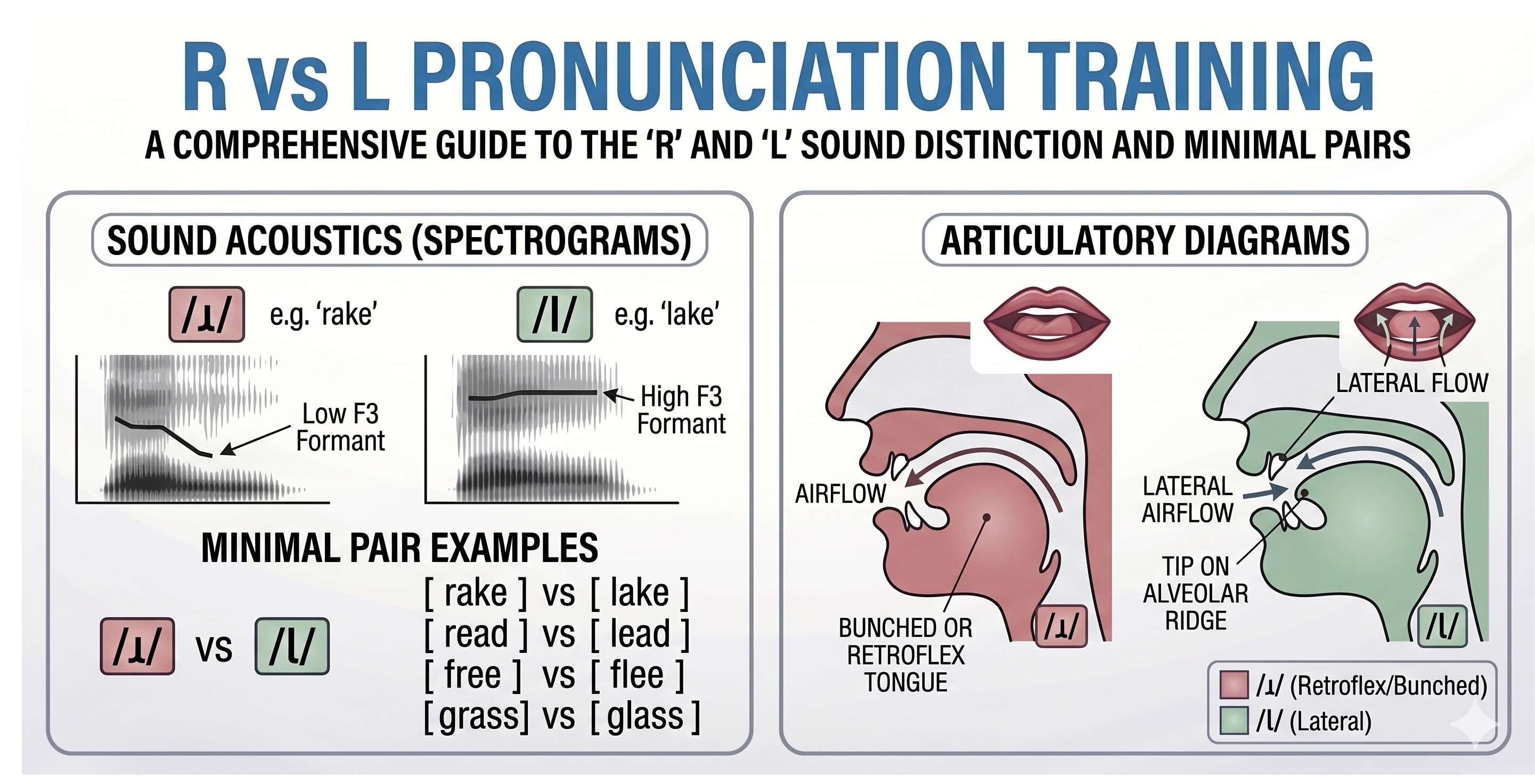
In English the contrast is carried by the shape of the tongue and, less obviously, by the lips: English /r/ is usually made with some lip rounding and /l/ is not. That second cue is often the quickest improvement, and the section on lip rounding below explains how to use it.
Word bank by position
| Position | Pairs |
|---|---|
| At the start of a word | light, right · lice, rice · lead, read · lock, rock · lane, rain · long, wrong · low, row |
| After another consonant | glass, grass · fly, fry · climb, crime · blush, brush · cloud, crowd · glow, grow |
| Between vowels | belly, berry · collect, correct · alive, arrive · pilot, pirate |
Pairs after another consonant are usually the hardest, because the tongue has less time to get into position. If the first row is already comfortable, spend most of your practice on the second.
The single fact that fixes most /r/ errors
English /ɹ/ is an approximant, and the tongue tip never touches anything. That one fact eliminates the majority of substitution errors, because nearly every incorrect version of English /r/ involves contact: a Spanish or Italian tap [ɾ], a Russian or Polish trill [r], a French or German uvular [ʁ], or a Japanese tap that lands on the alveolar ridge.
There are two tongue shapes that native speakers use for /ɹ/, and both are acceptable. In the bunched version the body of the tongue humps up towards the roof of the mouth while the tip points down behind the lower teeth. In the retroflex version the tip curls up and back without contacting the ridge. Roughly half of American speakers use each. Choose whichever you can hold steady; the acoustic result is nearly identical.
/l/ is the opposite: the tongue tip must touch the alveolar ridge, and air escapes over the sides of the tongue. That lateral airflow is what gives /l/ its characteristic sound.
The whisper test. Whisper a long rrrrr and then a long llllll. The /l/ produces a clear, thin hiss along the sides of the tongue. The /ɹ/ produces a hollow, muffled sound with no hiss at all. If both whispers sound the same, your tongue is making contact on the /ɹ/.
The cue almost nobody teaches: lip rounding
English /ɹ/ is normally produced with noticeable lip rounding, especially at the start of a word. /l/ has none. This is visible, easy to check in a mirror, and it changes the acoustics substantially by lowering the third formant, which is the frequency English listeners use to identify /ɹ/.
If you speak Japanese or Korean, start here rather than with the tongue. Round your lips as though for oo, then say red, run, right, room without letting the tongue tip rise. Many learners produce a recognisable /ɹ/ for the first time this way, because the rounding masks a tongue position that is not yet correct.
What goes wrong, by first language
| First language | What happens | Where to start |
|---|---|---|
| Japanese | One liquid phoneme, a tap [ɾ]; both /r/ and /l/ map to it | Perception training first — production practice fails until the contrast is audible |
| Korean | [ɾ] between vowels, [l] at syllable end; the two are allophones, not separate sounds | Word-initial /ɹ/ with heavy lip rounding |
| Mandarin | Has a retroflex approximant but rarely in coda position; car, more, four lose the /r/ | Final and pre-consonantal /ɹ/: hard, bird, work |
| Spanish, Portuguese, Italian | Tap or trill substituted for /ɹ/; /l/ is usually already fine | Removing tongue contact — hold a long steady /ɹ/ for five seconds |
| French, German | Uvular [ʁ] produced at the back of the throat | Moving the constriction forward; start from the vowel in her |
Clear /l/ and dark /l/
English has two noticeably different /l/ sounds and using the wrong one is a common source of a foreign-sounding accent even among advanced speakers. Clear /l/ occurs before a vowel: leaf, light, believe, alive. Dark /l/, written [ɫ], occurs at the end of a syllable: feel, milk, cold, full, table. For dark /l/ the back of the tongue lifts towards the soft palate, giving the sound an oo-like quality.
Speakers of Spanish, Italian, German and Russian typically use a clear /l/ everywhere, which makes milk and cold sound crisp in a way English never is. Try letting the word feel end in something close to ee-uhl, and cold in something close to coh-uhld.
A pair ladder, easiest to hardest
Do not start with right / light. Word-initial pairs are among the harder positions. Work up the ladder instead, spending several days at each rung and only moving on when you are above 90% accurate.
- Between vowels — clearest acoustic difference: berry / belly, pirate / pilot, arrive / alive, correct / collect, marry / Mallory.
- Word-initial: right / light, rock / lock, rate / late, road / load, rip / lip.
- In clusters — hardest, because there is no time to reposition: pray / play, fry / fly, grass / glass, crowd / cloud, brew / blue, free / flee.
- Both sounds in one word — the real test: railroad, rural, library, parallel, regularly, reliable, laboratory.
The word rural is difficult for native speakers too. If you can say rural library at conversational speed without the tongue tip touching on either /ɹ/, the contrast is established.
Frequently asked questions
Why can I hear the difference between R and L but not produce it, or the reverse?
Perception and production are separate skills and they improve on different timelines. Speakers of Japanese and Korean often need dedicated listening practice first, because a contrast the brain has categorised as a single sound is difficult to monitor while speaking. Speakers of Spanish and Italian usually hear the difference immediately but substitute a tap, which is a motor problem. Identify which of the two applies to you before choosing a drill.
Is the bunched or the retroflex R correct for English?
Both are correct. Roughly half of American English speakers bunch the tongue body upward with the tip pointing down, and roughly half curl the tip up and back. The acoustic output is almost identical because both shapes lower the third formant in the same way. Use whichever position you can hold steadily; what matters is that the tongue tip does not touch the roof of the mouth.
What is dark L and does it matter?
Dark L is the version of /l/ used at the end of a syllable, as in feel, milk, cold and table, where the back of the tongue lifts towards the soft palate and gives the sound an oo-like colour. Clear L is used before vowels, as in leaf and believe. Using a clear L everywhere is one of the most common residual accent features in otherwise advanced speakers, and it is straightforward to correct once you know the rule.
Which minimal pairs should I practise first?
Start with pairs where R and L fall between two vowels, such as berry and belly, or pirate and pilot, because the acoustic difference is largest there. Move to word-initial pairs like right and light next, and leave consonant clusters such as pray and play until last, since a cluster gives you no time to reposition the tongue.
Disclosure: this page links to Preply, a tutoring marketplace. If you book a lesson through that link we may earn a commission, at no extra cost to you. It does not change what is recommended here. See our disclaimer and privacy policy.
Test light and right with a recogniser
Say pairs such as light, right and glass, grass, and see which word the speech quiz hears.
Open the pronunciation quiz