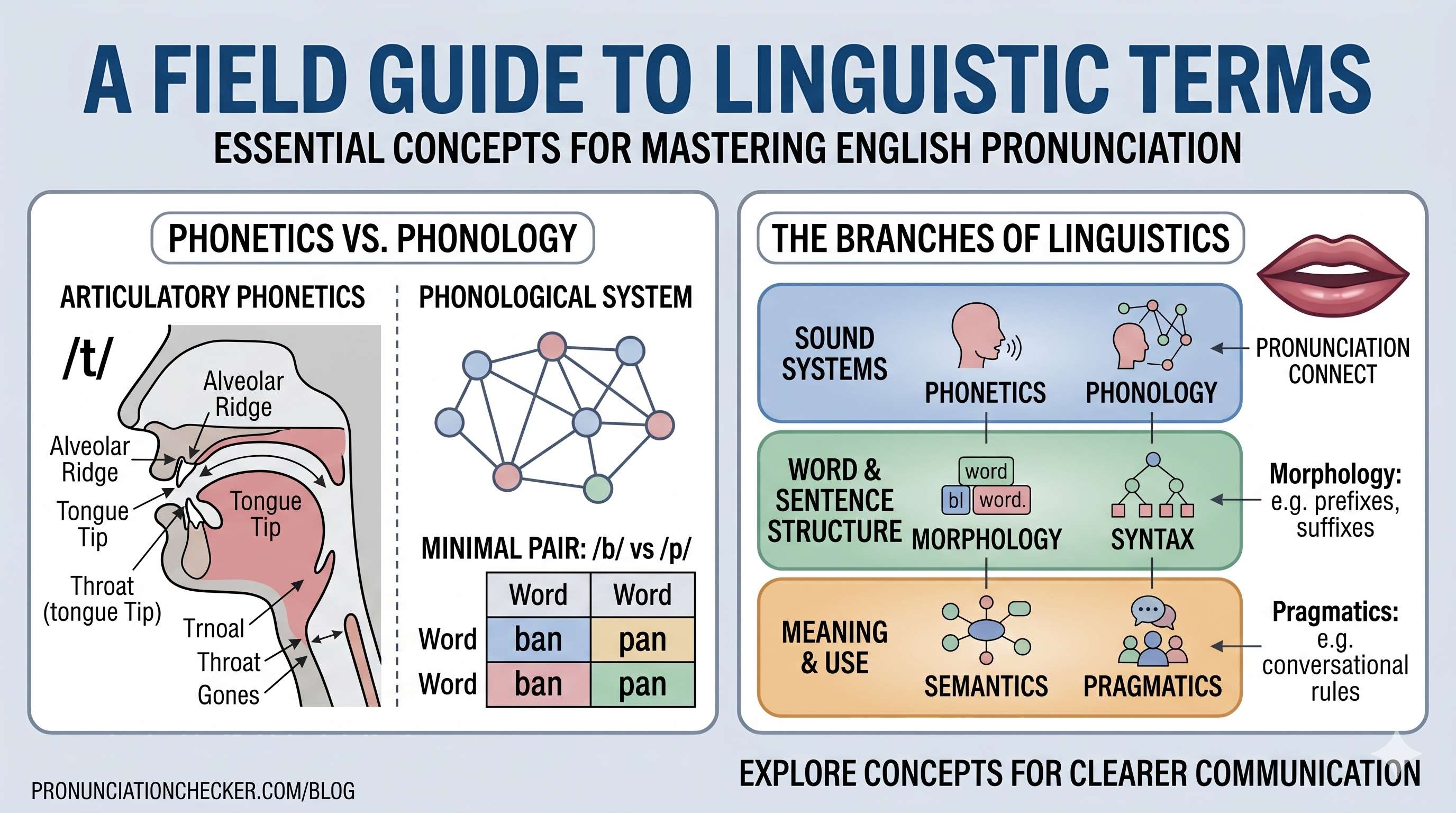
Pronunciation guides, dictionaries and teachers use a small technical vocabulary: phoneme, schwa, aspiration, weak form. None of it is difficult, but it is rarely explained in one place, and a single unfamiliar term can make a useful explanation impossible to follow.
This glossary covers the terms you are most likely to meet, with a plain definition, an English example, and a link to a full guide where one exists. It focuses on sound, because that is where the terminology does the most practical work, but it also covers the handful of word-structure terms, such as morpheme, that explain pronunciation patterns.
A to C
Accent
The overall way a person or group pronounces a language. Everyone has one; there is no accent-free English. For learners, the practical goal is usually intelligibility, not the removal of an accent. Accent vs intelligibility.
Affix, root and suffix
A root is the core of a word (photo, act); an affix is added to it, before (a prefix, re-) or after (a suffix, -ion). Some suffixes move the stress: PHOtograph, phoTOgraphy. Word stress rules.
Affricate
A consonant that starts as a stop and releases as a fricative, as one unit. English has two: /tʃ/ in church and /dʒ/ in judge. SH, CH and J.
Allomorph
A different pronunciation of the same morpheme. The plural ending has three allomorphs: /s/ in cats, /z/ in dogs, /ɪz/ in buses. The -s endings.
Allophone
One of the physical variants of a phoneme, chosen by position. The /t/ in top (with a puff of air) and in stop (without one) are allophones of the same phoneme. Swapping allophones never changes a word. Phoneme vs allophone.
Alveolar
Made with the tongue against the alveolar ridge, the bump behind the upper front teeth: /t d s z n l/.
Approximant
A consonant where the articulators come close but not close enough to create friction: /w r j l/ in English.
Aspiration
The puff of air after /p t k/ at the start of a stressed syllable, as in pin. Without it, English listeners may hear /b d ɡ/. Voiced vs voiceless consonants.
Assimilation
A sound changing to become more like its neighbour. Ten boys often becomes "tem boys" because the /n/ moves toward the lips for /b/. Connected speech.
Bilabial
Made with both lips: /p b m w/.
Cluster
Two or more consonants with no vowel between them: str in street, ksts in texts. Many learners add or drop sounds in clusters. Consonant clusters.
Coda and onset
The consonants after the vowel of a syllable are the coda (-mp in jump); those before it are the onset (j-).
Cognate
A word that shares its origin with a word in another language: night, German Nacht, Spanish noche. Cognates often differ in stress, which is a common source of errors. False friends look alike but differ in meaning.
Connected speech
The way words change when spoken together rather than one at a time, through linking, weak forms, assimilation and elision.
Content word and function word
Content words (nouns, main verbs, adjectives, adverbs) carry meaning and are usually stressed. Function words (a, the, to, of, can, was) carry grammar and are usually unstressed and reduced. Sentence stress and rhythm.
D to H
Dental and interdental
Made with the tongue against or between the teeth: /θ/ in think and /ð/ in this. TH vs S vs T.
Devoicing
A voiced sound losing some or all of its voicing, especially at the end of a word. German, Dutch, Russian and Turkish devoice final consonants, so their speakers may say bet for bed.
Dialect
A variety of a language with its own vocabulary, grammar and pronunciation. Dialects are rule-governed systems, not incorrect versions of a standard.
Diphthong
A vowel that glides from one position to another within a syllable: /aɪ/ in my, /eɪ/ in day, /aʊ/ in now. English diphthongs.
Elision
The loss of a sound in natural speech. Next day often loses its /t/; family often loses its middle vowel.
Epenthesis
Adding a sound, usually a vowel, to make a word easier to say: estreet for street, or "Facebook-i". It is one of the most common learner patterns. Pronunciation for Portuguese speakers.
Flap (tap)
A very quick single tap of the tongue. In American English /t/ and /d/ between vowels become a flap: water, better. The American T.
Fricative
A consonant made by forcing air through a narrow gap, creating friction: /f v θ ð s z ʃ ʒ h/.
Functional load
How much work a contrast does in a language. /p/–/b/ distinguishes hundreds of common words; /θ/–/ð/ distinguishes almost none. High-load contrasts deserve practice first.
Glottal stop
A brief closure of the vocal folds, the catch in uh-oh, written [ʔ]. It replaces /t/ in American button and in many British pronunciations of water.
Homophone, homograph and heteronym
Homophones sound the same but differ in spelling (see, sea). Homographs share a spelling (bank). Heteronyms share a spelling but differ in sound (read /riːd/, read /red/). Heteronyms.
I to M
Inflection and derivation
Inflection changes the grammatical form of a word without making a new word (walk → walked). Derivation makes a new word (act → action). Derivation is more likely to shift stress.
Intelligibility
How much of what you say a listener actually understands. It is related to, but different from, how strong your accent sounds.
Intonation
The rise and fall of pitch across a phrase. It signals where information is new, whether you have finished, and attitude. Intonation patterns.
IPA
The International Phonetic Alphabet: one symbol for each sound, used by dictionaries to show pronunciation regardless of spelling. Why start with IPA.
L1 and L2
Your first language (L1) and the language you are learning (L2). Most pronunciation difficulties can be predicted from the L1.
Lateral
A sound where air flows around the sides of the tongue: /l/. English has a clear [l] and a dark [ɫ]. Clear L and dark L.
Lexical stress
The stress that belongs to a word in the dictionary: the first syllable of TAble, the second of poTAto. Also called word stress.
Linking
Joining the end of one word to the start of the next: turn off sounds like "tur-noff". Linking R and intrusive R are special cases in non-rhotic accents. Linking R.
Manner of articulation
How the airflow is obstructed: completely (stops), partly with friction (fricatives), through the nose (nasals), and so on. Reading the consonant chart.
Minimal pair
Two words that differ in only one sound: ship, sheep; light, right. Minimal pairs prove that two sounds are separate phonemes. Guide to minimal pairs.
Monophthong
A vowel that holds one position throughout, like /iː/ in see or /æ/ in cat. Compare diphthong.
Morpheme
The smallest unit of meaning. Unbelievable has three: un-, believe, -able. Morphemes explain patterns like the silent g of sign reappearing in signature. Silent letters.
N to R
Nasal
A sound made with air flowing through the nose: /m n ŋ/. Portuguese and French also have nasal vowels, which English does not. The NG sound.
Nuclear stress (tonic syllable)
The most prominent syllable in a phrase, where the main pitch movement happens. It usually falls on the last content word: I left my KEYS.
Orthography
A language's spelling system. English has a deep orthography, with a loose link between letters and sounds; Spanish and Italian have shallow ones. Spelling to sound patterns.
Phoneme
A sound category that distinguishes words in a language. /p/ and /b/ are separate phonemes in English because pat and bat are different words.
Phonetics and phonology
Phonetics studies speech sounds physically: how they are made and heard. Phonology studies how a particular language organises them into a system.
Place of articulation
Where in the mouth a consonant is made: lips, teeth, alveolar ridge, hard palate, soft palate or glottis.
Plosive (stop)
A consonant made by blocking the air completely and releasing it: /p b t d k ɡ/.
Prosody
The "music" of speech: stress, rhythm and intonation together. Also called suprasegmentals.
Reduction
Weakening an unstressed syllable, usually by changing its vowel to schwa: to becomes /tə/.
Rhotic and non-rhotic
Rhotic accents pronounce /r/ at the end of a syllable (car /kɑːr/), as in most of the US. Non-rhotic accents do not (/kɑː/), as in southern England.
S to Z
Schwa
The short, neutral vowel /ə/ heard in the first syllable of about. It is the most frequent vowel in English and has no letter of its own. The schwa sound.
Segment and suprasegmental
Segments are individual sounds (vowels and consonants). Suprasegmentals are features that stretch across them: stress, rhythm, intonation.
Stress-timed and syllable-timed
In stress-timed languages like English, stressed syllables come at fairly regular intervals and unstressed ones are squeezed between them. In syllable-timed languages like Spanish, every syllable takes roughly equal time. Syllable vs stress timing.
Syllabic consonant
A consonant that forms a syllable without a vowel: the /n/ in button [ˈbʌʔn̩], the /l/ in bottle.
Tense and lax vowels
Tense vowels (/iː uː/) are made with more muscular effort and can end a word; lax vowels (/ɪ ʊ e æ ʌ/) are shorter and cannot. Sheep is tense, ship is lax. Vowel length and quality.
Transcription: phonemic and phonetic
Phonemic transcription, between slashes, shows phonemes: /pɪn/. Phonetic transcription, in square brackets, shows physical detail: [pʰɪn]. Dictionaries use phonemic transcription. Using an IPA dictionary.
Velar
Made with the back of the tongue against the soft palate: /k ɡ ŋ/.
Voicing
Whether the vocal folds vibrate. /z/ is voiced, /s/ is voiceless: put your fingers on your throat to feel the difference.
Vowel quadrilateral
The IPA vowel chart, a simplified map of the mouth: left to right is tongue front to back, top to bottom is tongue high to low. Reading the vowel chart.
Weak form
The reduced pronunciation of a function word when unstressed: can as /kən/, of as /əv/. Most English function words have one. Weak forms.
Yod-dropping
Losing the /j/ sound after certain consonants: tune is /tjuːn/ in traditional British English but /tuːn/ in American English.
Why the vocabulary is worth learning
You do not need any of these words to speak English well. Native speakers manage without them. But as an adult learner, you rely on explanations, and explanations rely on precise words. "Your vowel is wrong" is not something you can act on; "you are using a tense vowel where English has a lax one" is. The terms are tools for turning vague feedback into a specific thing to practise.
A practical approach: when a guide or teacher uses a term you do not know, look it up here, then try to find an example in your own speech. Recording yourself and describing what you hear, using two or three of these words, is one of the fastest ways to make them stick.
Frequently asked questions
What is the difference between a phoneme and an allophone?
A phoneme is a sound category that changes meaning (/p/ vs /b/ in pat and bat). An allophone is one physical version of a phoneme, chosen by position, such as the aspirated /t/ in top and the unaspirated /t/ in stop. Changing an allophone never changes the word.
What is the difference between phonetics and phonology?
Phonetics studies the physical sounds of speech: how they are produced, transmitted and heard. Phonology studies how a specific language organises those sounds into a system of contrasts and patterns.
What is a morpheme?
The smallest unit of meaning in a word. Cats has two morphemes, cat and the plural -s. Unbelievable has three: un-, believe and -able.
Do I need to learn linguistic terms to improve my pronunciation?
No, but a few terms make explanations much easier to follow and apply. Phoneme, stress, schwa, voicing and minimal pair are the most useful to start with.
Sources and further reading
- Crystal, D. (2008). A Dictionary of Linguistics and Phonetics (6th ed.). Blackwell.
- Roach, P. (2009). English Phonetics and Phonology (4th ed.). Cambridge University Press.
- International Phonetic Association (1999). Handbook of the International Phonetic Association. Cambridge University Press.
Disclosure: this page links to Preply, a tutoring marketplace. If you book a lesson through that link we may earn a commission, at no extra cost to you. It does not change what is recommended here. See our disclaimer and privacy policy.
See the terms in real transcriptions
Type any word to see its phonemes, stress and syllable breaks written out in IPA.
Open the IPA dictionary