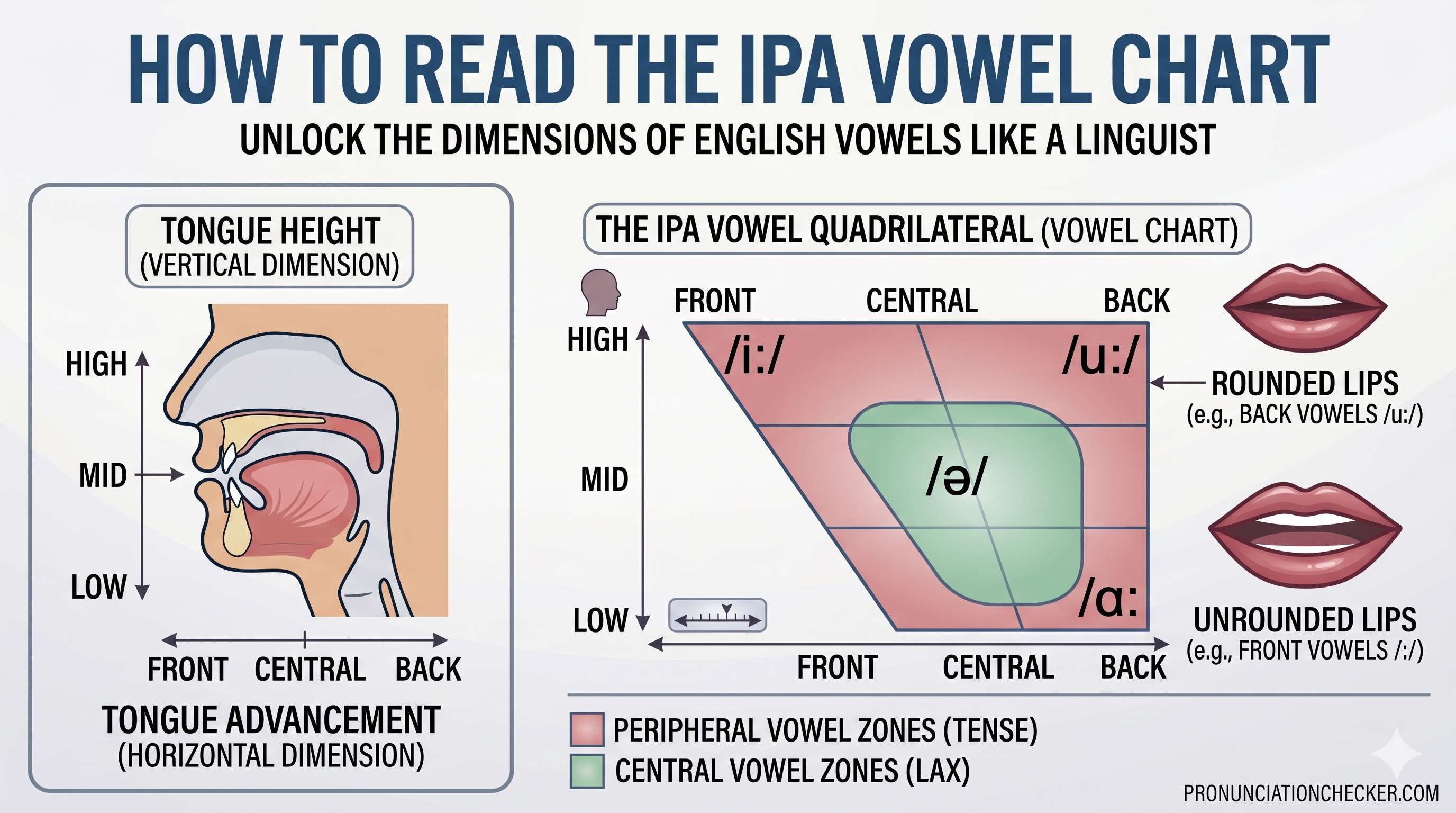
Vowels are harder to learn than consonants for a simple reason: you cannot see or feel them clearly. For /p/ your lips close. For /s/ your tongue approaches the ridge behind your teeth. For a vowel, the tongue floats in the mouth without touching anything, and tiny shifts change the word: bit, bet, bat, but.
The IPA vowel chart solves this by giving each vowel coordinates. This guide shows you how to read it as a map of your own mouth, why the corner vowels are the landmarks, where the English vowels really sit, and how to use the chart to diagnose one vowel you keep getting wrong. Keep five anchor words in mind as you read: fleece /iː/, goose /uː/, trap /æ/, palm /ɑː/ and comma /ə/.
The chart is a map of your mouth
The IPA vowel quadrilateral looks abstract, but it is a simplified cross-section of the mouth viewed from the left side, with the lips at the left edge and the throat at the right. Once you read it that way, the positions stop being arbitrary symbols and become instructions.
- Left to right = tongue front to back.
/i/at the top left has the tongue pushed forward;/u/at the top right has it pulled back. - Top to bottom = tongue high to low, which also corresponds to the jaw being closed or open.
/i/is high and close;/a/is low and open. - Pairs at a single point = lip rounding. Where two symbols appear together, the right-hand one is rounded.
Feel the axes directly. Say ee — ah slowly and repeatedly. You are moving down the left edge of the chart, and you can feel the jaw open and the tongue drop. Now say ee — oo. You are moving across the top, and you can feel the tongue slide backwards and the lips round. Those two movements define the whole space.
Why the corners are reference points
The chart is anchored by cardinal vowels, a set of reference positions defined by Daniel Jones so that phoneticians from different language backgrounds could describe vowels consistently. They are not the vowels of any particular language; they are fixed coordinates against which real vowels are plotted.
This explains something that confuses learners: the symbol /e/ does not mean the same thing in a French description and an English one. In careful phonetic transcription of English, the vowel of bed is closer to /ɛ/, but many dictionaries write /e/ because English has no contrast that would make the difference matter. Symbols in a phonemic transcription are labels for categories, not precise coordinates.
Where English vowels actually sit
| Symbol | Word | Height | Backness | Lips |
|---|---|---|---|---|
/iː/ | sheep | close | front | spread |
/ɪ/ | ship | near-close | near-front | neutral |
/e/ | bed | mid | front | neutral |
/æ/ | cat | near-open | front | neutral |
/ɑː/ | father | open | back | neutral |
/ɒ/ | hot (UK) | open | back | rounded |
/ɔː/ | thought | mid-open | back | rounded |
/ʊ/ | foot | near-close | near-back | slightly rounded |
/uː/ | goose | close | back | rounded |
/ʌ/ | cup | mid-open | central | neutral |
/ɜː/ | bird | mid | central | neutral |
/ə/ | about | mid | central | neutral |
Two observations that the chart makes visible and that word lists do not. First, English crowds the front and centre of the space with many contrasts, which is why front vowels are where learner errors concentrate. Second, the lax vowels /ɪ ʊ e ʌ/ all sit closer to the centre than their tense counterparts — the chart shows centralisation as a physical fact rather than an abstract label.
Using the chart to fix a specific vowel
- Find the target. Look up the word and locate its vowel symbol on the chart.
- Find your substitute. Identify the vowel you actually produce, usually the nearest one from your first language.
- Read the direction of travel. If your version is to the left of the target, pull the tongue back. If it is above, lower the jaw. If the target is rounded and yours is not, round the lips.
- Overshoot, then settle. Move further than the chart suggests, listen, then come back. Overshooting locates the boundary of the category, which is more informative than aiming directly at the centre.
Worked example. A Spanish speaker saying cat typically produces /e/ instead of /æ/. On the chart, /æ/ sits below /e/, so the instruction is to lower the jaw substantially while keeping the tongue forward. That is a concrete physical action, which is what makes the chart more useful than the advice to listen harder.
Where the chart stops helping
Three honest limitations. The chart shows tongue position but says nothing about duration, and English vowels differ substantially in length. It shows single positions, so diphthongs have to be drawn as arrows rather than points. And it is a simplification of a continuous acoustic space — modern phonetics plots vowels by formant frequencies, and the correspondence with tongue position, while real, is approximate.
None of this makes the chart less useful for learning. It makes it a starting framework rather than a complete description, which is the right way to use it.
Frequently asked questions
What do the axes of the IPA vowel chart mean?
The chart is a simplified cross-section of the mouth seen from the side, with the lips at the left and the throat at the right. Left to right shows the tongue moving from front to back, and top to bottom shows it moving from high to low, which also corresponds to the jaw closing and opening. Where two symbols share a position, the right-hand one is produced with rounded lips.
How can I feel the chart's axes in my own mouth?
Say ee and then ah slowly and repeatedly: you are travelling down the left edge of the chart, and you can feel the jaw open and the tongue drop. Then say ee and then oo: you are moving across the top, and you can feel the tongue slide back and the lips round. Those two movements define the entire vowel space.
Why do dictionaries use different symbols for the same English vowel?
Because symbols in a phonemic transcription label categories rather than exact coordinates. The vowel of bed is phonetically closer to /ɛ/, but many dictionaries write /e/ because English has no contrast that would make the difference meaningful. Only in narrow phonetic transcription does the precise symbol matter.
How do I use the chart to correct a vowel I get wrong?
Locate the target vowel and the vowel you actually produce, then read the direction between them as a physical instruction. If your version sits above the target, lower the jaw; if it sits to the left, pull the tongue back; if the target is rounded, round the lips. A Spanish speaker saying cat with the vowel of bed needs to lower the jaw substantially while keeping the tongue forward.
Disclosure: this page links to Preply, a tutoring marketplace. If you book a lesson through that link we may earn a commission, at no extra cost to you. It does not change what is recommended here. See our disclaimer and privacy policy.
Hear the vowel chart
Play each vowel in order around the chart and listen to how the quality shifts.
Open the interactive chart