Portuguese speakers learning English have some real advantages. Portuguese already has /ʃ/ and /ʒ/, nasal consonants in every position, a flap that is almost identical to the American T in water, and, in European Portuguese, strong vowel reduction that resembles English schwa. The difficulties come from a small number of Portuguese habits that transfer directly into English.
This guide focuses mainly on Brazilian Portuguese, with notes for speakers from Portugal. The ten issues are ordered by how much they affect intelligibility, not by how noticeable they are. Fix them in this order.
1. The extra vowel at the end of words
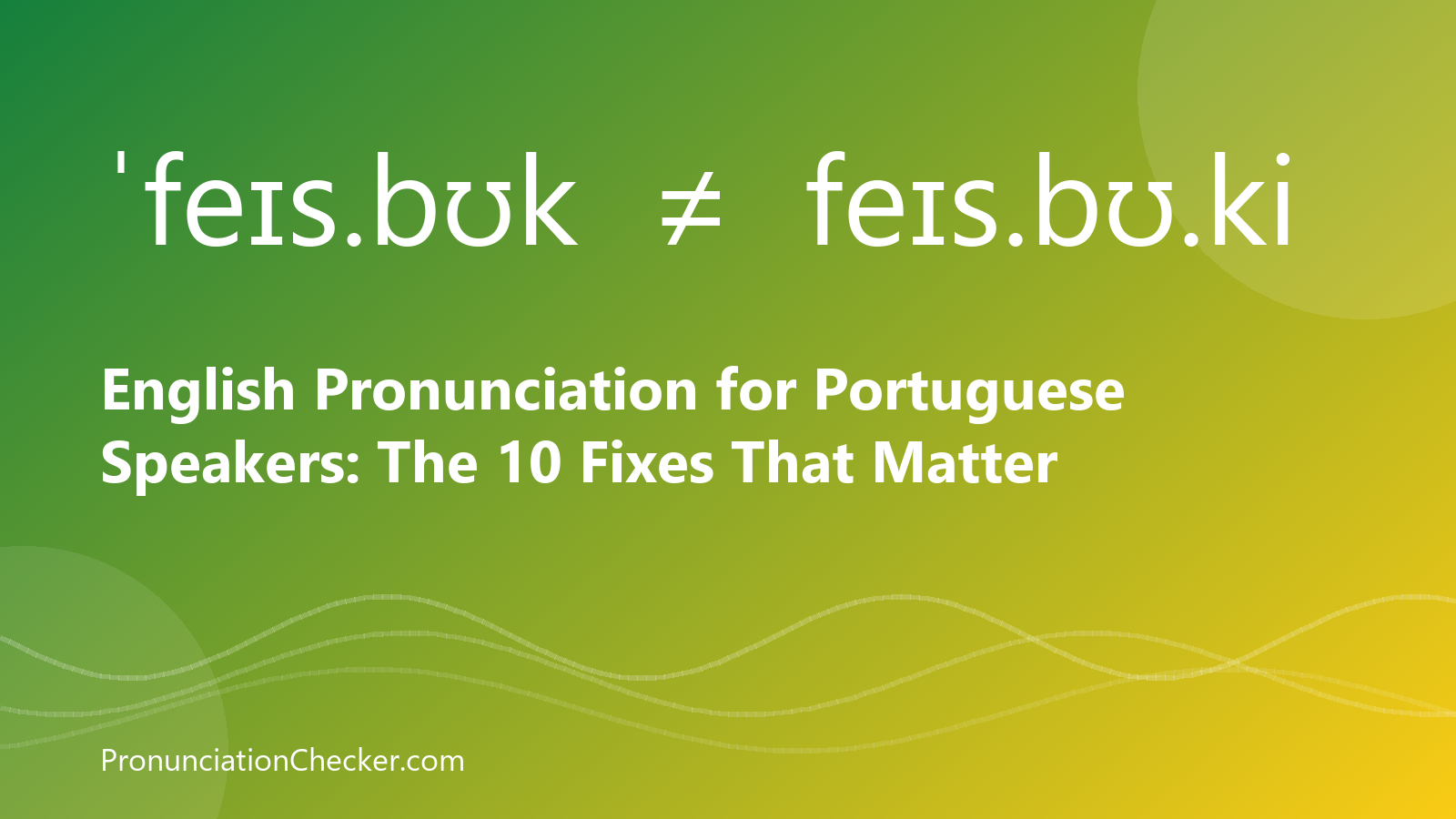
Brazilian Portuguese words rarely end in consonants other than /s/, /r/, /l/ and nasals. When a word does, speakers add a short [i]: Facebook becomes "Facebook-i", hot dog "hotchi dogui", big "bigui", stop "stopi". The same happens between consonants inside words: advogado is often "adivogado", and English admit becomes "adimit".
This matters more than it seems, because the extra syllable changes word rhythm and can create a different word: like said as "likey" or bag as "baggy". The fix is to end the word with the consonant held, not released. For stop, close the lips and simply stop. For big, raise the back of the tongue and hold it. There should be silence after, not a vowel.
2. T and D before i
In most of Brazil, /t/ and /d/ become [tʃ] and [dʒ] before an [i] sound: tia is "chia", dia is "jia". Transferred to English, team sounds like "cheem", different like "jifferent", city like "cichy", and party like "parchy". Combined with issue 1, want can become "wanchi".
English /t/ and /d/ never change before /iː/ or /ɪ/. Keep the tongue tip on the ridge and release it cleanly: tea is /tiː/, not /tʃiː/. Practise pairs: tip, chip · team, cheap · dip, gyp · deep, jeep.
3. L at the end of a syllable
Brazilian Portuguese pronounces every syllable-final L as [w]: Brasil is [bɾaˈziw]. In English this makes feel sound like "fee-oo", Paul like "pow", and milk like "miuk". The fix is to touch the tongue tip to the ridge behind the upper teeth at the end of the word. The clear L and dark L guide has detailed exercises. Speakers from Portugal usually do not have this problem, since European Portuguese has a dark L similar to English.
4. R at the start of words
In Brazil, initial R is usually a guttural sound like [h] or [x]: rato sounds like "hato". Transferred to English, red sounds like head and right like height. English speakers hear /h/, which is a real sound in English, so this causes genuine confusion.
English /r/ is made with the tongue tip raised toward, but not touching, the roof of the mouth, and the lips slightly rounded. It is close to the r caipira of the Brazilian interior. If you have that accent, you already have the American R.
5. The vowel pairs
Portuguese has seven oral vowels in stressed position; English has around twelve monophthongs plus diphthongs. The pairs that most often collapse for Portuguese speakers:
| English contrast | Pairs | Typical result |
|---|---|---|
| /iː/ and /ɪ/ | sheep, ship · beach, bitch · sheet, shit | both said as [i] |
| /æ/ and /e/ | bad, bed · man, men · sad, said | both said as [ɛ] |
| /ʌ/ and /ɑ/ or /æ/ | cut, cat · luck, lock | cut said as [a] |
| /uː/ and /ʊ/ | pool, pull · fool, full | both said as [u] |
The first pair is the famous one, for obvious reasons. For /ɪ/, relax the tongue and lower it slightly from the /iː/ position, and keep it short: it should be closer to Portuguese [e] than to [i]. See the vowel length and quality guide.
6. TH
Portuguese has no /θ/ or /ð/. Brazilians most often substitute [t] and [d] (think as "tink", the as "de"), and sometimes [f]. As with all learners, the fix is visible: the tongue tip goes lightly between the teeth. The TH minimal pairs guide covers the drills.
7. Nasal vowels instead of final M and N
In Portuguese, a vowel before M or N at the end of a syllable becomes nasal, and the consonant itself is often not fully pronounced: bom is [bõ]. In English, him, time, seem and fan need a real consonant. For M, close your lips at the end of the word. For N, touch the tongue tip to the ridge. Him said as a nasal vowel sounds like "hee" with a nasal twang.
8. The -ed ending
Portuguese speakers often pronounce every -ed as a syllable: worked as "work-ed". Combined with issue 1, it can become "worki-dji". Only verbs ending in /t/ or /d/ add a syllable. See how to pronounce -ed endings.
9. S at the start of a word
Portuguese does not allow /s/ + consonant at the start of a word, so speakers add a vowel: school becomes "eschool", student "estudent", Spain "Espain". This is mostly an accent marker, but it adds a syllable. Practise by starting with a long hiss: ssss-chool, then shorten the hiss.
10. Stress in cognates
Portuguese and English share thousands of words from Latin, but often stress them differently. Because stress is how English listeners find words, a misplaced stress in a familiar word can make it unrecognisable.
| English | Stress | Portuguese |
|---|---|---|
| photography | pho-TOG-ra-phy | fotografia |
| economy | e-CON-o-my | economia |
| technology | tech-NOL-o-gy | tecnologia |
| category | CAT-e-go-ry | categoria |
| chocolate | CHOC-late (2 syllables) | chocolate |
| comfortable | COMF-ta-ble (3 syllables) | confortável |
A pattern worth knowing: when a Portuguese word ending in stressed -ia has an English equivalent ending in -y, the English stress moves much earlier, usually to the third syllable from the end (photography, economy, technology), and sometimes further (category).
Notes for speakers from Portugal
European Portuguese reduces unstressed vowels heavily, which makes English schwa and weak forms much easier. It also has a dark L and does not usually add [i] to final consonants, so issues 1 and 3 are smaller. On the other hand, final /s/ is pronounced [ʃ] (yes as "yesh"), and the uvular R of Lisbon causes the same problem with English /r/ as the Brazilian one. Vowel pairs and TH remain the main challenges.
Frequently asked questions
Why do Brazilians add an "i" to English words?
Because Brazilian Portuguese rarely allows words to end in consonants like /k/, /g/, /p/ or /t/, speakers add a short [i] to make the pattern fit. In English this adds a syllable. The fix is to hold the final consonant and stop.
Is the Brazilian R similar to any English sound?
The initial R of most Brazilian accents sounds like English /h/, which causes confusion (red heard as head). The retroflex r caipira of the interior is close to the American /r/.
Which problem should a Brazilian learner fix first?
The extra vowel at the end of words, then the change of /t/ and /d/ before i. Both affect how many syllables listeners hear, which matters more for intelligibility than individual vowel or consonant quality.
Sources and further reading
- Barbosa, P. A. and Albano, E. C. (2004). Brazilian Portuguese. Journal of the International Phonetic Association, 34(2), 227–232.
- Cruz-Ferreira, M. (1995). European Portuguese. Journal of the International Phonetic Association, 25(2), 90–94.
- Swan, M. and Smith, B. (eds.) (2001). Learner English: A Teacher's Guide to Interference and Other Problems (2nd ed.). Cambridge University Press.
Disclosure: this page links to Preply, a tutoring marketplace. If you book a lesson through that link we may earn a commission, at no extra cost to you. It does not change what is recommended here. See our disclaimer and privacy policy.
Find your own priorities
Read a passage aloud and see which words the recogniser misheard.
Take the voice test