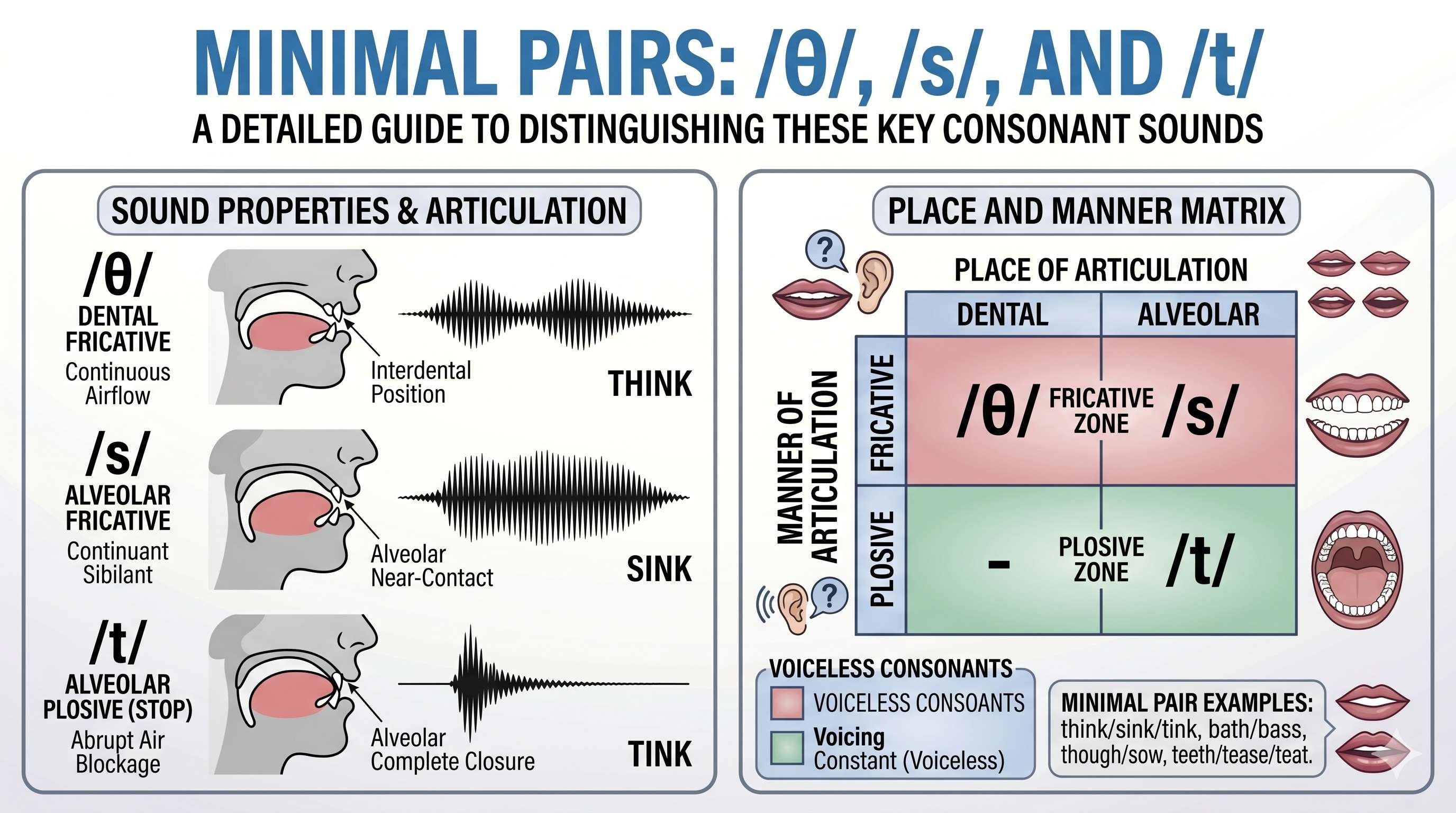
I think becomes I sink, three becomes tree or free, and they becomes day or zey. The two TH sounds, /θ/ in think and /ð/ in this, are rare among the world's languages, and almost every learner substitutes something. What they substitute depends on their first language.
They are also the only English consonants you can check in a mirror, which makes them easier to fix than their reputation suggests. Use these sets as a quick test of which substitution you make:
- /θ/ and /s/: think, sink · thumb, some · thick, sick · path, pass · mouth, mouse · faith, face
- /θ/ and /t/: three, tree · thank, tank · thin, tin · both, boat · thought, taught
- /θ/ and /f/: three, free · thin, fin · thought, fought · death, deaf
- /ð/ and /d/ or /z/: then, den · they, day · those, doze · breathe, breeze · clothing, closing
The one English sound you can see
/θ/ and /ð/ are the only English consonants that are reliably visible from the outside. The tongue tip sits lightly against or just between the upper front teeth, and air flows continuously through the narrow gap. If someone watching you cannot see the tip of your tongue, you are not making the sound.
That visibility is the most useful training tool available for this contrast. Practise in front of a mirror, or record a short video on your phone, and check the tongue rather than trusting your ear. Learners regularly believe they have corrected a /θ/ when the video shows no tongue at all.
Three sounds, three airflow signatures. Hold a fingertip two centimetres in front of your lips. /θ/ gives a weak, steady, diffuse stream. /s/ gives a sharp, narrow, high-pressure jet. /t/ gives a single burst and then nothing. Any of these substituted for another is immediately audible to a native listener even when the tongue looks approximately right.
Your first language predicts your substitution
| First language | /θ/ becomes | /ð/ becomes | Result |
|---|---|---|---|
| French, German, Japanese | /s/ | /z/ | think → sink; they → zay |
| Brazilian Portuguese, Russian | /t/ | /d/ | think → tink; they → day |
| Hindi, Urdu | dental /t̪ʰ/ | dental /d̪/ | close but with tongue contact and a stop burst |
| Mandarin | /s/ | /z/ or /d/ | three → sree |
| Vietnamese, Tagalog | /t/ | /d/ | both → bot |
| Arabic | often already correct | often already correct | Standard Arabic has both sounds; some dialects do not |
Knowing your own pattern matters because the corrections point in opposite directions. If you substitute /t/, you must stop the tongue from making a full seal and let air flow continuously. If you substitute /s/, you already have continuous airflow and simply need to move the tongue forward until it touches the teeth.
Practise /ð/ first, not /θ/
Almost every course teaches think, thank, three, thirty first. That is the wrong order for practical purposes. /ð/ is far more frequent in running speech than /θ/, because it appears in the highest-frequency words in the language: the, this, that, these, those, they, them, their, there, then, than, though, with, other, another, together, whether, rather, mother, father, brother.
In a typical minute of conversational English you will produce /ð/ dozens of times and /θ/ perhaps once or twice. Correcting /ð/ therefore changes far more of your speech per hour of practice. Begin with the in connected phrases: the other day, with them, rather than that, this and that.
Three-way pair sets
Working with three-way sets rather than pairs is more effective here because your ear has to place the sound on a scale rather than choose between two options.
/θ/ | /s/ | /t/ | /f/ |
|---|---|---|---|
| thin | sin | tin | fin |
| thick | sick | tick | — |
| thought | sought | taught | fought |
| three | — | tree | free |
| path | pass | pat | — |
| mouth | mouse | — | — |
| both | — | boat | — |
For /ð/, contrast with /d/ and /z/: they / day, then / den / Zen, breathe / breed / breeze, other / udder, bathe / bade, lather / ladder, worthy / wordy.
Sentences that force the contrast
Once single words are reliable, move to phrases where the sound recurs faster than you can consciously monitor it. Start slowly and increase speed only while accuracy holds.
- I thought the three thin things were there.
- These things are worth more than those.
- They both breathe through their mouths.
- My mother and my brother would rather go together.
- The thirty-third thief thought that through.
Finally, a note on realism: some native varieties of English do not use these sounds either. Many speakers in London, Essex and parts of Ireland use /f/ and /v/, and speakers in New York and Dublin often use /t/ and /d/. Perfect interdentals are not a requirement for intelligibility — but consistency is, and confusing think with sink in both directions does cause real misunderstandings.
Frequently asked questions
Should I learn the TH in think or the TH in this first?
Learn the voiced one, /ð/, first. It appears in the most frequent words in English — the, this, that, they, them, there, then, with, other — and you will produce it dozens of times per minute of conversation, whereas the voiceless /θ/ of think appears far less often. Correcting /ð/ therefore improves a much larger proportion of your speech for the same practice time.
How can I check I am making TH correctly without a teacher?
Use a mirror or record a short video on your phone. TH is the only English consonant that is reliably visible: the tip of the tongue should be against or slightly between the upper front teeth. Then hold a fingertip in front of your lips — TH gives a weak, steady stream of air, S gives a sharp narrow jet, and T gives a single burst and then silence.
Does it matter if I say think as sink or as tink?
The two errors are equally noticeable but need opposite corrections, so it matters that you know which one you make. If you say sink, your airflow is already continuous and you only need to move the tongue forward to the teeth. If you say tink, your tongue is sealing completely and you need to release the seal so the air can flow without interruption.
Do all native English speakers use the TH sounds?
No. Many speakers in London and southeast England use /f/ and /v/ instead, so think becomes fink, and speakers in parts of New York and Dublin use /t/ and /d/. Intelligibility does not depend on perfect interdental sounds. What does matter is consistency, because switching unpredictably between think and sink in both directions leads to genuine misunderstandings.
Disclosure: this page links to Preply, a tutoring marketplace. If you book a lesson through that link we may earn a commission, at no extra cost to you. It does not change what is recommended here. See our disclaimer and privacy policy.
Test think, sink and tink
Say each word to the speech quiz and find out which one it recognises.
Open the pronunciation quiz