Say leaf and then feel. They contain the same two sounds in reverse order, yet the /l/ sounds different. In leaf it is bright and light; in feel it is darker and deeper, almost like a vowel. Native speakers never notice this, but it is one of the features that makes an accent sound English.
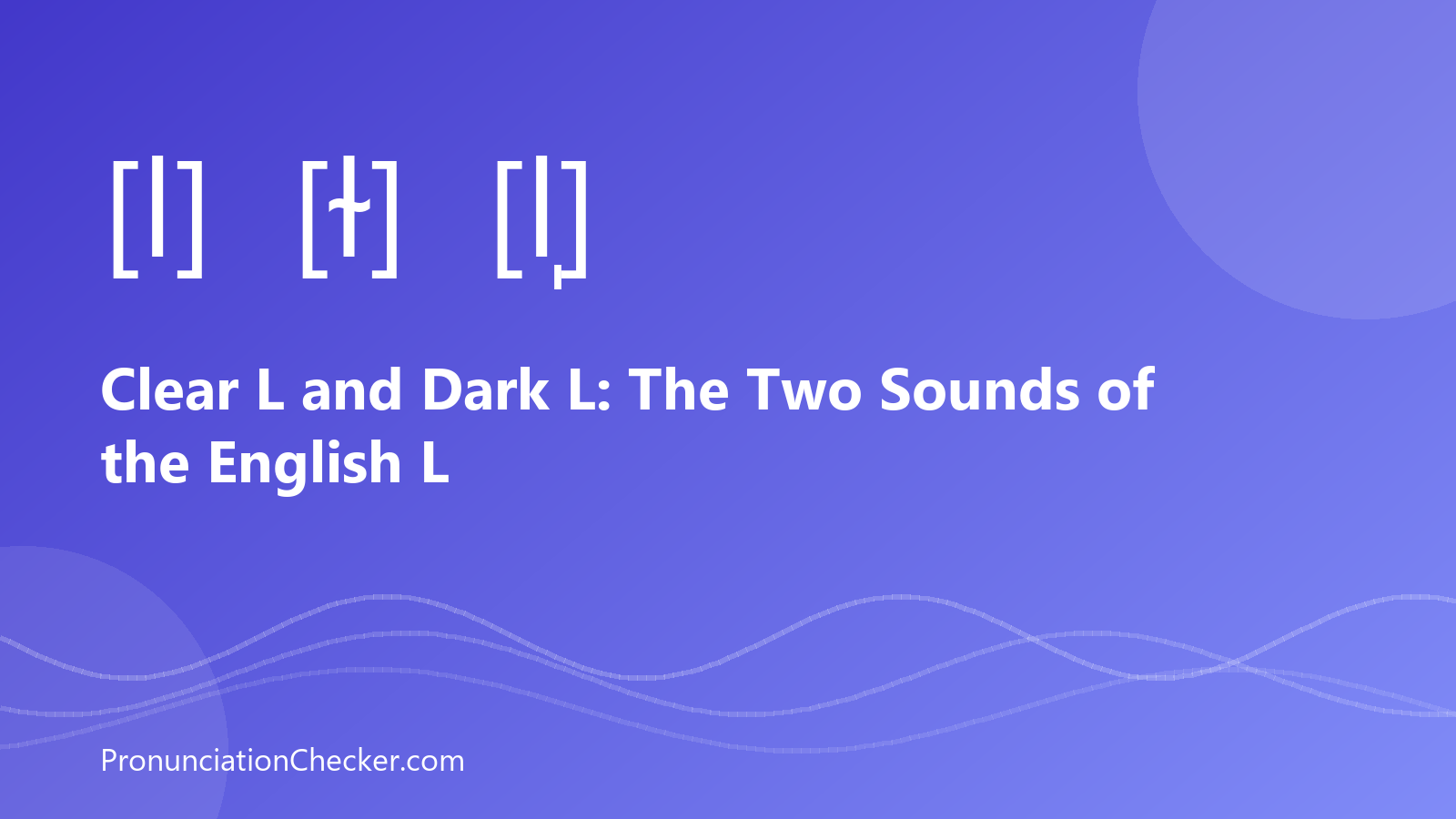
These are the two main variants of English /l/, called clear L and dark L. They are allophones of one phoneme, so using the wrong one never changes a word. But some learners replace dark L with something else entirely, a vowel or a /w/, and that can.
Where each one appears
| Clear L [l] | Dark L [ɫ] | |
|---|---|---|
| Position | Before a vowel | After a vowel, at the end of a word, or before a consonant |
| Examples | leaf, light, love, silly, hello, blue | feel, ball, milk, help, world, full |
| Tongue tip | On the ridge behind the upper teeth | On the ridge behind the upper teeth |
| Back of tongue | Relaxed, fairly low | Raised toward the soft palate |
This pattern describes Standard Southern British English. Accents differ considerably: in most American English, L is fairly dark in every position, so even leaf has a darker L than in London. In Irish English and many Welsh accents, L tends to be clear everywhere. Neither is wrong.
How to make a dark L
The tongue tip does the same thing for both. The difference is at the back of the tongue.
- Say the vowel in book, /ʊ/, and hold it. Notice that the back of your tongue is raised toward the roof of your mouth.
- Keep the back of the tongue there, and add the tongue tip touching the ridge behind your upper teeth.
- That combination is a dark L. Now say fee, and add this sound to the end: feel.
A common mistake is to forget the tongue tip, which leaves only the /ʊ/-like part: feel becomes "fee-oo" and milk becomes "mee-ook". Check in a mirror that the tip is touching the ridge at the end of ball.
When L turns into a vowel
If the tongue tip does not touch, the dark L becomes a vowel like [ʊ] or a glide like [w]. This is called L-vocalisation, and it is natural in several places:
- In London and much of south-east England, milk is often [mɪʊk] and bottle [ˈbɒʔʊ].
- In Brazilian Portuguese, every syllable-final L is [w]: Brasil is [bɾaˈziw], mal sounds like mau. Brazilians carry this into English, so Paul sounds like "Pow" and feel like "fee-oo".
- In Cantonese and Mandarin, L does not occur at the end of a syllable, so speakers often drop it or replace it with a vowel: call becomes "caw".
In native London speech, vocalised L is a recognised feature. In learner speech, it can cause confusion, because fill and fee, or bowl and bow, stop being distinct. If this describes you, the priority is simply to touch the ridge with the tongue tip at the end of the word. Getting the darkness right is secondary.
Syllabic L: bottle, little, people
In words like bottle, little, apple, people and middle, there is normally no vowel between the last consonant and the L. The L itself forms a syllable: /ˈbɒt.l̩/, with the small mark showing a syllabic consonant.
The trick is in the release. For bottle, the tongue tip is already on the ridge for /t/. Instead of lowering it and making a vowel, keep it there and let the air escape around the sides of the tongue. This is called lateral release. Learners who say "bot-tel" or "bot-tow" add a vowel that native speakers do not have.
Practise with words where the consonant before L is made in the same place: little, middle, bottle, metal, pedal, total. Then move to ones with lips or back of the tongue: apple, people, table, uncle, eagle.
The hardest combinations
Two combinations are hard even for advanced learners:
- R followed by L: world, girl, curl, Charles. The tongue has to move from the /r/ shape, tip curled or bunched, to touching the ridge, within one syllable. Say world slowly as "wer-ld", then shorten it.
- L followed by another consonant: film, help, milk, twelfth. Learners often insert a vowel ("fi-lem") or drop the L. Keep the tip on the ridge, then move straight to the next consonant.
Dark L before a vowel
When a word ending in L is followed by a word beginning with a vowel, the L usually becomes clear, because it now comes before a vowel: feel it, call us, fill up. The same happens inside words: feel has a dark L, but feeling has a clear one. This is a small detail, but using a clear L in feeling and calling makes your connected speech sound smoother.
Practice
- Pairs with L at opposite ends: leaf, feel · lip, pill · lock, call · lead, deal · lame, male
- Syllabic L: little, bottle, middle, people, apple, table, total, metal
- Sentences: Will you fill the bottle? · Paul called the whole school. · The little girl held a small doll. · I feel ill, all of a sudden.
Frequently asked questions
What is the difference between clear L and dark L?
In both, the tongue tip touches the ridge behind the upper teeth. For dark L, the back of the tongue is also raised toward the soft palate, giving a deeper, vowel-like quality. Clear L comes before vowels; dark L after them.
Is dark L necessary for a good accent?
It is not needed for intelligibility, because both variants are the same phoneme. What does matter is touching the ridge with the tongue tip, so that L is not replaced by a vowel or a /w/.
Why do Brazilians pronounce final L like W?
Because in Brazilian Portuguese, L at the end of a syllable is always pronounced [w]. English words like feel and Paul inherit that pattern. The fix is to touch the tongue tip to the ridge behind the teeth at the end of the word.
Sources and further reading
- Cruttenden, A. (2014). Gimson's Pronunciation of English (8th ed.). Routledge.
- Ladefoged, P. and Maddieson, I. (1996). The Sounds of the World's Languages. Blackwell.
- Wells, J. C. (1982). Accents of English. Cambridge University Press.
Disclosure: this page links to Preply, a tutoring marketplace. If you book a lesson through that link we may earn a commission, at no extra cost to you. It does not change what is recommended here. See our disclaimer and privacy policy.