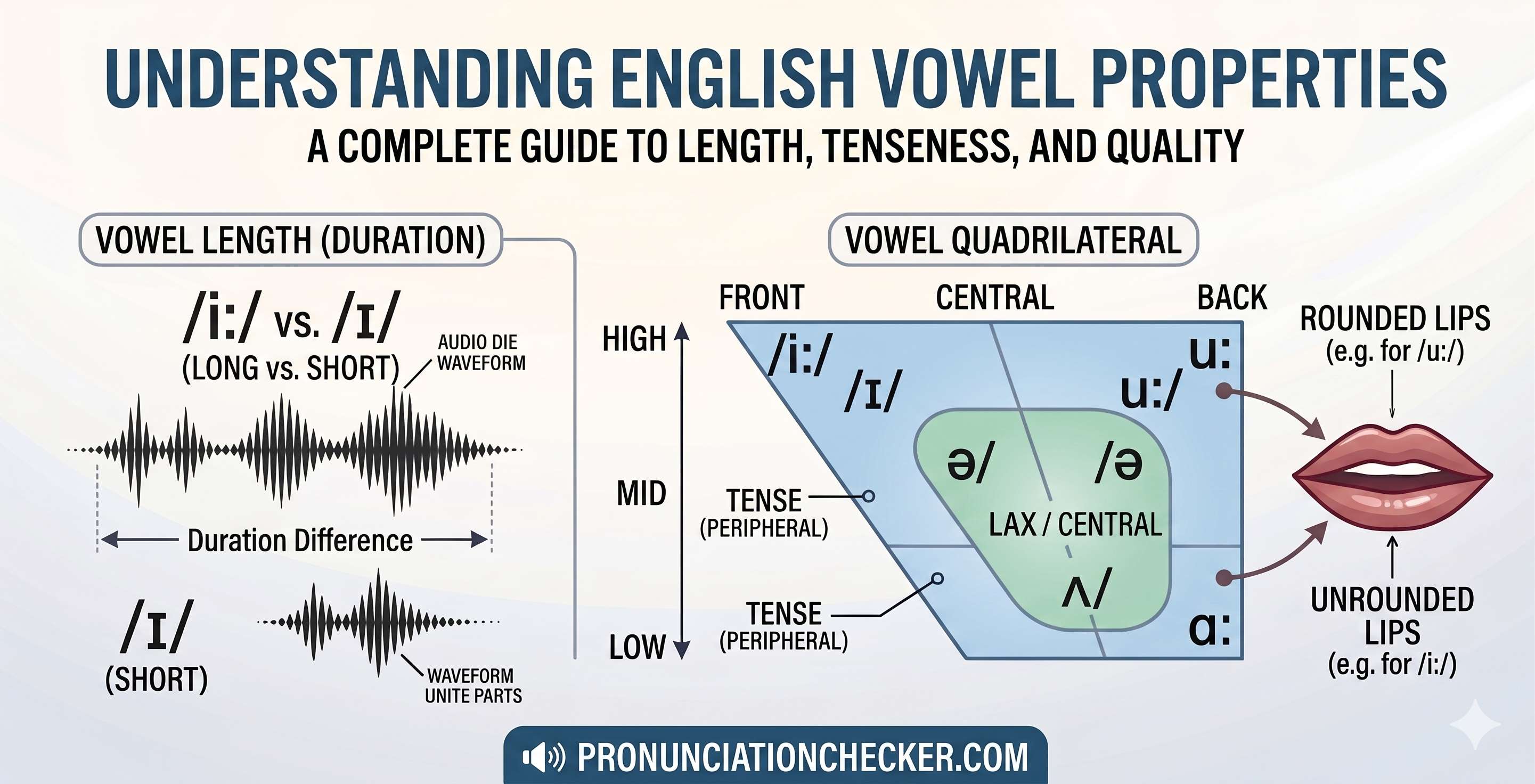
Many learners are taught that sheep has a "long e" and ship a "short i", so they practise by holding the vowel longer. It does not work, and this article explains why: English vowels differ mainly in quality, meaning where the tongue sits, with length as a secondary cue that changes with context.
Before reading on, compare these pairs aloud. In each pair, only the vowel changes:
- /iː/ and /ɪ/: beat and bit, seat and sit, leave and live, feel and fill
- /uː/ and /ʊ/: pool and pull, fool and full, Luke and look, suit and soot
- /e/ and /æ/: bed and bad, men and man, said and sad, pen and pan
If you can hear these differences but cannot produce them, the sections on tenseness and diphthongs are for you. If some pairs sound identical, start with the section on the length mark, which explains what to listen for.
What the length mark really tells you
IPA writes sheep as /ʃiːp/ and ship as /ʃɪp/. The colon-like symbol ː means long, and learners reasonably conclude that the difference is duration. That conclusion produces a persistent error: lengthening /ɪ/ does not turn it into /iː/. It produces a long /ɪ/, which native listeners still hear as ship.
The symbols differ for a reason. /iː/ and /ɪ/ are written with different letters because they are different vowels, articulated in different places. The length mark records a tendency, not the defining property.
The decisive evidence. English shortens vowels before voiceless consonants. Measure the vowel in beat and the vowel in bid: the so-called long vowel in beat is physically shorter. Native listeners nonetheless identify both words correctly every time, which is only possible if quality rather than duration is doing the work.
Tense and lax: the description that works
The more useful distinction is between tense and lax vowels. Tense vowels are produced with greater muscular effort, the tongue moves further from the centre of the mouth, and they can end a stressed syllable on their own. Lax vowels are relaxed, more central, and cannot stand alone at the end of a stressed syllable.
| Tense | Lax | Pair | Position difference |
|---|---|---|---|
/iː/ sheep | /ɪ/ ship | high front | Lax is lower and more central |
/uː/ fool | /ʊ/ full | high back | Lax is lower, less rounded |
/eɪ/ late | /e/ let | mid front | Tense is a diphthong |
/oʊ/ coat | /ɔː/ caught | mid back | Tense is a diphthong |
/ɑː/ calm | /ʌ/ cup | low central | Lax is higher and shorter |
A structural test confirms the pattern: no English word ends in a stressed lax vowel. You can say see, too, day, go, car. You cannot end a word with the vowels of ship, full, let or cup. That restriction is a property of laxness, and it has nothing to do with duration.
Pre-fortis clipping, and how to use it
Every English vowel shortens before a voiceless consonant. The effect is large — often 30 to 50 per cent — and English listeners use it in reverse, inferring the identity of the final consonant from the length of the vowel.
| Short vowel | Long vowel | Same vowel phoneme |
|---|---|---|
| beat | bead | /iː/ |
| cart | card | /ɑː/ |
| rice | rise | /aɪ/ |
| safe | save | /eɪ/ |
| back | bag | /æ/ |
This gives you a practical technique for final consonants: instead of struggling to voice a final /d/ or /z/, lengthen the vowel in front of it. The listener will supply the voicing.
Diphthongs are movements, not positions
English has a set of vowels in which the tongue moves during the sound. The movement itself is the identity of the vowel, and producing a steady position instead is one of the clearest markers of a foreign accent — particularly for speakers of Spanish, Italian, Japanese and Korean, whose corresponding vowels are steady.
/eɪ/day, make, rain — starts near/e/, glides towards/ɪ//aɪ/time, buy, height — the widest movement in English, from low central to high front/ɔɪ/boy, coin, voice/aʊ/now, house, loud/oʊ/go, home, boat — this is why go does not rhyme with a pure Spanish o
A useful drill: say each diphthong slowly enough to feel the tongue travel, then compress it to normal speed while keeping the movement intact. Learners typically lose the second half first, so check the endpoint rather than the start.
Testing whether you have it
- The endless vowel. Hold
/iː/for five seconds, then/ɪ/for five seconds. If they sound the same at equal length, you are producing one vowel with two durations. This is the diagnostic that matters. - The word-final test. Try to say each lax vowel alone as a complete word. It should feel unnatural. If it feels comfortable, you are probably producing the tense vowel.
- Clipping pairs. Alternate beat / bead, rice / rise, safe / save, back / bag, deliberately doubling the vowel on the second item.
- Diphthong endpoints. Record day, time, boy, now, go and check that each ends somewhere different from where it started.
Frequently asked questions
Does the length mark in IPA mean I should hold the vowel longer?
Only partly, and relying on it causes errors. The vowels written /iː/ and /ɪ/ use different symbols because they are articulated in different places: /iː/ is tense with the tongue high and forward, /ɪ/ is lax with the tongue lower and more central. Lengthening /ɪ/ produces a long /ɪ/, not /iː/. The length mark records a tendency rather than the defining property.
What does tense and lax mean for English vowels?
Tense vowels are made with greater muscular effort and the tongue further from the centre of the mouth, and they can end a stressed syllable alone — see, too, day, go. Lax vowels are relaxed and more central, and no English word ends in a stressed lax vowel, which is why you cannot end a word with the vowel of ship, full, let or cup. That structural restriction is a property of laxness, not of duration.
What is pre-fortis clipping?
The shortening of a vowel before a voiceless consonant, which in English is substantial — often 30 to 50 per cent. The vowel in beat is shorter than the vowel in bead even though both are the same phoneme. Listeners use this in reverse to identify the final consonant, which is why lengthening the vowel is more effective than forcing voicing on a final /d/ or /z/.
Why do my diphthongs sound wrong?
Most likely because you are producing a steady tongue position rather than a movement. In English the movement is the identity of the vowel: /aɪ/ in time travels from low central to high front, and /oʊ/ in go does not stay where a pure Spanish or Italian o would. Learners usually lose the second half of the glide first, so check where each diphthong ends rather than where it begins.
Disclosure: this page links to Preply, a tutoring marketplace. If you book a lesson through that link we may earn a commission, at no extra cost to you. It does not change what is recommended here. See our disclaimer and privacy policy.
Test whether you hear the difference
Click the tense and lax vowel symbols one after another and listen for the change in quality.
Start ear training