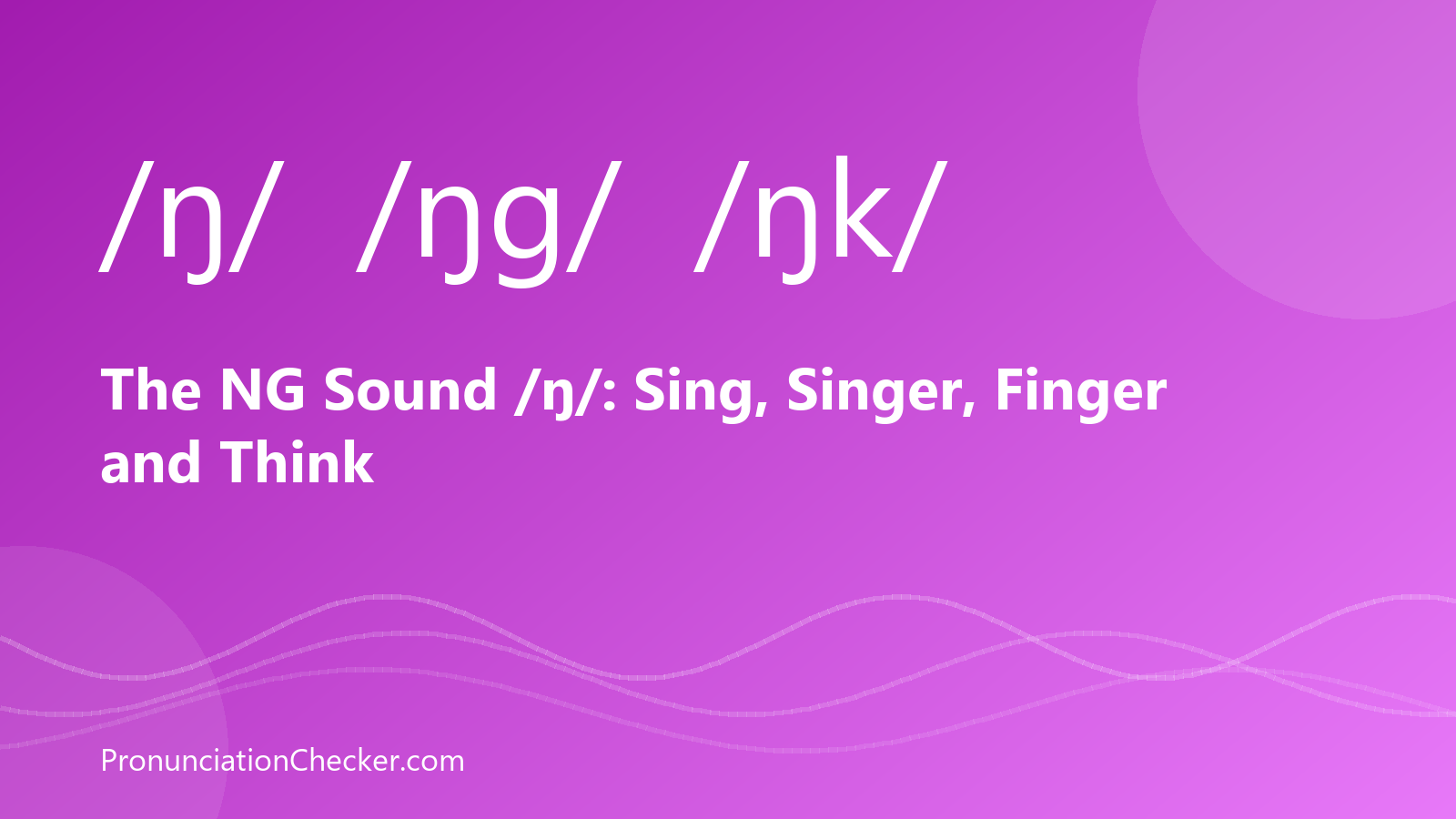
The sound at the end of sing is a single consonant, not an /n/ followed by a /g/. Its symbol is /ŋ/, and it is made at the back of the mouth, where /k/ and /g/ are made, with the air going out through the nose.
Most languages have this sound somewhere, often before /k/ or /g/ (Spanish tengo, German Bank). What makes English different is that /ŋ/ can end a word on its own. Learners tend to do one of two things: replace it with /n/, so thing sounds like thin, or add a /g/ after it, so sing sounds like "sing-g".
How to make /ŋ/
- Say ga. Notice where the back of your tongue touches the roof of your mouth.
- Put the tongue there again and hold it. Now hum. The air goes out through your nose. That is /ŋ/.
- Check: pinch your nose while humming. The sound should stop completely, because a nasal consonant needs the nose open.
- Compare with /n/: say sin and sing. For sin the tip of the tongue is up; for sing the tip is down and the back is up.
Where it appears in spelling
- ng: sing, long, thing, bring, young, running
- n before k or c: think /θɪŋk/, bank, uncle /ˈʌŋ.kəl/, anxious /ˈæŋk.ʃəs/
- n before g: finger /ˈfɪŋ.ɡə/, anger, English /ˈɪŋ.ɡlɪʃ/, language /ˈlæŋ.ɡwɪdʒ/
- n before x: anxiety /æŋˈzaɪ.ə.ti/, where /ŋ/ comes before /z/
The singer and finger rule
The spelling ng is pronounced /ŋ/ in some words and /ŋɡ/ in others. In most accents, the rule is:
| Pronunciation | When | Examples |
|---|---|---|
| /ŋ/ alone | At the end of a word, and when a suffix is added to such a word | sing, singer, singing · long, longing · hang, hanger · bring, bringing |
| /ŋɡ/ | In the middle of a single, indivisible word | finger, anger, hungry, England, single, jungle, language |
| /ŋɡ/ (exception) | Comparatives and superlatives of long, strong, young | longer, strongest, younger |
In other words: if you can remove the ending and still have a word ending in -ng, there is no /g/. Singer is sing + -er, so /ˈsɪŋ.ə/. Finger cannot be split that way, so /ˈfɪŋ.ɡə/. The three adjectives long, strong, young are the only common exceptions.
In parts of north-west England and the English Midlands, including Liverpool, Manchester and Birmingham, many speakers pronounce the /g/ everywhere: sing is [sɪŋɡ] and singer rhymes with finger. This is a regional feature, not a mistake, but it is not the standard pattern.
Mistake 1: /n/ instead of /ŋ/
If your first language has /ŋ/ only before /k/ and /g/, you may replace word-final /ŋ/ with /n/. Many pairs then collapse:
| /n/ | /ŋ/ |
|---|---|
| sin | sing |
| thin | thing |
| win | wing |
| ran | rang |
| ban | bang |
| kin | king |
| sun | sung |
| ton | tongue |
The fix is to keep the tip of the tongue down, behind the lower front teeth, for the whole of /ŋ/. Only the back of the tongue moves.
Mistake 2: adding /g/ or /k/
If your language has /ŋ/ only as part of /ŋɡ/ or /ŋk/, you may add a stop after it: sing as "sing-g" or thing as "think". The second one matters, because it creates a different word:
| /ŋ/ | /ŋk/ |
|---|---|
| thing | think |
| sing | sink |
| rang | rank |
| wing | wink |
| bang | bank |
| sung | sunk |
The fix: at the end of sing, release the tongue slowly while the humming continues, without any burst of air. A /k/ or /g/ has a small explosion when the tongue releases; /ŋ/ does not.
The -ing ending
Every -ing ending has /ŋ/ in careful speech: running /ˈrʌn.ɪŋ/. In relaxed speech, in every accent, it is often /ɪn/: runnin', goin', somethin'. This is not a learner error; native speakers of all backgrounds do it in casual conversation. Learners should use /ɪŋ/ by default, but should not be confused when they hear /ɪn/.
Linking /ŋ/ to a following vowel
When a word ending in /ŋ/ is followed by a vowel, the /ŋ/ links forward without adding /g/: sing a song is [sɪ.ŋə.sɒŋ], bring it is [brɪ.ŋɪt], long ago is [lɒ.ŋə.ɡəʊ]. Learners who add /g/ here are especially noticeable, because the /g/ is fully audible before the vowel.
Practice
- Hum /ŋ/ for three seconds, pinch your nose to check, then release without a burst.
- Read the two pair tables aloud, recording yourself.
- Sentences: The singer is bringing something long. · The king sang a song in English. · I think the young thing is hungry. · Hang the sign on the long wall.
Frequently asked questions
Is there a G sound in sing?
Not in standard British or American English. Sing ends in the single nasal /ŋ/. Some speakers from north-west England and the Midlands do pronounce a /g/, but that is a regional feature.
Why is there a G in finger but not in singer?
Singer is formed from sing plus -er, so it keeps the /ŋ/ of sing. Finger is a single word that cannot be split, and in such words ng is /ŋɡ/. Longer, stronger and younger are the main exceptions.
Is it wrong to say goin' instead of going?
It is normal in relaxed speech in every English accent. In careful or formal speech, most speakers use /ɪŋ/. Learners should default to /ɪŋ/.
Sources and further reading
- Roach, P. (2009). English Phonetics and Phonology (4th ed.). Cambridge University Press.
- Wells, J. C. (1982). Accents of English, vol. 2 (on NG coalescence). Cambridge University Press.
- Cruttenden, A. (2014). Gimson's Pronunciation of English (8th ed.). Routledge.
Disclosure: this page links to Preply, a tutoring marketplace. If you book a lesson through that link we may earn a commission, at no extra cost to you. It does not change what is recommended here. See our disclaimer and privacy policy.
Test sin and sing
Say the pairs from this guide to the speech quiz and see which word it recognises.
Open the pronunciation quiz