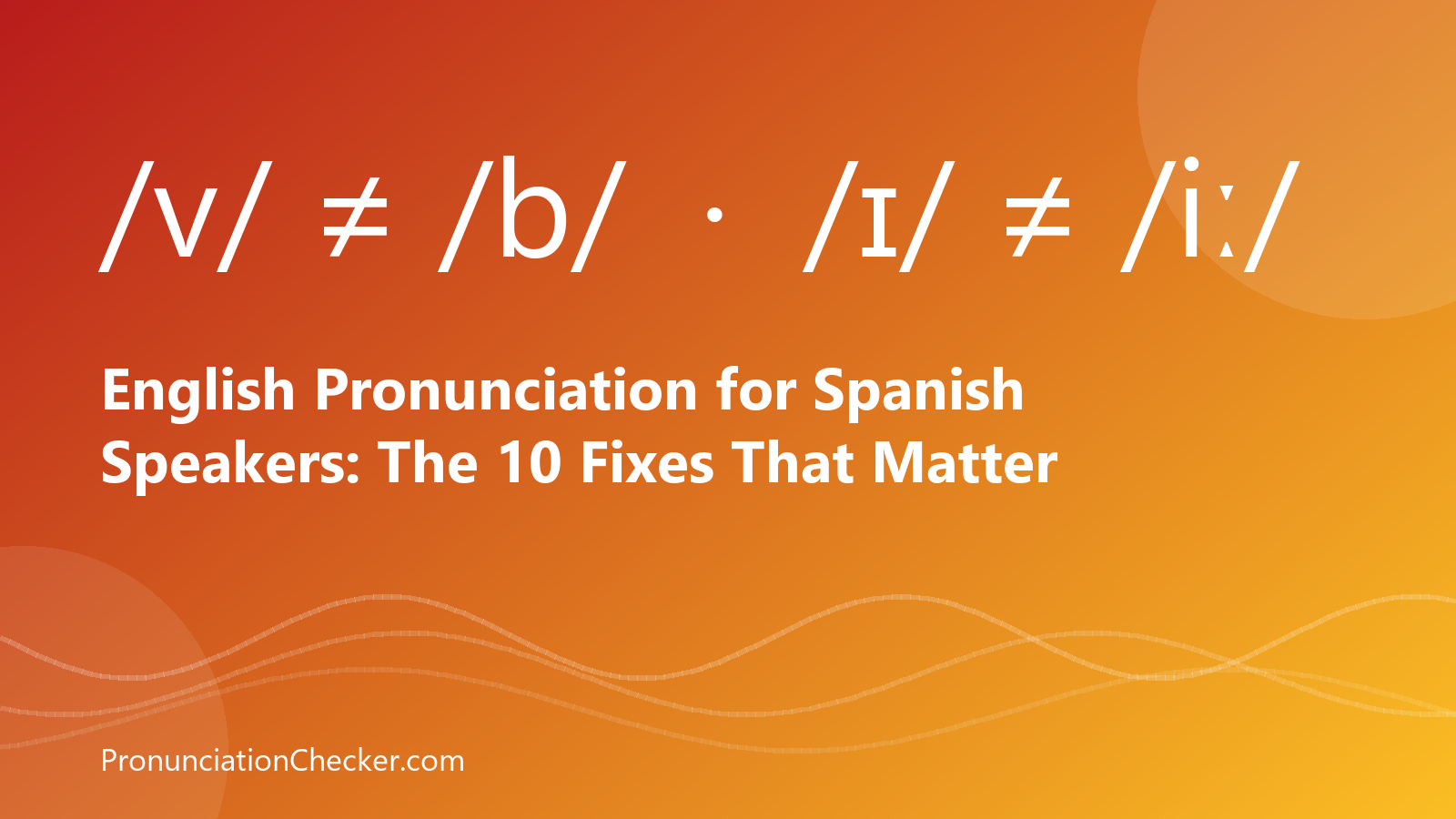
Spanish has five vowels, a mostly regular spelling system and a steady syllable-by-syllable rhythm. English has around twelve vowels plus diphthongs, highly irregular spelling, and a rhythm built on stress. Almost every difficulty Spanish speakers have with English pronunciation comes from one of these three differences.
The ten issues below are ordered by how much they affect intelligibility, starting with the ones most likely to cause a real misunderstanding. Notes on regional differences within the Spanish-speaking world are included where they matter.
1. Five vowels for twelve
Spanish has /a e i o u/. English uses its vowels to distinguish thousands of words that Spanish would pronounce identically. The most important pairs:
| Contrast | Pairs | Typical Spanish result |
|---|---|---|
| /iː/ and /ɪ/ | sheep, ship · leave, live · feet, fit | both [i] |
| /uː/ and /ʊ/ | pool, pull · fool, full · Luke, look | both [u] |
| /æ/, /ʌ/, /ɑ/ | cat, cut, cot · hat, hut, hot | all close to [a] |
| /e/ and /æ/ | bed, bad · men, man | both [e] |
| /ɜː/ (UK), /ɝ/ (US) | bird, word, work, girl | [e] or [o] + r |
Start with /iː/ and /ɪ/, because they occur in so many common words. /ɪ/ is shorter and more relaxed than Spanish [i]; the tongue drops toward the position of Spanish [e]. The short vowel minimal pairs guide has drills.
2. No schwa, no reduction
Spanish pronounces every vowel with its full quality, stressed or not. English reduces most unstressed vowels to schwa, /ə/. A Spanish speaker who says banana with three clear [a] vowels, or chocolate with four syllables, sounds very foreign, and the lack of reduction also flattens English rhythm. See the schwa guide.
3. Syllable-timed rhythm
Spanish gives each syllable roughly equal time. English squeezes unstressed syllables between stressed ones. Spoken with Spanish rhythm, "I want to go to the shop" has eight even beats; in English it has three strong ones. This is the single biggest contributor to a Spanish accent, and it is covered in syllable timing vs stress timing.
4. "Espeak" and "estudent"
Spanish does not allow /s/ + consonant at the start of a word, which is why España and escuela begin with e. Speakers add that vowel to English: speak becomes "espeak", student "estudent", Spain "Espain". It adds a syllable and can create confusion (eschool for school). Practise by starting with a long hiss, sssss-peak, and gradually shortening it.
5. B and V
Spanish writes both letters but pronounces them the same: [b] at the start of a phrase, a soft [β] between vowels. English /v/ is made with the upper teeth on the lower lip. Without it, very sounds like berry, vest like best and vote like boat. Check in a mirror that your teeth touch your lip for every V.
6. P, T and K without a puff of air
Spanish /p t k/ are unaspirated. English /p t k/ at the start of a stressed syllable have a puff of air after them. Without it, English listeners often hear /b d g/: pig as big, time as dime, coat as goat. Hold a sheet of paper in front of your mouth and say pie: the paper should move. It should not move for buy.
7. SH, Y and J
Most varieties of Spanish have no /ʃ/, so she becomes "chee", shoes becomes choose, and wash becomes watch. Many speakers also confuse /j/ and /dʒ/: yes as "jes", job as "yob", year as "jeer". The exception is Rioplatense Spanish (Argentina, Uruguay), where ll and y are often pronounced [ʃ] or [ʒ], so speakers from there usually find English /ʃ/ easy. See the SH, CH and J guide.
8. Z and final consonants
Spanish has no /z/ except as a variant before voiced consonants. English /z/ is very common, especially in endings: is, was, dogs, plays, rise. Spanish speakers use /s/: zoo sounds like "soo", rise like rice. At the end of a word, the most practical fix is to lengthen the vowel before the /z/, as explained in -s endings.
Spanish also allows only a few consonants at the end of a word (mainly /s n l r d/), so English clusters are often simplified: first as "firs", asked as "ask", texts as "tex". This removes grammar, so it matters.
9. TH and D
Speakers from most of Spain already have /θ/, the sound of z and c in zapato and cielo, so English think is easy for them. Latin American speakers usually substitute /s/ or /t/. Everyone has [ð], but only as a soft variant of /d/ between vowels (nada is [ˈnaða]). This creates a curious double problem: they is pronounced with a hard [d], as "day", while lady is pronounced with a soft [ð], as "lathy". In English, /d/ is always a full stop, and /ð/ is always a separate sound.
10. H and R
Spanish j is [x], a rough sound at the back of the mouth. Many speakers use it for English /h/, which is much lighter: just breath, like fogging a mirror. Hello with a Spanish jota sounds harsh. The English /r/ also differs from both Spanish R sounds: it is not tapped or trilled, and the tongue does not touch the roof of the mouth. The Spanish tap does happen to match the American T in water and better, which Spanish speakers can use to their advantage.
Where to start
If you only work on three things, work on these: word and sentence stress with vowel reduction (issues 2 and 3), the /iː/ and /ɪ/ contrast (issue 1), and final consonants and endings (issue 8). Together they account for most of the misunderstandings that Spanish speakers experience in English.
Frequently asked questions
Why do Spanish speakers say "espeak"?
Because Spanish words cannot begin with /s/ plus another consonant, so Spanish adds an e (España, escuela). Speakers carry that pattern into English. Start with a long hissing /s/ and shorten it gradually.
Is B and V the same in English?
No. English /b/ is made with both lips; /v/ with the upper teeth on the lower lip. Confusing them turns very into berry and vote into boat.
Which Spanish speakers find English easiest to pronounce?
It varies by sound. Speakers from most of Spain already have /θ/ for think. Speakers from Argentina and Uruguay usually find /ʃ/ easy. Every Spanish speaker has the American flap T, which is the Spanish single r.
Sources and further reading
- Martínez-Celdrán, E., Fernández-Planas, A. M. and Carrera-Sabaté, J. (2003). Castilian Spanish. Journal of the International Phonetic Association, 33(2), 255–259.
- Swan, M. and Smith, B. (eds.) (2001). Learner English: A Teacher's Guide to Interference and Other Problems (2nd ed.). Cambridge University Press.
- Hualde, J. I. (2005). The Sounds of Spanish. Cambridge University Press.
Disclosure: this page links to Preply, a tutoring marketplace. If you book a lesson through that link we may earn a commission, at no extra cost to you. It does not change what is recommended here. See our disclaimer and privacy policy.
Get feedback on your English rhythm
Say a sentence and see, word by word, what the speech recogniser understood.
Open the accent coach