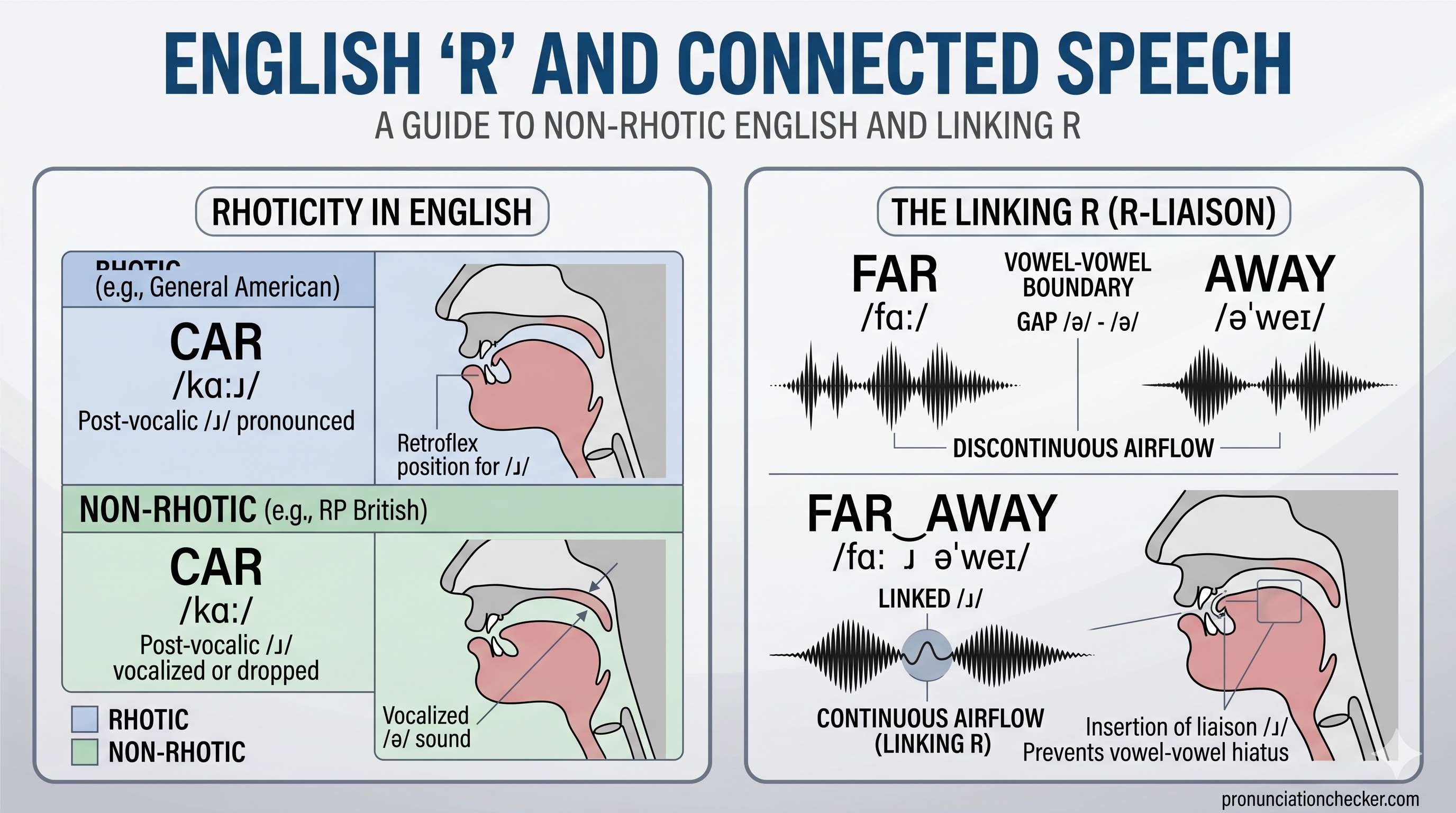
Listen to a speaker from London say far, then far away. In the first there is no /r/ at all; in the second it comes back. Now listen to law and order: many of the same speakers say "law-r-and order", with an /r/ that is not in the spelling.
These two habits, linking R and intrusive R, are what make non-rhotic English sound connected rather than choppy, and textbooks rarely mention them. This article explains the rhotic and non-rhotic split, the rules for when the /r/ reappears, and what to do if you prefer the American, rhotic pattern.
The single biggest split in English accents
Whether the letter r is pronounced at the end of a syllable divides English accents more sharply than any other feature, and choosing a side is one of the first decisions a learner should make consciously rather than by accident.
| Rhotic | Non-rhotic | |
|---|---|---|
| Accents | Most of the United States, Canada, Ireland, Scotland, parts of southwest England | Southern England (RP), Australia, New Zealand, South Africa, parts of the eastern US |
| car | /kɑːr/ | /kɑː/ |
| bird | /bɜːrd/ | /bɜːd/ |
| teacher | /ˈtiːtʃər/ | /ˈtiːtʃə/ |
| hard | /hɑːrd/ | /hɑːd/ |
Note what is not different: an r before a vowel is pronounced in every accent. Red, around, very, three all keep their /r/ everywhere. The split concerns only r at the end of a syllable.
Pick one and be consistent. Mixing the two systems is more noticeable than either one alone, because listeners cannot form a stable expectation of your accent. Choose based on where you live, work or study, or on the accent you hear most often — both are fully standard and neither is more correct.
Linking R: the rule that surprises learners
Non-rhotic speakers do not simply delete every syllable-final r. When the next word begins with a vowel, the /r/ comes back. This is linking R, and it applies automatically across a word boundary.
- my car — no
/r/| my car is red —/r/pronounced - far — no
/r/| far away —/r/pronounced - four — no
/r/| four apples —/r/pronounced - better — no
/r/| better idea —/r/pronounced - here — no
/r/| here it is —/r/pronounced
Learners who have decided to use a British accent frequently delete the /r/ everywhere, including before vowels. The result is not a British accent; it is a pattern no native speaker uses, and it also breaks the linking that English relies on to connect words smoothly.
Intrusive R: the one that is not in the spelling
Non-rhotic speakers extend the linking pattern to places where no r is written at all, inserting one between two vowels to avoid a hiatus.
- law and order → law-r-and order
- the idea of it → the idea-r-of it
- drama and comedy → drama-r-and comedy
- Africa and Asia → Africa-r-and Asia
- saw it → saw-r-it
Some speakers consider intrusive R incorrect, and it is occasionally criticised in style guides, but it is produced by the great majority of non-rhotic speakers including newsreaders and is best understood as a regular feature of the accent rather than an error. As a learner you do not need to produce it, but you should expect to hear it.
If you choose a rhotic accent
American English does not usually append a separate /r/ consonant to the vowel. Instead the vowel itself is produced with the tongue in the /r/ position throughout, giving what is called an r-coloured vowel, transcribed /ɚ/ or /ɝ/.
In bird /bɝd/ there is no separate vowel followed by an r. There is one continuous r-coloured sound. Learners who produce a clear vowel and then add an /r/ — buh-erd — sound noticeably non-native even when both components are individually accurate.
Practise by holding a single steady /ɝ/ for three seconds and then wrapping consonants around it: ɝɝɝ → bɝɝɝ → bɝd. Apply the same approach to word, world, heard, learn, girl, work, first, nurse, turn, church, hurt, search.
A common difficulty for Mandarin speakers
Mandarin has a retroflex approximant, but it does not occur at the end of a syllable, so learners often delete the /r/ in car, more, four, hard, work while producing it correctly in red and around. If that describes you, the result is effectively a partial non-rhotic accent applied inconsistently. Decide which system you want, and if you choose rhotic, concentrate practice entirely on the final and pre-consonantal positions, since the initial position is already correct.
Frequently asked questions
What does rhotic mean?
A rhotic accent pronounces the letter r at the end of a syllable, so car, bird and teacher all contain an audible /r/. Most of the United States, Canada, Ireland and Scotland are rhotic. Non-rhotic accents, including southern England, Australia and New Zealand, drop it in that position. An r before a vowel, as in red, around and very, is pronounced in every accent.
If I use a British accent, do I drop every R?
No, and this is where learners most often go wrong. Non-rhotic speakers restore the /r/ whenever the next word begins with a vowel. My car has no /r/, but my car is red does. Deleting it everywhere produces a pattern no native speaker uses and also breaks the linking that connects words in fluent English.
What is intrusive R?
It is an /r/ inserted between two vowels where none is written, as in law-r-and order, the idea-r-of it, or drama-r-and comedy. Non-rhotic speakers produce it to avoid two vowels meeting directly. Some style guides criticise it, but the great majority of non-rhotic speakers use it, including broadcasters. You do not need to produce it, but you should expect to hear it.
How do I pronounce the R in American words like bird and work?
Not as a vowel followed by a separate r consonant. American English uses an r-coloured vowel, transcribed /ɝ/, where the tongue stays in the r position throughout the whole vowel. Saying buh-erd with two distinct parts sounds noticeably non-native. Practise by holding one steady /ɝ/ for three seconds and then adding consonants around it.
Disclosure: this page links to Preply, a tutoring marketplace. If you book a lesson through that link we may earn a commission, at no extra cost to you. It does not change what is recommended here. See our disclaimer and privacy policy.
See where the R disappears
Transcribe a sentence in British and American IPA and compare where /r/ is written.
Open the IPA converter