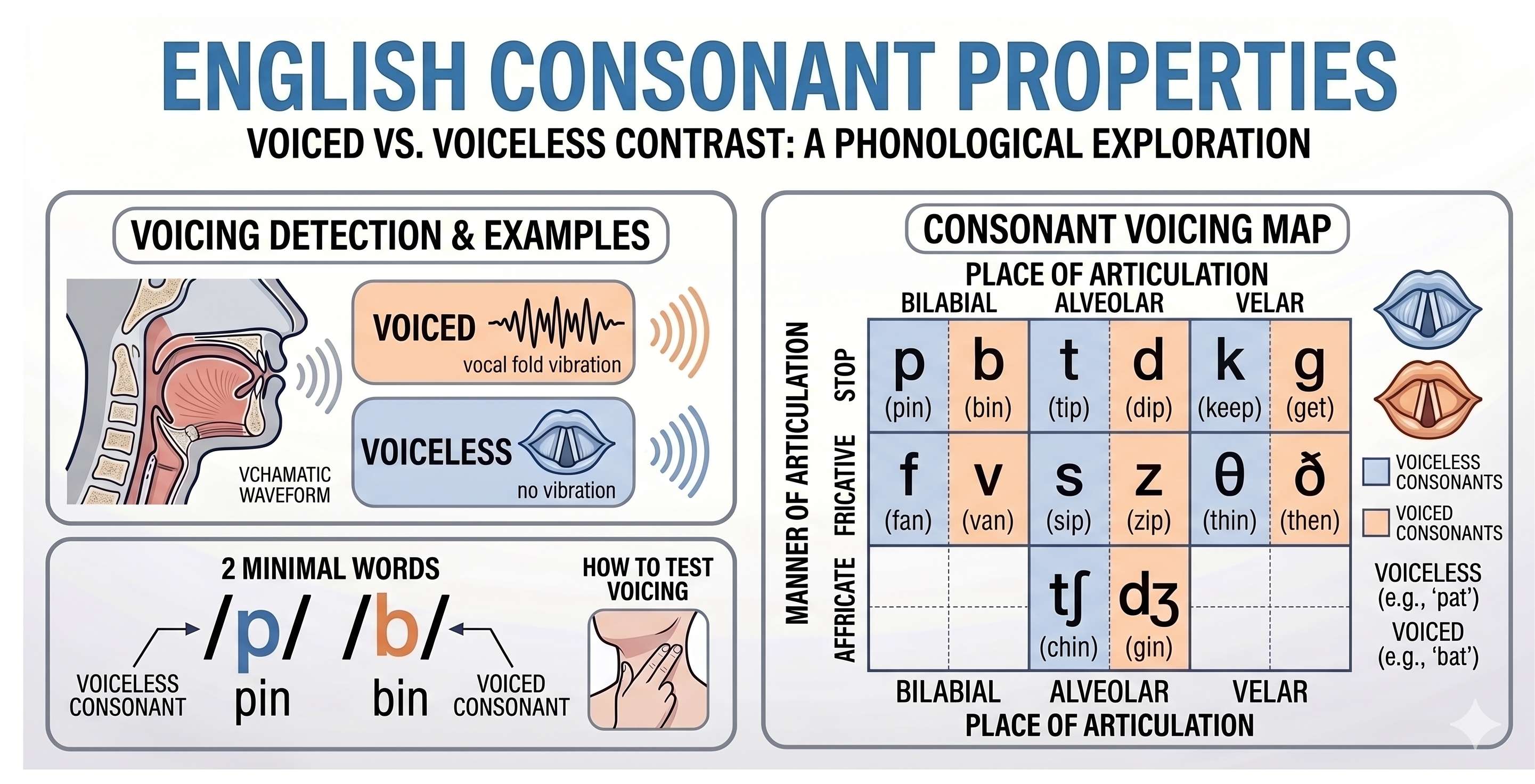
English has eight pairs of consonants that are said to differ only in voicing: /p b/, /t d/, /k ɡ/, /f v/, /θ ð/, /s z/, /ʃ ʒ/ and /tʃ dʒ/. Put your fingers on your throat and say a long /sss/, then a long /zzz/. The buzz you feel on /z/ is voicing.
That test is a good start, but it misses how English listeners actually tell these sounds apart in running speech: by aspiration at the start of a word and by vowel length at the end of one. Voicing also matters for grammar, because the -s and -ed endings change depending on the sound before them. The sections below go through each of these.
Start with the test, then learn why it is incomplete
Place two fingers on your throat over the larynx. Say a long sssss, then a long zzzzz without stopping. The buzz you feel on the second is vocal fold vibration, and that is the textbook definition of voicing. English has eight pairs that differ in this way and nothing else:
| Voiceless | Voiced | Example pair |
|---|---|---|
/p/ | /b/ | pat / bat |
/t/ | /d/ | ten / den |
/k/ | /ɡ/ | coat / goat |
/f/ | /v/ | fan / van |
/θ/ | /ð/ | thigh / thy |
/s/ | /z/ | sip / zip |
/ʃ/ | /ʒ/ | pressure / pleasure |
/tʃ/ | /dʒ/ | rich / ridge |
Now the complication that explains why the throat test does not solve the problem in practice: English signals this contrast differently depending on where the consonant sits in the word, and in two of the three positions actual vocal fold vibration is not the main cue at all.
One contrast, three different mechanisms
| Position | What really distinguishes them | Example |
|---|---|---|
| Start of a stressed syllable | Aspiration. /p t k/ carry a puff of breath; /b d ɡ/ do not and are often barely voiced. | pin [pʰɪn] vs bin [bɪn] |
After /s/ | Nothing — the contrast is neutralised. /p t k/ lose their aspiration entirely. | spin, stop, skin |
| End of a word | Length of the preceding vowel. The final consonant is often devoiced or unreleased. | bat (short) vs bad (long) |
Why this matters more than any drill. A learner who works hard at buzzing final consonants will still be misheard, because English listeners are mostly measuring the vowel. A learner who lengthens the vowel in bad, leave and dog will be understood even if the final consonant is completely devoiced — which is what many native speakers produce anyway.
If your first language devoices final consonants
German, Dutch, Russian, Polish, Turkish and Catalan all devoice obstruents at the end of a word. Speakers of these languages produce bad as bat, dog as dock, have as haff. The instinctive correction is to push harder on the final consonant, which produces an unnatural, over-articulated ending.
The effective correction is to leave the consonant alone and stretch the vowel. Practise these pairs while deliberately doubling the vowel length on the second item: bat / bad, set / said, back / bag, rope / robe, leaf / leave, rice / rise, lock / log, cart / card, bus / buzz, place / plays.
Where voicing becomes a grammar problem
English decides the pronunciation of two of its most common grammatical endings by the voicing of the sound in front of them. These are not exceptions to memorise; they are automatic assimilation rules, and once you can classify the preceding sound they apply without thought.
The -s ending (plurals, third person singular, possessives):
- After a sibilant —
/s z ʃ ʒ tʃ dʒ/— add a syllable:/ɪz/. buses, watches, judges, wishes, roses. - After any other voiceless sound:
/s/. cats, books, laughs, months, stops. - After any other voiced sound, including all vowels:
/z/. dogs, cars, rooms, plays, knives, keys.
The -ed ending (past and past participle):
- After
/t/or/d/: add a syllable,/ɪd/. wanted, needed, decided, started. - After any other voiceless sound:
/t/. walked, stopped, laughed, washed, passed. - After any other voiced sound:
/d/. played, called, opened, lived, moved.
Note that walked is one syllable, not two. Adding a vowel there — walk-ed — is one of the most recognisable learner errors in English, and it comes from reading the spelling rather than applying the rule.
A compact practice routine
- Aspiration check (2 min). Paper in front of the lips: pin, tin, kin must move it; bin, din, gin must not.
- Neutralisation check (2 min). Say spin, stop, skin. The paper should stay still. Hearing that the
/p/of spin is not the/p/of pin is what retunes your ear. - Vowel length (4 min). Ten final pairs, deliberately doubling the vowel on the voiced item.
- Endings (4 min). Read a short paragraph in the past tense aloud and mark every -ed with
/t/,/d/or/ɪd/before you read it again at speed.
Frequently asked questions
How do I tell whether a consonant is voiced?
Put two fingers on your throat over the larynx and produce the sound continuously. A long zzzzz vibrates under your fingers; a long sssss does not. English has eight pairs that differ only in this way: p/b, t/d, k/g, f/v, θ/ð, s/z, ʃ/ʒ and tʃ/dʒ. The test works well for fricatives held in isolation but is less informative inside real words, where other cues carry the contrast.
Why does buzzing the final consonant not make bad sound different from bat?
Because English listeners mainly use the length of the vowel in front of the consonant, not the consonant itself. Final consonants are frequently devoiced or unreleased even in native speech. Lengthening the vowel in bad, leave and dog is far more effective than forcing vibration on the final consonant, and it also sounds more natural.
What is the rule for pronouncing the -ed ending?
Three cases. After /t/ or /d/ it adds a syllable and is pronounced /ɪd/, as in wanted and needed. After any other voiceless sound it is /t/, as in walked, stopped and laughed. After any other voiced sound it is /d/, as in played, called and lived. Walked is one syllable, not two — pronouncing it walk-ed is a common error that comes from reading the spelling instead of applying the rule.
Why does the p in spin sound like a b?
English aspirates /p t k/ at the beginning of a stressed syllable but not after /s/, so the contrast is neutralised in that position and the p of spin is acoustically close to a b. This is a regular feature of the language rather than an exception, and noticing it is a useful sign that you are hearing aspiration, which is the real cue in initial position, rather than voicing.
Disclosure: this page links to Preply, a tutoring marketplace. If you book a lesson through that link we may earn a commission, at no extra cost to you. It does not change what is recommended here. See our disclaimer and privacy policy.
Check your voicing
Say pairs like cap and cab or rice and rise and see which word the quiz recognises.
Open the pronunciation quiz