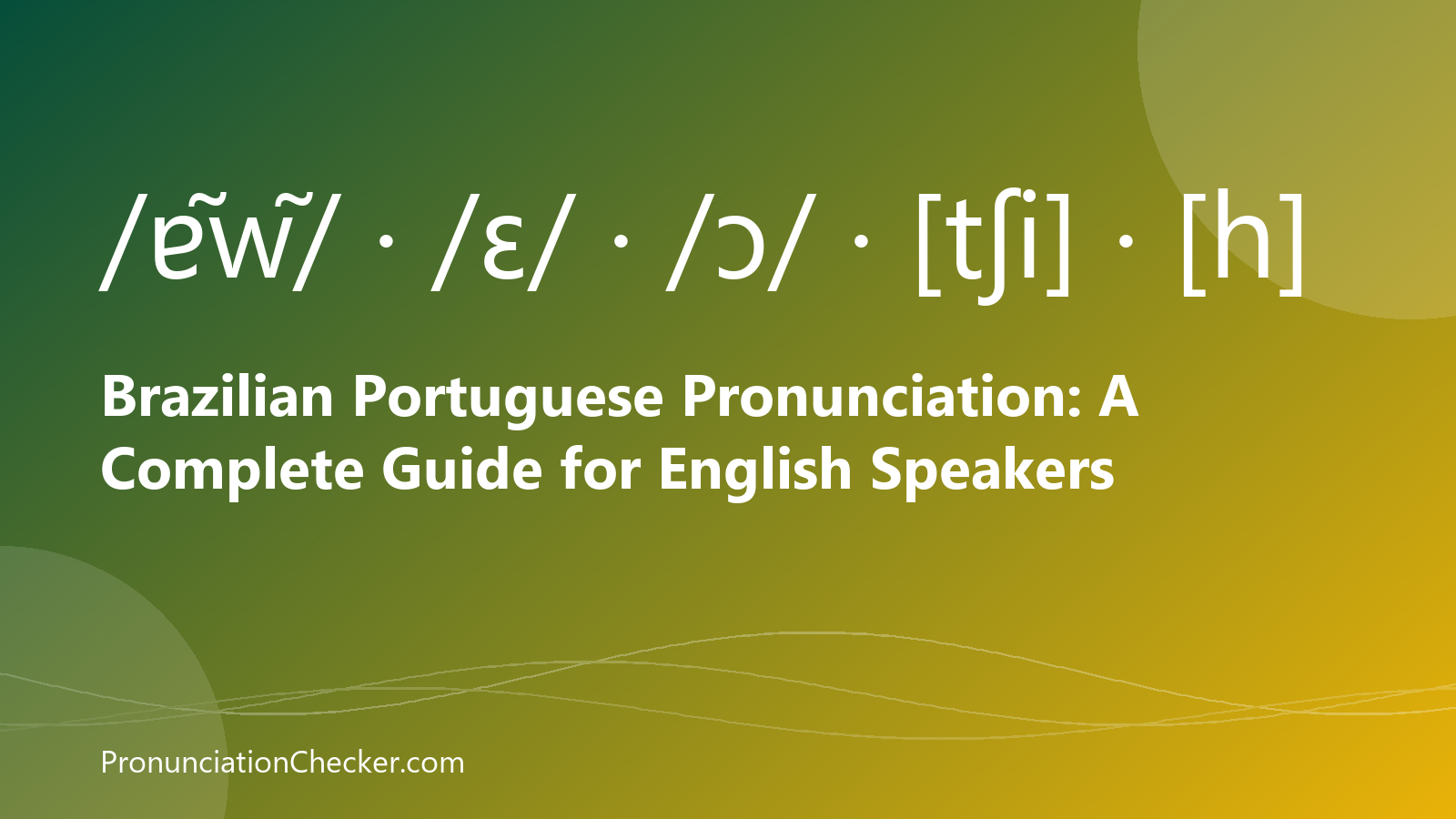
Brazilian Portuguese is one of the most musical languages to listen to and one of the most surprising to read aloud. The spelling looks close to Spanish, but the sound is quite different: open and closed vowels, nasal diphthongs like ão, an R that often sounds like English H, and a T that becomes "tch" before i. This guide covers each feature and links to detailed guides and drills.
Seven oral vowels
Stressed syllables in Portuguese can have seven different vowels. The key difference from Spanish is that e and o each have an open and a closed version, and the difference changes meaning.
| IPA | Spelling | Examples |
|---|---|---|
| /i/ | i | |
| /e/ closed | e, ê | |
| /ɛ/ open | e, é | |
| /a/ | a, á | |
| /ɔ/ open | o, ó | |
| /o/ closed | o, ô | |
| /u/ | u |
An acute accent (é, ó) always marks an open vowel and a circumflex (ê, ô) a closed one, but most words have no accent, so you learn them word by word. See open and closed e and o.
Vowel reduction
Unstressed vowels are reduced, especially at the end of words. In Brazil, final unstressed -e is pronounced [i] and final -o is [u]: is [ˈlej.tʃi], is [ˈka.hu]. Final -a becomes a weak [ɐ]: [ˈka.zɐ]. This is one of the most important rules to learn, and it triggers the next one.
T and D before [i]
In most of Brazil, t and d become [tʃ] ("ch") and [dʒ] ("j") when followed by an [i] sound, whether written i or an unstressed e pronounced [i]: [ˈtʃi.ɐ], [ˈdʒi.ɐ], [ˈnoj.tʃi], [si.ˈda.dʒi]. See the "tchi" and "dji" guide.
Nasal vowels and ão
Portuguese has five nasal vowels and several nasal diphthongs. A vowel is nasal when marked with a tilde (ã, õ) or followed by m or n in the same syllable: , , , , . The most famous is ão, [ɐ̃w̃], as in , and . Word-final -em is also a diphthong: [bẽj̃]. See the nasal vowels guide.
The R sounds
Portuguese has two R phonemes, a tap and a "strong R", and Brazil pronounces the strong R very differently from Spain or Portugal:
- Tap [ɾ] between vowels and after consonants: , , . Like the American tt in butter.
- Strong R at the start of a word and for rr: in most of Brazil it is [h] or [x], like English h: [ˈha.tu], [ˈka.hu], [ˈhi.u].
- R at the end of a syllable varies most by region: [h] in Rio and much of Brazil (, ), a tap in São Paulo city, and an English-like retroflex [ɻ] in the interior of São Paulo state and neighbouring regions.
See the R sounds guide for drills.
Final L becomes W
In Brazil, l at the end of a syllable is pronounced [w], so ends like English now: [bɾa.ˈziw]. (badly) and (bad) sound the same. , , and follow the same rule.
Other consonants
- lh is [ʎ], like lli in million: , .
- nh is [ɲ], like ny in canyon: , .
- ch is [ʃ]: . j and g before e/i are [ʒ]: , .
- s between vowels is [z]: . Final s is [s] in most of Brazil but [ʃ] in Rio de Janeiro: , .
- x has several values, usually [ʃ]: , . See lh, nh, x and ch.
- c before e/i and ç are [s]: , .
Stress
The default rules resemble Spanish: words ending in a, e, o (plus s) and am, em, ens are stressed on the second-to-last syllable (, ); words ending in i, u, consonants and nasal vowels are stressed on the last (, , ). Exceptions carry a written accent: , , .
Phrases in this drill:
- Bom dia, tudo bem?
- Eu não falo português muito bem.
- A cidade do Rio de Janeiro é muito bonita.
- Quero um café com leite, por favor.
- Obrigado, até amanhã!
Frequently asked questions
Is Portuguese pronunciation similar to Spanish?
The consonants are fairly similar, but the vowels are very different. Portuguese has seven oral vowels instead of five, plus nasal vowels and nasal diphthongs, and it reduces unstressed vowels. Spanish speakers often understand written Portuguese far better than spoken Portuguese.
Should I learn Brazilian or European Portuguese?
Choose the one you will use. Brazilian Portuguese has far more speakers and more learning material; European Portuguese is spoken in Portugal and is the model in much of Lusophone Africa. The grammar is almost the same, but the accents are very different.
Which Brazilian accent is standard?
There is no single official accent. Teaching materials and national television often use a neutral accent close to that of Rio de Janeiro or São Paulo. This guide describes features common to most of Brazil and notes the main regional differences.
Sources and further reading
- Barbosa, P. A. and Albano, E. C. (2004). Brazilian Portuguese. Journal of the International Phonetic Association, 34(2), 227–232.
- Cristófaro Silva, T. (2003). Fonética e fonologia do português: roteiro de estudos e guia de exercícios (7th ed.). Contexto.
- Mateus, M. H. and d'Andrade, E. (2000). The Phonology of Portuguese. Oxford University Press.
- Câmara Jr., J. M. (1970). Estrutura da língua portuguesa. Vozes.
Disclosure: this page links to Preply, a tutoring marketplace. If you book a lesson through that link we may earn a commission, at no extra cost to you. It does not change what is recommended here. See our disclaimer and privacy policy.
Practise Portuguese out loud
Type any sentence, listen to a native voice, then record yourself and see which words a speech recogniser understood.
Open the practice page