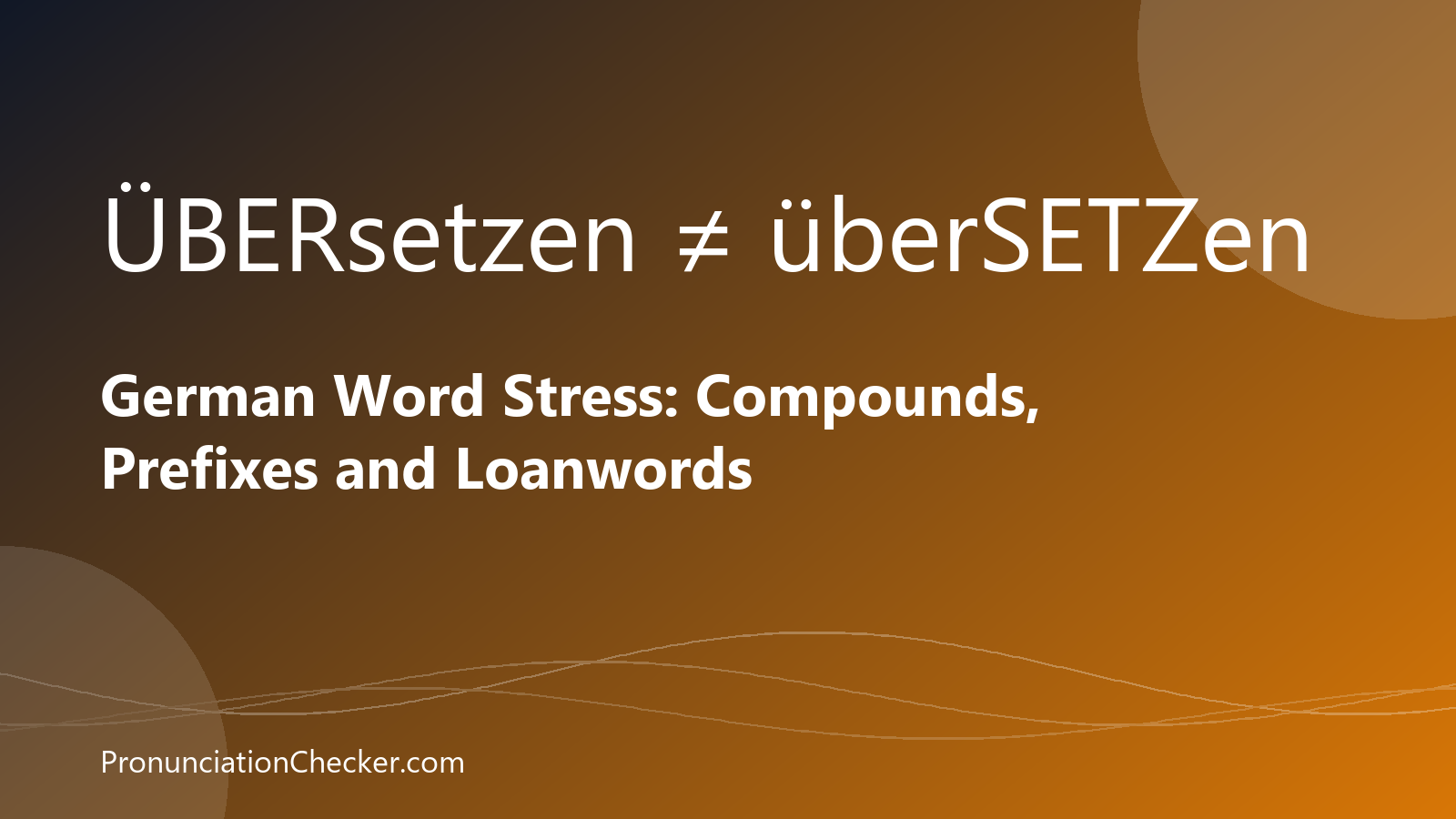
German stress is less predictable than Spanish stress but far more regular than English. A handful of principles cover almost all native words, and they come with a bonus: stress tells you whether a verb prefix separates or not, which matters for grammar as well as for pronunciation.
The basic rule: stress the stem
In native German words, stress falls on the first syllable of the stem. Since most simple words begin with their stem, this usually means the first syllable: , , , , , . Endings and suffixes like -en, -er, -lich, -ung, -heit, -keit, -schaft, -ig, -isch are never stressed: , , .
Unstressed prefixes
The prefixes be-, ge-, er-, ver-, zer-, ent- and emp- are never stressed. The stress goes on the stem that follows:
- be-zah-len · ge-spräch · er-zäh-len
- ver-ste-hen · zer-stö-ren · ent-de-cken · emp-feh-len
The vowel e in be- and ge- is a weak schwa, and ver-, er-, zer- have the vocalic R, [fɐ], [ɐ], [tsɐ].
Separable prefixes are stressed
Separable verb prefixes, which split off in main clauses, always carry the stress: (an-ru-fen: ich rufe dich an), , , , (zu-rück-ge-hen), . The past participle keeps the stress on the prefix: , .
Prefixes that can be both
A few prefixes (über-, unter-, um-, durch-, wieder-, voll-, hinter-) can be separable and stressed, or inseparable and unstressed. The meaning changes, and stress is the only audible clue:
| Stressed prefix (separable) | Unstressed prefix (inseparable) |
|---|---|
| übersetzen: to ferry across Er setzt uns über. | übersetzen: to translate Er übersetzt das Buch. |
| umfahren: to knock down (with a vehicle) Er fährt das Schild um. | umfahren: to drive around Er umfährt das Schild. |
| wiederholen: to fetch back Ich hole es wieder. | wiederholen: to repeat Ich wiederhole es. |
| unterstellen: to put underneath, shelter | unterstellen: to insinuate, assume |
The umfahren pair is a classic German joke: the difference between going around the sign and running it over is a single stress.
Compound nouns
German forms long compound nouns, and the main stress normally falls on the first element: (Haus-tür), , , , . In longer compounds, the first element of the whole compound wins: , .
There are exceptions. Some compound adverbs and place names stress the second element: (Jahr-hun-dert), , , , . Words beginning with un- usually stress it (, ), although in long adjectives the stress can shift (unglaublich is often un-glaub-lich).
Loanwords
Words borrowed from Latin, French and Greek often keep their original stress, usually on the last or second-to-last syllable. Certain endings are reliably stressed:
| Ending | Examples |
|---|---|
| -ie | , , |
| -ion | , , |
| -tät | , |
| -ur | , , |
| -ent, -ant | , , , |
| -ieren (verbs) | , , |
| -ik (varies) | , (end), but , (first) |
Beware of cognates whose German stress differs from English: (mu-sik), (ho-tel), (ta-bak in the north), (kaf-fee in Germany, kaf-fee in Austria).
Where is the stress?
Choose an answer to see the explanation.
1. verstehen
- VER-ste-hen
- ver-STE-hen
- ver-ste-HEN
Answer: ver-STE-hen. ver- is an unstressed prefix.
2. anrufen
- AN-ru-fen
- an-RU-fen
Answer: AN-ru-fen. an- is a separable prefix, and separable prefixes are stressed.
3. Universität
- U-ni-ver-si-tät
- U-ni-ver-si-TÄT
- u-ni-VER-si-tät
Answer: U-ni-ver-si-TÄT. -tät is a stressed loan ending.
4. übersetzen, meaning "to translate"
- ÜBER-set-zen
- über-SET-zen
Answer: über-SET-zen. With the inseparable meaning, the prefix is unstressed.
5. Krankenhaus
- KRAN-ken-haus
- kran-ken-HAUS
Answer: KRAN-ken-haus. Compounds stress the first element.
Frequently asked questions
Is German stress always on the first syllable?
In native German words, stress usually falls on the first syllable of the stem, which is often the first syllable of the word. Unstressed prefixes (be-, ge-, er-, ver-, zer-, ent-, emp-, miss- in some words) and many loanwords are exceptions.
Which part of a German compound is stressed?
Normally the first part: Haustür, Bahnhof, Kindergarten. Some compounds, particularly place names and some adverbs, stress a later part: Jahrhundert, Nordrhein-Westfalen, willkommen.
How do I know if a verb prefix is separable?
Separable prefixes are stressed and split off in main clauses: ANrufen, ich rufe dich an. Inseparable prefixes are unstressed and never split: beSUchen, ich besuche dich. A few prefixes (über-, unter-, um-, durch-, wieder-) can be either, with different meanings.
Sources and further reading
- Wiese, R. (1996). The Phonology of German, chapter 8 on word stress. Oxford University Press.
- Féry, C. (1998). German word stress in Optimality Theory. Journal of Comparative Germanic Linguistics, 2(2), 101–142.
- Eisenberg, P. (2013). Grundriss der deutschen Grammatik: Das Wort (4th ed.). Metzler.
Disclosure: this page links to Preply, a tutoring marketplace. If you book a lesson through that link we may earn a commission, at no extra cost to you. It does not change what is recommended here. See our disclaimer and privacy policy.
Practise German out loud
Type any sentence, listen to a native voice, then record yourself and see which words a speech recogniser understood.
Open the practice page