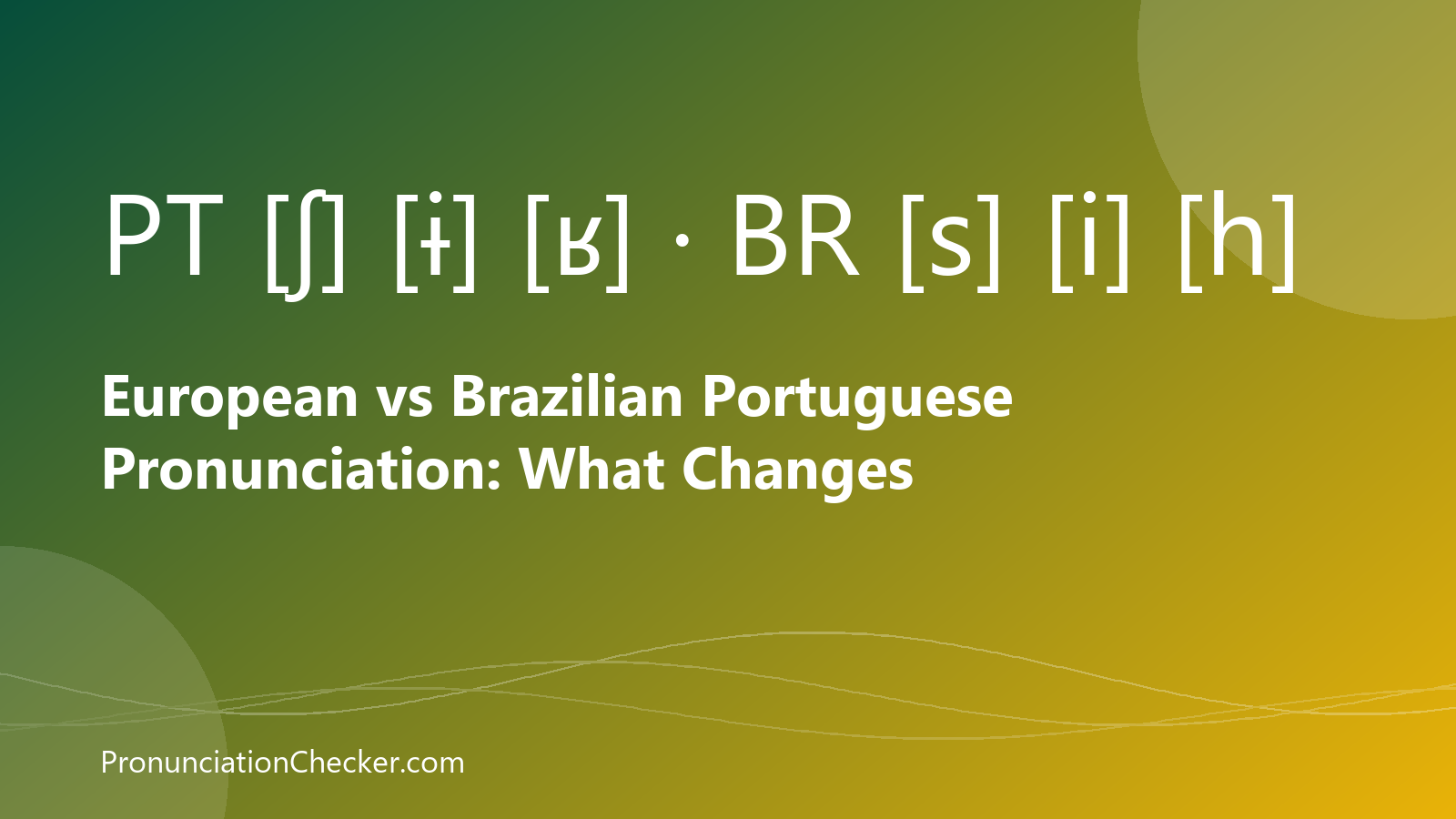
European and Brazilian Portuguese share a grammar and, since the 1990 Orthographic Agreement, nearly the same spelling. Their pronunciations, however, have drifted far apart. A Brazilian hearing a Lisbon news broadcast may struggle for the first few minutes, and learners who start with one variety are often surprised by the other. Here is what actually differs.
1. Vowel reduction: the big one
European Portuguese reduces unstressed vowels far more than Brazilian Portuguese. Unstressed e becomes a very short, high central vowel, [ɨ], or disappears entirely; unstressed a becomes [ɐ]; unstressed o becomes [u].
| Word | Brazil | Portugal |
|---|---|---|
| telefone | [te.le.ˈfo.ni] | [tɨ.lɨ.ˈfɔn(ɨ)], often "tlfón" |
| pequeno | [pe.ˈke.nu] | [pɨ.ˈke.nu], often "pquénu" |
| verdade | [veʁ.ˈda.dʒi] | [vɨɾ.ˈða.ð(ɨ)] |
| obrigado | [o.bɾi.ˈga.du] | [ɔ.bɾi.ˈɣa.ðu] |
The effect is that European Portuguese has more consonant clusters and fewer audible syllables. Its rhythm has been measured as closer to stress-timed English, while Brazilian Portuguese is closer to syllable-timed Spanish (Frota and Vigário 2001).
Listen to the same words in both varieties, if your browser has voices for each:
- Portugal:
- Brazil:
2. S at the end of syllables: [ʃ]
In Portugal, s and z at the end of a syllable are pronounced [ʃ] (or [ʒ] before voiced consonants): [majʃ], [ˈfɛʃ.tɐ], [puɾ.tu.ˈɣeʃ], [ˈmeʒ.mu]. This gives European Portuguese its "shushing" quality. In Brazil, most regions use [s]; Rio de Janeiro is the notable exception and sounds more like Portugal in this respect.
3. No "tchi" and "dji"
European Portuguese never palatalises t and d: tia is [ˈti.ɐ], dia is [ˈdi.ɐ], and noite is [ˈnoj.t(ɨ)]. Since final -e is not [i] anyway, the context for palatalisation rarely arises. See the Brazilian T and D guide.
4. The R
The strong R (rr, initial r) is uvular [ʁ] in Lisbon and much of Portugal, similar to French, and sometimes a trill [r] in the north. In Brazil it is usually [h]. Syllable-final R is a tap in Portugal, never [h] or dropped: falar is [fɐ.ˈlaɾ].
5. L at the end of a syllable
Portugal keeps a dark, velarised [ɫ]: Portugal [puɾ.tu.ˈɣaɫ], Brasil [bɾɐ.ˈziɫ]. Brazil vocalises it to [w]. For a Portuguese speaker, mal and mau are different; for most Brazilians they are the same.
6. Soft b, d, g
Like Spanish, European Portuguese softens b, d and g between vowels to [β ð ɣ]: cada [ˈka.ðɐ], lago [ˈla.ɣu]. Brazilian Portuguese keeps them as full stops.
7. Nasal diphthongs and -em
Final -em is [ɐ̃j̃] in Lisbon (bem, também), closer to mãe, while Brazil has [ẽj̃]. The ei diphthong also differs: Lisbon [ɐj] (primeiro [pɾi.ˈmɐj.ɾu]) vs Brazil [ej] or [e].
8. Different vowels in some words
Before nasal consonants, Portugal often has open vowels where Brazil has closed ones, which is reflected in spelling: Portugal António, académico, ténis; Brazil Antônio, acadêmico, tênis. The unstressed a before the stressed syllable also differs: the first-person plural past falámos (Portugal, open a) vs present falamos is distinguished in Portugal but not in Brazil.
Summary table
| Feature | Brazil (general) | Portugal (Lisbon) |
|---|---|---|
| Unstressed final e | [i] | [ɨ] or silent |
| Final s | [s] (Rio: [ʃ]) | [ʃ] |
| t, d before [i] | [tʃ], [dʒ] | [t], [d] |
| Strong R | [h], [x] | [ʁ] |
| Final l | [w] | [ɫ] |
| b, d, g between vowels | stops | soft [β ð ɣ] |
| Rhythm | more syllable-timed | more stress-timed |
Brazil or Portugal?
Choose an answer to see the explanation.
1. A speaker says noite as "noitchi".
- Brazil
- Portugal
Answer: Brazil. Palatalised t before [i] is Brazilian.
2. A speaker says Portugal ending in a dark [ɫ].
- Brazil
- Portugal
Answer: Portugal. Brazil would say [w].
3. A speaker says telefone almost as two syllables, "tlfón".
- Brazil
- Portugal
Answer: Portugal. Heavy vowel reduction is characteristic of European Portuguese.
4. A speaker says carro as "cahu".
- Brazil
- Portugal
Answer: Brazil. [h] for the strong R is Brazilian; Portugal uses [ʁ].
Frequently asked questions
Can Brazilians and Portuguese understand each other?
Yes, though Brazilians often find European Portuguese harder to follow than the reverse, because Portuguese people hear Brazilian accents constantly on television, while European Portuguese vowel reduction makes words shorter and less clear to Brazilian ears.
Is European Portuguese harder to learn?
For pronunciation, many learners find it harder, because of the reduced vowels and consonant clusters. Brazilian Portuguese keeps more vowels and syllables, which makes it easier to hear and imitate.
Which variety is used in Africa?
Angola, Mozambique, Cape Verde, Guinea-Bissau and São Tomé and Príncipe follow European Portuguese spelling and grammar norms, but their accents are distinct; they typically reduce vowels less than Lisbon Portuguese.
Sources and further reading
- Cruz-Ferreira, M. (1995). European Portuguese. Journal of the International Phonetic Association, 25(2), 90–94.
- Barbosa, P. A. and Albano, E. C. (2004). Brazilian Portuguese. Journal of the International Phonetic Association, 34(2), 227–232.
- Mateus, M. H. and d'Andrade, E. (2000). The Phonology of Portuguese. Oxford University Press.
- Frota, S. and Vigário, M. (2001). On the correlates of rhythmic distinctions: the European/Brazilian Portuguese case. Probus, 13(2), 247–275.
Disclosure: this page links to Preply, a tutoring marketplace. If you book a lesson through that link we may earn a commission, at no extra cost to you. It does not change what is recommended here. See our disclaimer and privacy policy.
Practise Portuguese out loud
Type any sentence, listen to a native voice, then record yourself and see which words a speech recogniser understood.
Open the practice page