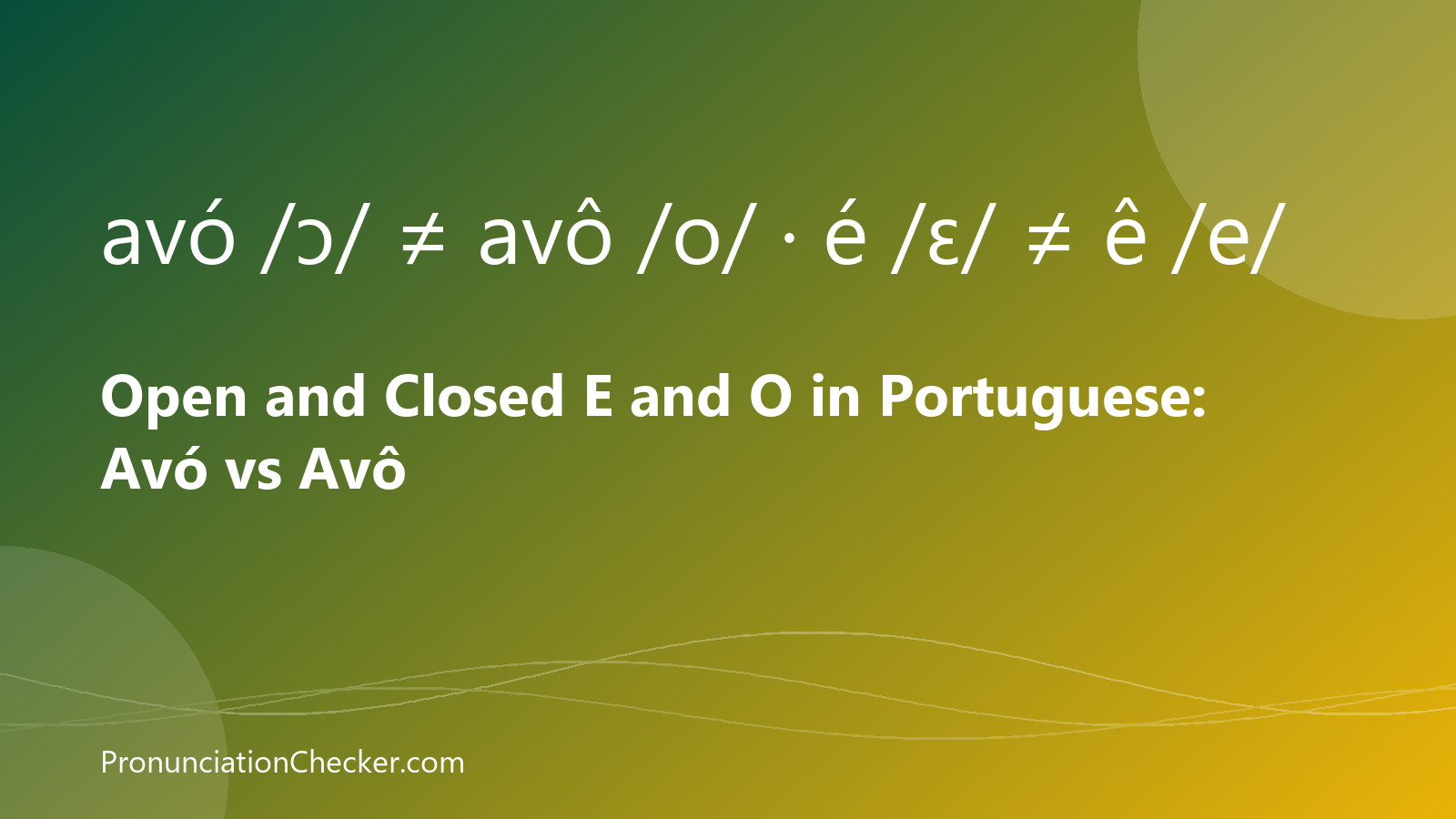
Spanish has one e and one o. Portuguese has two of each, and swapping them changes words: avó (grandmother) and avô (grandfather), pôde (he could) and pode (he can), sede (headquarters) and sede (thirst). For Spanish speakers and English speakers alike, this is the vowel contrast to master.
The four vowels
| Closed | Open | |
|---|---|---|
| e | [e], as in English day without the glide: , , | [ɛ], as in English bed: , , |
| o | [o], as in English go without the glide: , , | [ɔ], as in British thought: , , |
The closed vowels are tense and the lips are more active; the open vowels have a lower jaw and a more relaxed tongue. English speakers must avoid the glide on the closed ones: você ends in a pure [e], not English say.
What the accents tell you
- Acute accent (é, ó) = stressed and open: , , , , .
- Circumflex (ê, ô) = stressed and closed: , , , (Brazil).
Portugal uses the acute in some words where Brazil has a circumflex, reflecting a genuine pronunciation difference: Brazil ônibus [o], econômico, Portugal económico [ɔ].
Minimal pairs
| Closed | Meaning | Open | Meaning |
|---|---|---|---|
| grandfather | grandmother | ||
| he could (past) | he can (present) | ||
| your | sky | ||
| I am | only | ||
| he | she (the vowel opens in the feminine) | ||
| well (for water) | I can | ||
| the letter P | foot | ||
| (unstressed [nus]) | us | we | |
| baking mould | shape |
Fôrma is one of the few words where the 2009 spelling agreement allows an optional accent, precisely to distinguish it from forma.
Items in this drill: avô / avó; pôde / pode; seu / céu; sou / só; fôrma / forma; poço / posso; pê / pé; ê / é; dou / dó.
Same spelling, different vowel
Because most words have no accent mark, many identical spellings hide two pronunciations. Context tells you which is meant:
- sede [ˈse.dʒi] "thirst" vs sede [ˈsɛ.dʒi] "headquarters"
- colher [ko.ˈʎɛɾ] "spoon" (noun) vs colher [ko.ˈʎeɾ] "to harvest" (verb)
- gosto [ˈgos.tu] "taste" (noun) vs gosto [ˈgɔs.tu] "I like" (verb)
- almoço [aw.ˈmo.su] "lunch" vs almoço [aw.ˈmɔ.su] "I have lunch"
- jogo [ˈʒo.gu] "game" vs jogo [ˈʒɔ.gu] "I play"
The last three follow a real pattern: many nouns have a closed vowel, while the related verb forms have an open one.
Plurals and feminines that open the vowel
A large group of nouns and adjectives with a closed stressed o in the masculine singular open it in the plural and the feminine. This process is called metafonia:
| Singular [o] | Plural [ɔ] | Feminine [ɔ] |
|---|---|---|
| (eye) | — | |
| (egg) | — | |
| (new) | ||
| (pig) | ||
| (thick) | ||
| (famous) |
Not all words do this: /, / and / keep [o].
Verbs
In regular verbs with e or o in the stem, the stressed forms (I, you, he, they in the present) usually have the open vowel, while the unstressed forms have the closed or reduced one: eu [ɛ], but nós [e]; eu [ɔ], but nós [o].
Helpful spelling patterns
- Usually open: endings -ela (), -ola (), -ó and -é with accents, -el (), -ol ().
- Usually closed: endings -eza (), -oso (masc. sing.: ), -ês (), -or (, ), and any stressed e/o before a nasal (, ).
Frequently asked questions
Do the accents é and ê mean different sounds?
Yes. The acute accent (é, ó) marks an open vowel, [ɛ] or [ɔ]. The circumflex (ê, ô) marks a closed vowel, [e] or [o]. Both also mark the stressed syllable.
How do I know whether an unaccented e or o is open or closed?
Often you cannot tell from spelling alone and need to learn the word. There are helpful patterns: the endings -ela, -ola, -eta and -ote often have open vowels, and -eza, -oso, -ês, and -dor/-dora have closed vowels, and many nouns switch to an open o in the plural (olho, olhos).
Does the difference matter in unstressed syllables?
Much less. The open/closed contrast is fully used only in stressed syllables. In unstressed syllables, Brazilian Portuguese usually has closed [e] and [o], which become [i] and [u] at the end of a word.
Sources and further reading
- Barbosa, P. A. and Albano, E. C. (2004). Brazilian Portuguese. Journal of the International Phonetic Association, 34(2), 227–232.
- Mateus, M. H. and d'Andrade, E. (2000). The Phonology of Portuguese, chapter 2 and 5 on vowel harmony in verbs. Oxford University Press.
- Wetzels, W. L. (1992). Mid vowel neutralization in Brazilian Portuguese. Cadernos de Estudos Linguísticos, 23, 19–55.
Disclosure: this page links to Preply, a tutoring marketplace. If you book a lesson through that link we may earn a commission, at no extra cost to you. It does not change what is recommended here. See our disclaimer and privacy policy.
Practise Portuguese out loud
Type any sentence, listen to a native voice, then record yourself and see which words a speech recogniser understood.
Open the practice page