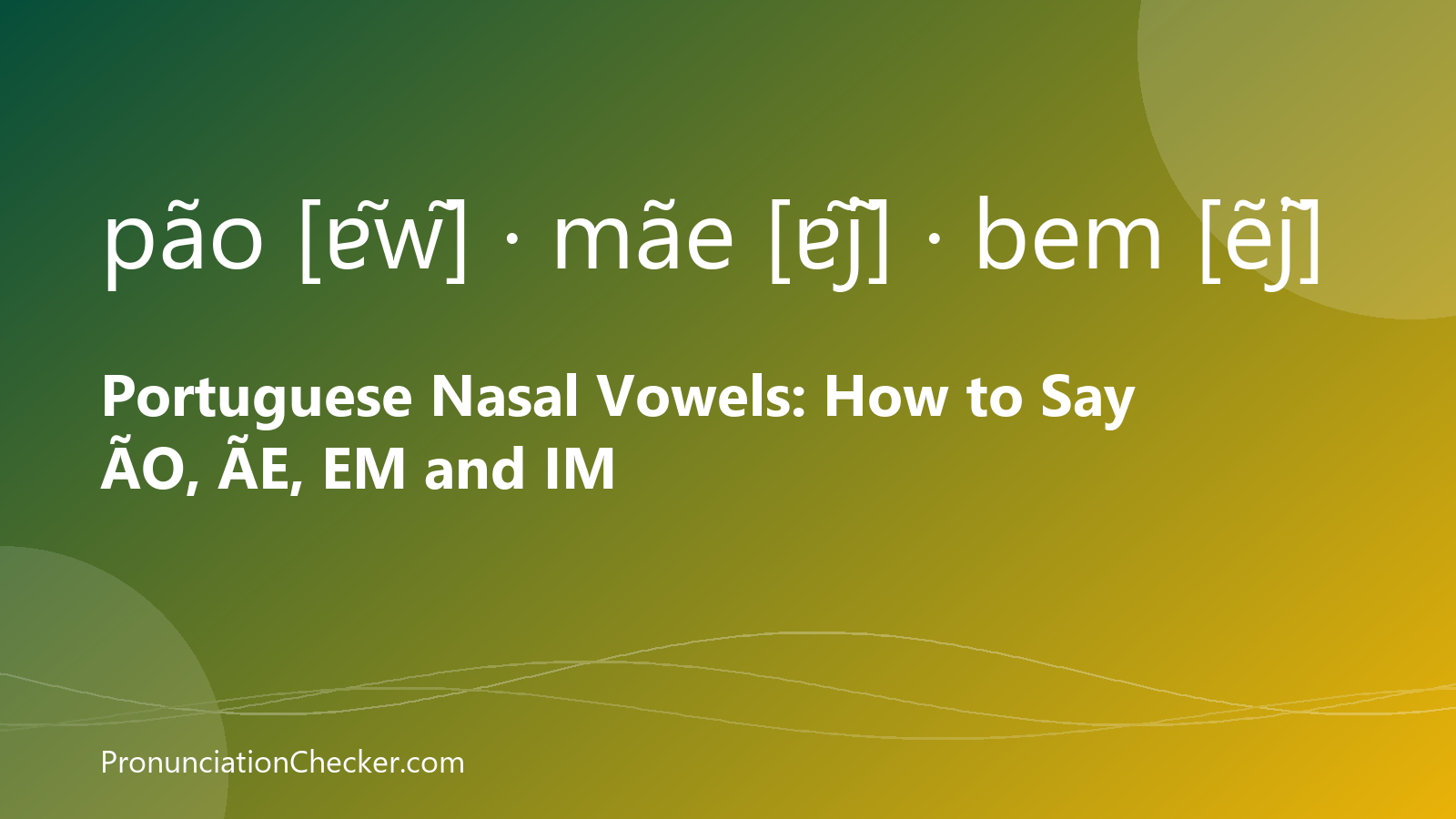
Nasal vowels are everywhere in Portuguese: não, sim, bem, também, mãe, pão, muito. Many of the most common words of the language contain one. They are also where learners, including Spanish and French speakers, most often sound foreign, because Portuguese nasals behave differently from both.
What makes a vowel nasal
A nasal vowel is produced with the soft palate lowered, so air flows through the nose and mouth together. In Portuguese spelling, a vowel is nasal when:
- it carries a tilde: , , ;
- it is followed by m or n in the same syllable: , , , , , .
The m or n is not pronounced as a separate consonant; it only signals nasality. The written m at the end of words is simply the spelling convention used before a pause.
In Brazilian Portuguese, stressed vowels before m, n or nh in the next syllable are also nasalised: , , . This is automatic and less strong in Portugal.
The five nasal vowels
| IPA | Spellings | Examples |
|---|---|---|
| [ɐ̃] | ã, am, an | |
| [ẽ] | em, en (inside a word) | |
| [ĩ] | im, in | |
| [õ] | om, on | |
| [ũ] | um, un |
Note that nasal a is [ɐ̃], a more closed vowel than oral [a]: think of the vowel in English cup, nasalised. Many learners use an open [a] and sound off.
Nasal diphthongs
This is the part with no parallel in Spanish or French. Portuguese has four common nasal diphthongs:
| Diphthong | Spellings | Examples | How to make it |
|---|---|---|---|
| [ɐ̃w̃] | ão, final -am | nasal uh gliding to rounded w | |
| [ɐ̃j̃] | ãe, ãi (and final -em in Portugal) | nasal uh gliding to y | |
| [õj̃] | õe | nasal o gliding to y | |
| [ẽj̃] | final -em, -ém, -ens | nasal e gliding to y |
-am and -ão sound the same when unstressed and stressed respectively: falam (they speak) ends in [ɐ̃w̃], exactly like falarão (they will speak) ends in stressed [ɐ̃w̃]. The difference between falaram (they spoke) and falarão (they will speak) is only stress: fa-la-ram vs fa-la-rão.
How to say ão
- Say the vowel of English cup and let air flow through your nose: [ɐ̃].
- Without stopping the nasal airflow, round your lips toward oo: [ɐ̃w̃].
- Do not close your mouth or touch the tongue to the roof of the mouth at the end. There is no n or ng.
- Try , , , then longer words: , , .
Oral vs nasal pairs
Nasality changes meaning. These pairs differ only in whether the vowel is nasal:
- (bad) / (hand)
- (stick) / (bread)
- (more) / (mothers)
- (I saw) / (I came)
- (there) / (wool)
- (if) / (without)
Items in this drill: mau / mão; pau / pão; mais / mães; vi / vim; lá / lã; se / sem; cato / canto; mato / manto; ri / rim; pôs / pões; falaram / falarão.
Common mistakes
- Adding a consonant. Saying bom as English bomb or sim as seem with a closed m. Keep the lips apart.
- Using Spanish habits. Spanish speakers pronounce n fully: canto as [ˈkan.to]. In Portuguese the vowel is nasal and the n is weak or absent.
- Splitting ão into two syllables. Não is one syllable, not "na-o".
- Using -ão for -am in verbs. Unstressed falam should not be stressed at the end.
Phrases in this drill:
- Não, obrigado, eu não quero pão.
- Minha mãe também vem.
- Bom dia, tudo bem?
- O homem tem cinco irmãos.
- As lições são muito importantes.
Frequently asked questions
How do you pronounce "ão"?
Start with a nasalised version of the vowel in English "cup", and glide to a nasalised "w" with rounded lips: [ɐ̃w̃]. It is one syllable. Do not add an n or ng at the end.
Are Portuguese nasal vowels the same as French ones?
No. Portuguese nasal vowels are generally more closed and are often followed by a short nasal glide or consonant-like segment. Portuguese also has nasal diphthongs (ão, ãe, õe, em) that French lacks.
Is "bem" pronounced like "bang"?
No. Word-final em is the nasal diphthong [ẽj̃], like a nasalised English "bay" without closing the mouth. The m is not pronounced as a consonant.
Sources and further reading
- Barbosa, P. A. and Albano, E. C. (2004). Brazilian Portuguese. Journal of the International Phonetic Association, 34(2), 227–232.
- Mateus, M. H. and d'Andrade, E. (2000). The Phonology of Portuguese, chapter 2.3 on nasal vowels. Oxford University Press.
- Câmara Jr., J. M. (1970). Estrutura da língua portuguesa, chapter on nasal vowels. Vozes.
Disclosure: this page links to Preply, a tutoring marketplace. If you book a lesson through that link we may earn a commission, at no extra cost to you. It does not change what is recommended here. See our disclaimer and privacy policy.
Practise Portuguese out loud
Type any sentence, listen to a native voice, then record yourself and see which words a speech recogniser understood.
Open the practice page