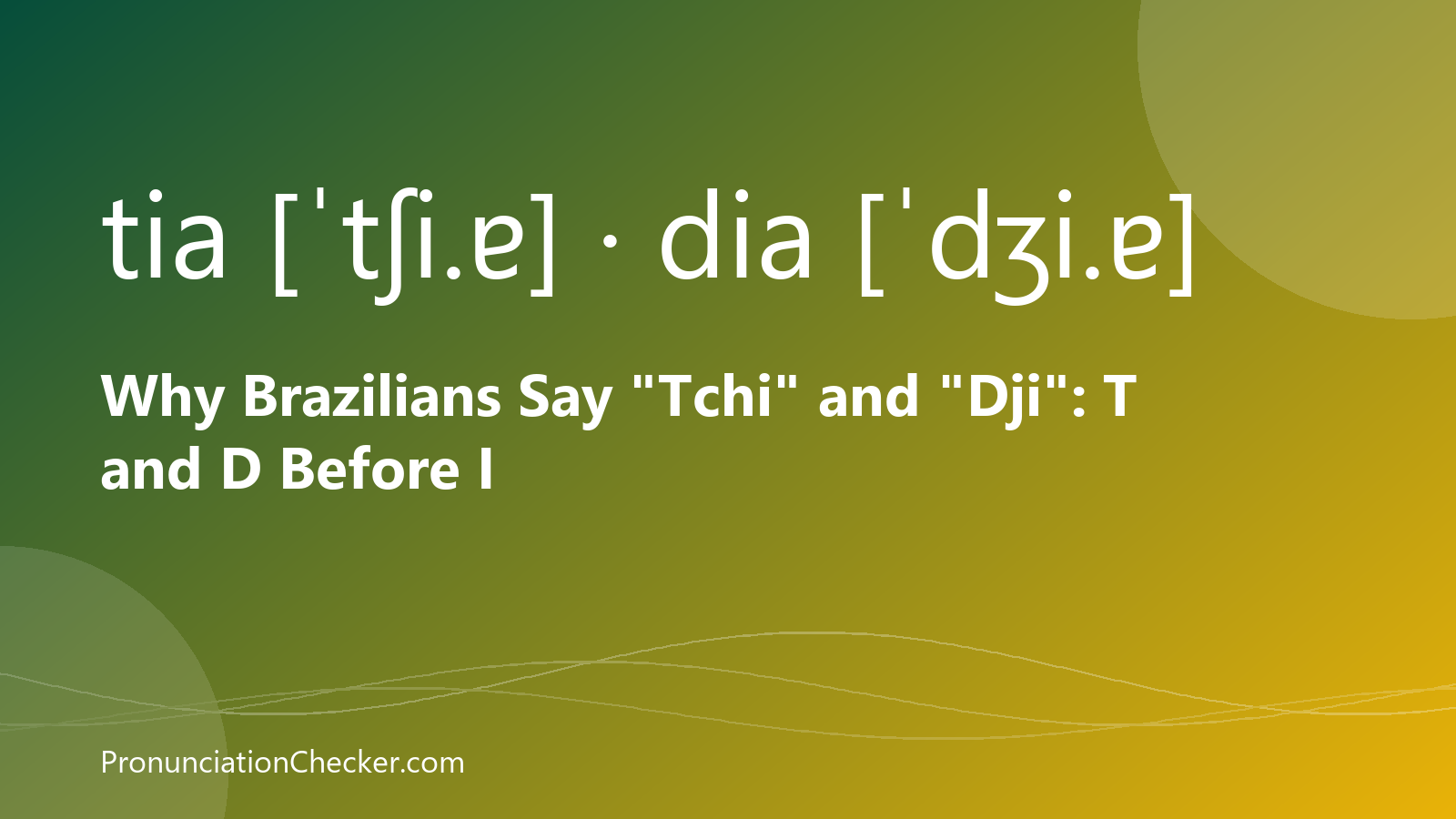
One of the first things English speakers notice about Brazilian Portuguese is that t and d sometimes sound like the ch in cheese and the j in jeep. Tia (aunt) is "tchia", dia (day) is "djia", and noite (night) is "noitchi". This is not random: it follows one simple rule, and applying it will make your Portuguese sound Brazilian immediately.
The rule
In most Brazilian accents, t becomes [tʃ] and d becomes [dʒ] whenever the next sound is [i]. The linguistic term is palatalisation: the tongue moves toward the palate in anticipation of the [i].
| Before [i] | Elsewhere |
|---|---|
| [ˈtʃi.ɐ] | [ˈtu.ɐ] |
| [ˈdʒi.ɐ] | [ˈda.du] |
| [ˈtʃi.pu] | [ˈto.pu] |
| [dʒi.ˈfi.siw] | [de.ˈveɾ] |
| [ˈtʃi.mi] | [ˈte.mɐ] |
The hidden i: final -te and -de
Here is what makes the rule so frequent: in Brazil, unstressed final -e is pronounced [i]. So every word ending in unstressed -te or -de ends in "tchi" or "dji":
- [ˈnoj.tʃi] · [ˈlej.tʃi] · [ˈʒẽ.tʃi] · [ˈsɛ.tʃi] · [ˈpaʁ.tʃi]
- [si.ˈda.dʒi] · [saw.ˈda.dʒi] · [veʁ.ˈda.dʒi] · [ˈtaʁ.dʒi] · [ˈõ.dʒi]
The same happens with unstressed e inside words when it reduces to [i], particularly in common words: is usually [dʒi], and often [dʒis.ˈkuw.pɐ].
Stressed e does not trigger it. In tema, dedo and teto the e is stressed, so it keeps its [e] or [ɛ] quality and the t or d stays plain. Only an [i] sound triggers palatalisation.
Loanwords and names
The rule applies to borrowed words too, which is why English words often sound surprising in Brazilian mouths: internet is [ĩ.teʁ.ˈnɛ.tʃi], chocolate [ʃo.ko.ˈla.tʃi], Facebook [fej.ʃi.ˈbu.ki]. Brazilians add an [i] after final consonants that Portuguese does not allow, and if that consonant is t or d, it becomes "tchi" or "dji": hot dog sounds like "hotchi dógui".
Where it does not happen
Palatalisation is the norm in Rio, São Paulo, Minas Gerais, Brasília and most of the South, but it is not universal:
- In much of the Northeast, including Recife and João Pessoa, t and d stay [t] and [d] before [i]: tia is [ˈti.ɐ]. Some northeastern speakers palatalise only before a written i, not before final -e: tia "tchia" but noite [ˈnoj.ti].
- In parts of the South, especially rural Rio Grande do Sul and among speakers of Italian or German heritage, final -e may stay [e], so there is no trigger: leite [ˈlej.te].
- In Portugal and Lusophone Africa, palatalisation does not occur.
If you are learning a general Brazilian accent, apply the rule consistently.
Getting the sounds right
Both sounds exist in English: [tʃ] is the ch in church and [dʒ] is the j in judge. The only difficulty is remembering to use them, and not overdoing them. Brazilian [tʃ] is usually a little lighter and shorter than English ch. Also avoid palatalising where it does not belong: tudo is never "tchudo".
Items in this drill: tia / tua; tipo / topo; time / tema; parte / parto; tarde / tarda; leite / leito; tinta / tanta; dica / doca.
Tchi, dji or neither?
Choose an answer to see the explanation.
1. How is the t in gente pronounced in São Paulo?
- [t]
- [tʃ]
- silent
Answer: [tʃ]. Final unstressed -e is [i], so gente is [ˈʒẽ.tʃi].
2. How is the d in dedo (finger) pronounced?
- [d], both times
- [dʒ] at the start
- [dʒ] both times
Answer: [d], both times. The first e is stressed ([ˈde.du]), and the final o is [u], so neither d is followed by [i].
3. How is verdade usually pronounced in Rio?
- [ver.ˈda.de]
- [veʁ.ˈda.dʒi]
- [veʁ.ˈdʒa.dʒi]
Answer: [veʁ.ˈda.dʒi]. Only the final -de is followed by [i].
Phrases in this drill:
- Boa tarde, tudo bem?
- A cidade é bonita de noite.
- Que saudade da minha tia!
- Onde fica a parte antiga?
- É difícil dizer a verdade.
Frequently asked questions
Do all Brazilians say "tchi" and "dji"?
Most do, including speakers from Rio de Janeiro, São Paulo, Minas Gerais and the South. The main exceptions are parts of the Northeast (such as Pernambuco and Paraíba), where t and d before i often stay as plain [t] and [d], and some rural and southern communities.
Do Portuguese people from Portugal say "tchi"?
No. In European Portuguese, t and d are always [t] and [d]. And final unstressed -e is usually reduced to a weak vowel or dropped, so noite sounds like [nojt], not "noitchi".
Does "tchi" happen in the middle of words?
Yes, whenever t or d is followed by an [i] sound: tipo [ˈtʃi.pu], dizer [dʒi.ˈzeɾ], antigo [ɐ̃.ˈtʃi.gu], medicina [me.dʒi.ˈsi.nɐ].
Sources and further reading
- Barbosa, P. A. and Albano, E. C. (2004). Brazilian Portuguese. Journal of the International Phonetic Association, 34(2), 227–232.
- Cristófaro Silva, T. (2003). Fonética e fonologia do português (7th ed.), section on palatalisation. Contexto.
- Bisol, L. (ed.) (2005). Introdução a estudos de fonologia do português brasileiro (4th ed.). EDIPUCRS.
Disclosure: this page links to Preply, a tutoring marketplace. If you book a lesson through that link we may earn a commission, at no extra cost to you. It does not change what is recommended here. See our disclaimer and privacy policy.
Practise Portuguese out loud
Type any sentence, listen to a native voice, then record yourself and see which words a speech recogniser understood.
Open the practice page