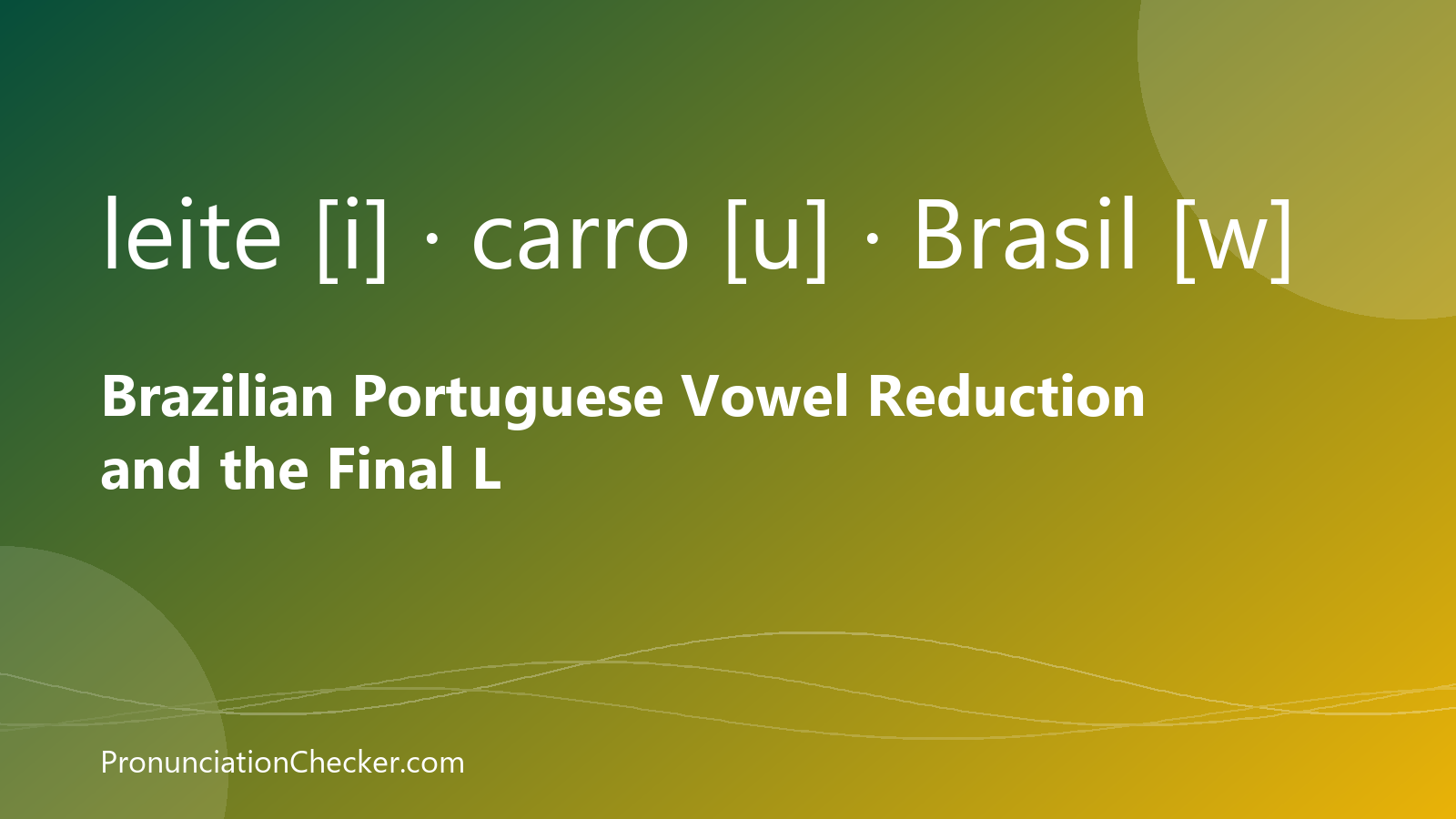
If you read Portuguese as if it were Spanish, words like leite, carro, Brasil and futebol will come out quite wrong. Brazilian Portuguese changes vowels depending on stress and changes l at the end of a syllable into a vowel-like [w]. These three rules account for much of the Brazilian "sound".
Rule 1: unstressed final e is [i]
When a word ends in an unstressed -e (or -es), it is pronounced [i]:
- [ˈlej.tʃi] · [ˈno.mi] · [ˈgɾɐ̃.dʒi] · [ˈpɔ.dʒi]
- [ˈɐ̃.tʃis] · [ˈma.ɾis] · [vo.ˈse ˈsa.bi]
Combined with the palatalisation rule, this is why so many words end in "tchi" or "dji". The one-syllable words de, que, se, me, te, lhe usually follow the same pattern: [dʒi], [ki].
Rule 2: unstressed final o is [u]
Likewise, unstressed final -o (and -os) is pronounced [u]:
- [ˈka.hu] · [ˈli.vɾu] · [o.bɾi.ˈga.du] · [ˈmũj.tu]
- [ˈto.dus] · [u me.ˈni.nu]
The definite article o is also [u]: o carro is [u ˈka.hu].
Final a
Unstressed final -a becomes a weaker, more central vowel, [ɐ], similar to the a of English sofa: [ˈka.zɐ], [ˈme.zɐ], . This is subtler than the changes to e and o and does not trigger any other change.
Unstressed vowels before the stress
Before the stressed syllable, the rules are looser. Brazilian Portuguese generally has [e] and [o] there (, ), but they often raise to [i] and [u] in common words and in casual speech, especially when the next syllable has an [i] or [u]: [mi.ˈni.nu], [bu.ˈni.tu], [kus.ˈtu.mi]. This "vowel harmony" varies a lot between speakers and regions. As a learner, use [e] and [o] here and you will be understood everywhere.
Contrast with Portugal: European Portuguese reduces unstressed vowels even more strongly. Final -e is a very weak [ɨ] or disappears, and pre-stress e often drops too: telefone can sound like [tlˈfɔn]. See European vs Brazilian Portuguese.
Rule 3: final L becomes [w]
An l at the end of a syllable, whether at the end of a word or before a consonant, is pronounced [w], like the w in English now:
| Word | Pronunciation |
|---|---|
| [bɾa.ˈziw] | |
| [fu.tʃi.ˈbɔw] | |
| [a.ˈzuw] | |
| [pa.ˈpɛw] | |
| [ˈaw.tu] | |
| [ˈvɔw.tɐ] | |
| [poʁ.tu.ˈgaw] |
This creates homophones: (badly) and (bad) are both [maw]; (syrup) and (tail) are both [ˈkaw.dɐ]. The l is still a normal [l] when a vowel follows, so it comes back in plurals and related words: [w] but [l]; but .
Bonus: the extra i
Brazilian Portuguese dislikes most consonants at the end of a syllable. When a word has a consonant that cannot close a syllable, speakers insert an [i] after it:
- [a.dʒi.vo.ˈga.du] ("adjivogado")
- [pi.si.ko.lo.ˈʒi.ɐ]
- [ˈhi.tʃi.mu]
- English loans: internet [ĩ.teʁ.ˈnɛ.tʃi], rock [ˈhɔ.ki], club [ˈklu.bi]
Notice how the inserted [i] then triggers the "tchi/dji" rule, as in advogado.
Apply the rules
Choose an answer to see the explanation.
1. How does verde end?
- [de]
- [dʒi]
- [d]
Answer: [dʒi]. Final unstressed e is [i], and d before [i] becomes [dʒ].
2. How is sol pronounced?
- [sɔl]
- [sɔw]
- [sol]
Answer: [sɔw]. Final l is [w]: [sɔw].
3. How does obrigado end?
- [do]
- [du]
- [dʒu]
Answer: [du]. Final unstressed o is [u]; d before [u] stays [d].
4. Do mal and mau sound different in Brazil?
- Yes
- No, both are [maw]
Answer: No, both are [maw]. Because final l becomes [w], they are homophones.
Phrases in this drill:
- O futebol é muito popular no Brasil.
- Eu gosto de leite com café.
- O livro azul está na mesa.
- Obrigado pelo presente.
- O advogado volta amanhã.
Frequently asked questions
Why does Brazilian Portuguese sound so different from Spanish?
Mostly because of the vowels. Spanish keeps its five vowels the same in every position. Brazilian Portuguese has seven stressed vowels and reduces unstressed ones, especially at the end of words, where e becomes [i] and o becomes [u].
Is the final o always pronounced like u?
When it is unstressed, yes, in almost all of Brazil: carro, livro, obrigado. A stressed final o keeps its quality: avô [a.ˈvo], avó [a.ˈvɔ].
Do all Brazilians pronounce final l as w?
Nearly all. A few speakers in the far south, near the borders with Uruguay and Argentina, and some older speakers keep a velarised l, but [w] is the norm across the country.
Sources and further reading
- Barbosa, P. A. and Albano, E. C. (2004). Brazilian Portuguese. Journal of the International Phonetic Association, 34(2), 227–232.
- Câmara Jr., J. M. (1970). Estrutura da língua portuguesa, chapter on the vowel system. Vozes.
- Cristófaro Silva, T. (2003). Fonética e fonologia do português (7th ed.). Contexto.
- Bisol, L. (ed.) (2005). Introdução a estudos de fonologia do português brasileiro (4th ed.). EDIPUCRS.
Disclosure: this page links to Preply, a tutoring marketplace. If you book a lesson through that link we may earn a commission, at no extra cost to you. It does not change what is recommended here. See our disclaimer and privacy policy.
Practise Portuguese out loud
Type any sentence, listen to a native voice, then record yourself and see which words a speech recogniser understood.
Open the practice page