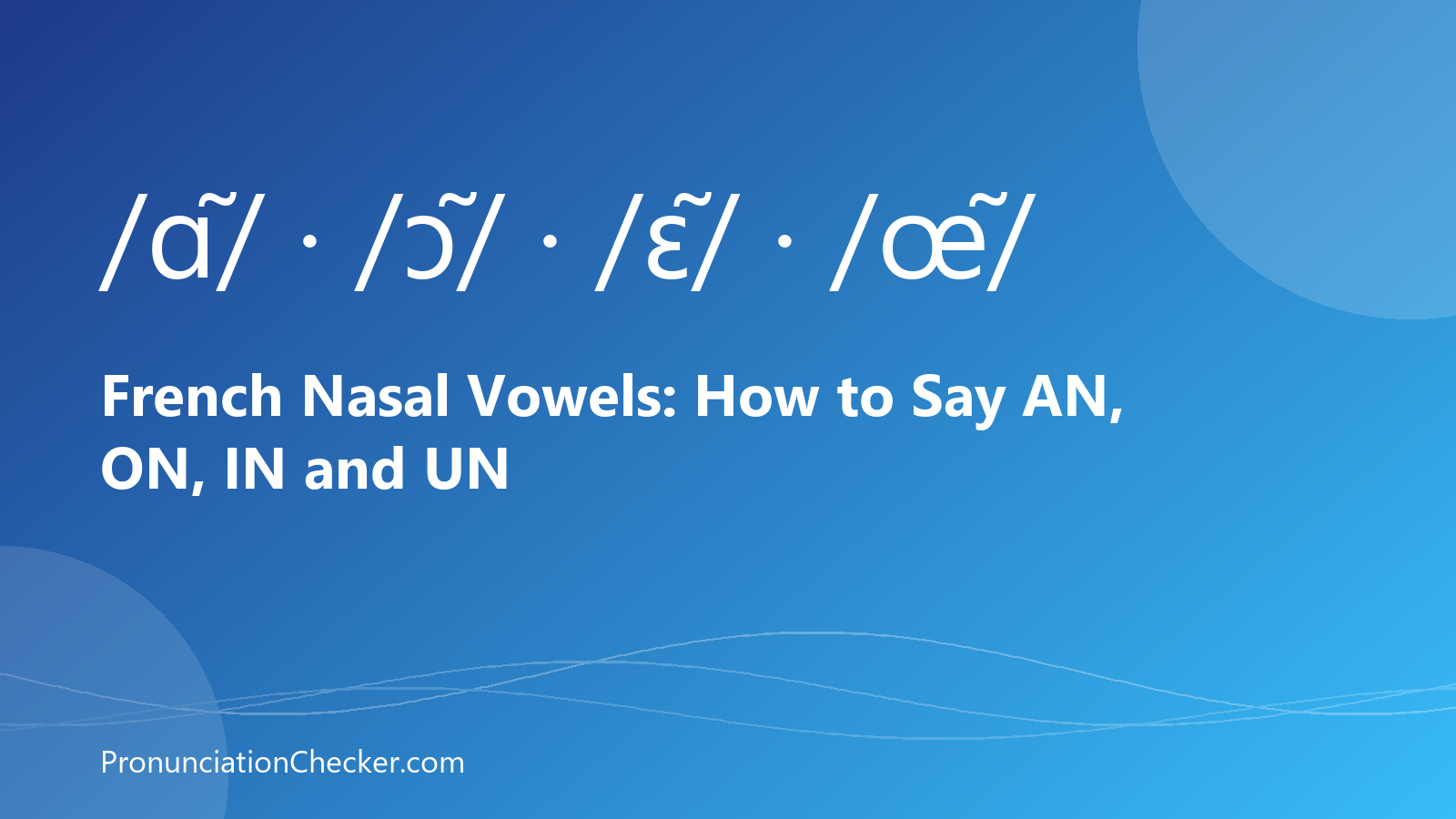
Nasal vowels are the sound most people associate with French, and they are essential: vin (wine), vent (wind) and vont (they go) differ only in their nasal vowel. English has nasalised vowels before n and m, but never uses nasality to tell words apart, so English speakers have to learn both to produce and to hear these contrasts.
What a nasal vowel is
In a nasal vowel, the soft palate at the back of the roof of the mouth lowers, so air flows out through the nose and the mouth at the same time. No consonant follows. To feel it, pinch your nose while saying : the sound changes, and you feel vibration in your nose. Now say : pinching makes no difference, because it is an oral vowel.
The classic English-speaker error is to say an oral vowel followed by an [n] or [ŋ], so that French bon sounds like English bone or bong. The tongue should never touch the roof of the mouth at the end.
The four nasal vowels
| IPA | Common spellings | Examples | How to make it |
|---|---|---|---|
| /ɑ̃/ | an, am, en, em | mouth open, tongue back, lips slightly rounded; start from the a of father | |
| /ɔ̃/ | on, om | lips well rounded, as for o; closer than /ɑ̃/ | |
| /ɛ̃/ | in, im, ain, aim, ein, yn, (i)en | lips spread, tongue forward; start from the e of bet, mouth a bit more open | |
| /œ̃/ | un, um | as /ɛ̃/ with rounded lips; merged with /ɛ̃/ for most speakers in France |
The en trap. The spelling en is usually /ɑ̃/, the same as an: enfant, cent, vent. But after i, y and é it is /ɛ̃/: bien, rien, chien, européen. And in the verb ending -ent it is completely silent: ils parlent.
When a vowel is nasal, and when it is not
A vowel followed by n or m is nasal only if the n/m is at the end of the syllable, meaning it is followed by a consonant or the end of the word. If the n/m is followed by a vowel, or is doubled, the vowel is oral and the consonant is pronounced:
| Nasal | Oral + n/m |
|---|---|
| [bɔ̃] | [bɔn] |
| [ɑ̃] | [a.ne] |
| [plɛ̃] | [plɛn] |
| [bʁœ̃] | [bʁyn] |
| [fɛ̃] | [fin] |
| [i.ta.ljɛ̃] | [i.ta.ljɛn] |
This alternation is how French marks many feminine forms, so getting it right is grammar as well as pronunciation.
Hearing the difference
The most common confusion is between /ɑ̃/ and /ɔ̃/, and between /ɑ̃/ and /ɛ̃/. These sets differ only in the nasal vowel:
- (wind) · (go) · (wine)
- (without) · (sound) · (saint)
- (slow) · (long) · (linen)
- (bench) · (good) · (bath)
And these pairs contrast a nasal vowel with an oral one:
- / · / · / · /
Items in this drill: vent / vont / vin; sans / son / saint; lent / long / lin; banc / bon / bain; temps / ton / teint; pan / pont / pain; blanc / blond; cent / son; beau / bon; sa / sans; fait / faim; mot / mon.
Practice tips
- Start from the oral vowel. Say and hold the vowel, then let air escape through your nose without moving your tongue: .
- Check with your nose. Pinching your nostrils should change nasal vowels and leave oral ones unaffected.
- Stop before the n. Record yourself saying . If you hear an n or ng at the end, your tongue is touching the palate.
- Drill feminine pairs like bon/bonne: the switch from nasal vowel to oral vowel plus n is where learners make most errors.
Phrases in this drill:
- Un bon vin blanc.
- Mon enfant a faim.
- Le vent est très lent ce matin.
- Cinq chiens bruns dans le jardin.
- Combien de temps ?
Frequently asked questions
How many nasal vowels does French have?
Traditionally four: /ɑ̃/ (an), /ɔ̃/ (on), /ɛ̃/ (in) and /œ̃/ (un). Most speakers in France now pronounce un like in, leaving three. Speakers in Belgium, Switzerland and southern France often keep four.
Do you pronounce the n in French nasal vowels?
No. The n or m is only a spelling signal that the vowel is nasal. It is not pronounced unless liaison applies (un ami) or the n is followed by a vowel (bonne).
What is the difference between vin and vent?
Vin has /ɛ̃/, a front nasal vowel with spread lips; vent has /ɑ̃/, a back nasal vowel with the mouth more open and the tongue further back. Many English speakers hear them as the same until they practise.
Sources and further reading
- Fougeron, C. and Smith, C. L. (1993). French. Journal of the International Phonetic Association, 23(2), 73–76.
- Tranel, B. (1987). The Sounds of French: An Introduction, chapter 5. Cambridge University Press.
- Delvaux, V., Metens, T. and Soquet, A. (2002). French nasal vowels: acoustic and articulatory properties. Proceedings of the 7th International Conference on Spoken Language Processing, 53–56.
Disclosure: this page links to Preply, a tutoring marketplace. If you book a lesson through that link we may earn a commission, at no extra cost to you. It does not change what is recommended here. See our disclaimer and privacy policy.
Practise French out loud
Type any sentence, listen to a native voice, then record yourself and see which words a speech recogniser understood.
Open the practice page