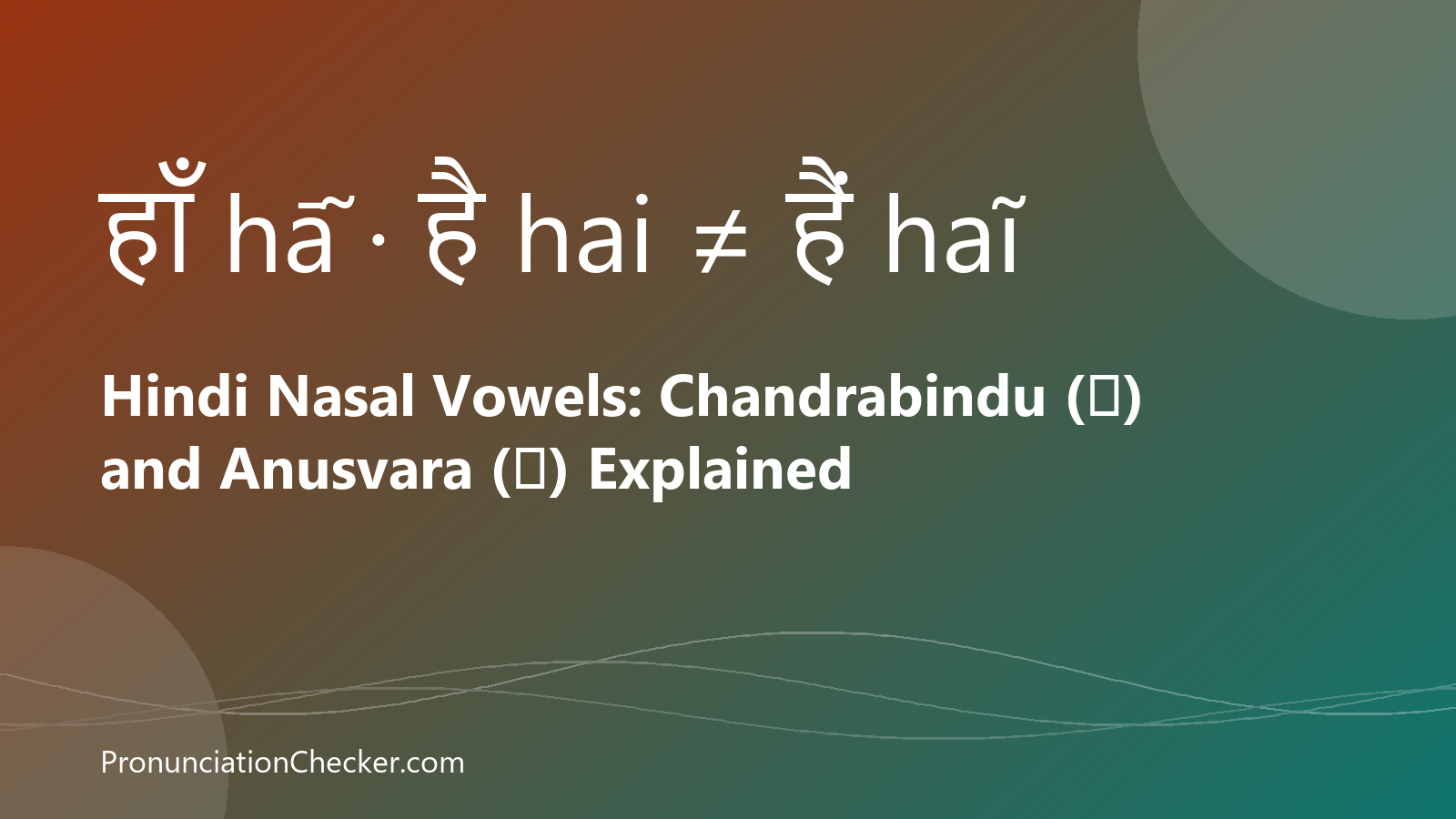
Hindi vowels can be oral or nasal, and the difference is often grammatical. Hai means "is" and haĩ means "are"; maĩ ("I") and mẽ ("in") both contain nasal vowels. Devanagari marks nasality with two signs, the chandrabindu ँ and the anusvara ं, and learning when each is a nasal vowel and when it is a nasal consonant makes reading far easier.
What a nasal vowel is
A nasal vowel is produced with the soft palate lowered, so air flows through the nose as well as the mouth. The tongue does not touch the roof of the mouth: there is no n or m consonant. If you know French or Portuguese nasal vowels, Hindi ones work the same way. For English speakers, try saying uh-huh with your mouth open, or say hang slowly and stop before the tongue touches the palate.
Chandrabindu ँ: always a nasal vowel
The chandrabindu, a small crescent with a dot, is placed above a letter to nasalise its vowel: hā̃ "yes", mā̃ "mother", gā̃v "village", ā̃kh "eye", cā̃d "moon", ū̃ṭ "camel".
Anusvara ं: vowel or consonant
The anusvara is a single dot above the letter. It has two jobs:
1. A nasal consonant before another consonant
Before a stop or affricate, the dot stands for the nasal consonant made at the same place as the following sound. This is a spelling shortcut for the full nasal letter:
| Before | ं sounds like | Example |
|---|---|---|
| क ख ग घ | [ŋ] | raṅg "colour", gaṅgā |
| च छ ज झ | [ɲ] | pañjāb, cañcal |
| ट ठ ड ढ | [ɳ] | ṭhaṇḍā "cold", ghaṇṭā "hour" |
| त थ द ध | [n] | ant "end", hindī |
| प फ ब भ | [m] | lambā "long", kambal "blanket" |
2. A nasal vowel where chandrabindu does not fit
When a vowel sign already sits above the line (ि ी े ै ो ौ), there is no room for the crescent, so the dot alone marks a nasal vowel: maĩ "I", haĩ "are", mẽ "in", nahī̃ "no, not", kyõ "why". In modern printed Hindi, the dot is also widely used instead of chandrabindu everywhere for convenience, so and both appear. Context tells you which is meant.
Pairs that differ only in nasality
| Oral | Nasal |
|---|---|
| hai "is" | haĩ "are" |
| sās "mother-in-law" | sā̃s "breath" |
| pūch "ask" | pū̃ch "tail" |
| god "lap" | gõd "glue" |
| kahā "said" | kahā̃ "where" |
Items in this drill: hai / haĩ; sās / sā̃s; pūch / pū̃ch; god / gõd; kahā / kahā̃.
Nasal vowels in grammar
Many Hindi grammatical endings are nasal vowels, which is why getting them right matters for being understood:
- Plural of the verb "to be": haĩ, hū̃ "am".
- Plural oblique nouns: laṛkõ "boys (oblique)", kitābẽ "books".
- Future and subjunctive forms: jāū̃, karẽ, milẽge.
- Pronouns and postpositions: maĩ, mẽ, yahā̃, vahā̃.
Phrases in this drill:
- मैं यहाँ हूँ।
- आप कहाँ हैं?
- मेरी माँ गाँव में रहती हैं।
- हाँ, मुझे नहीं पता।
- किताबें मेज़ पर हैं।
Frequently asked questions
What is the difference between chandrabindu and anusvara?
Chandrabindu (ँ, a crescent with a dot) always marks a nasal vowel. Anusvara (ं, a dot) marks either a nasal vowel or a nasal consonant that matches the following consonant. Where a vowel sign already occupies the top of the letter, the anusvara dot is used instead of chandrabindu for a nasal vowel: मैं, हैं, में.
Is ं pronounced as n or m?
Before a consonant it takes the place of that consonant's nasal: [ŋ] before k/g sounds (रंग raṅg), [n] before t/d (अंत ant), [m] before p/b (लंबा lambā), and so on. At the end of a word or before a vowel-like sound, it usually marks a nasal vowel.
Do nasal vowels really change meaning in Hindi?
Yes. हैं (haĩ, "are") vs है (hai, "is"), सास (sās, "mother-in-law") vs साँस (sā̃s, "breath"), and पूछ (pūch, "ask") vs पूँछ (pū̃ch, "tail") differ only in nasalisation.
Sources and further reading
- Ohala, M. (1983). Aspects of Hindi Phonology, chapter on nasalisation. Motilal Banarsidass.
- Ohala, M. (1999). Hindi. In Handbook of the International Phonetic Association, 100–103. Cambridge University Press.
- Kendriya Hindi Nideshalaya (Central Hindi Directorate) (2016). Devanagari Lipi tatha Hindi Vartani ka Manakikaran (Standardisation of Devanagari script and Hindi spelling). Government of India.
Disclosure: this page links to Preply, a tutoring marketplace. If you book a lesson through that link we may earn a commission, at no extra cost to you. It does not change what is recommended here. See our disclaimer and privacy policy.
Practise Hindi out loud
Type any sentence, listen to a native voice, then record yourself and see which words a speech recogniser understood.
Open the practice page