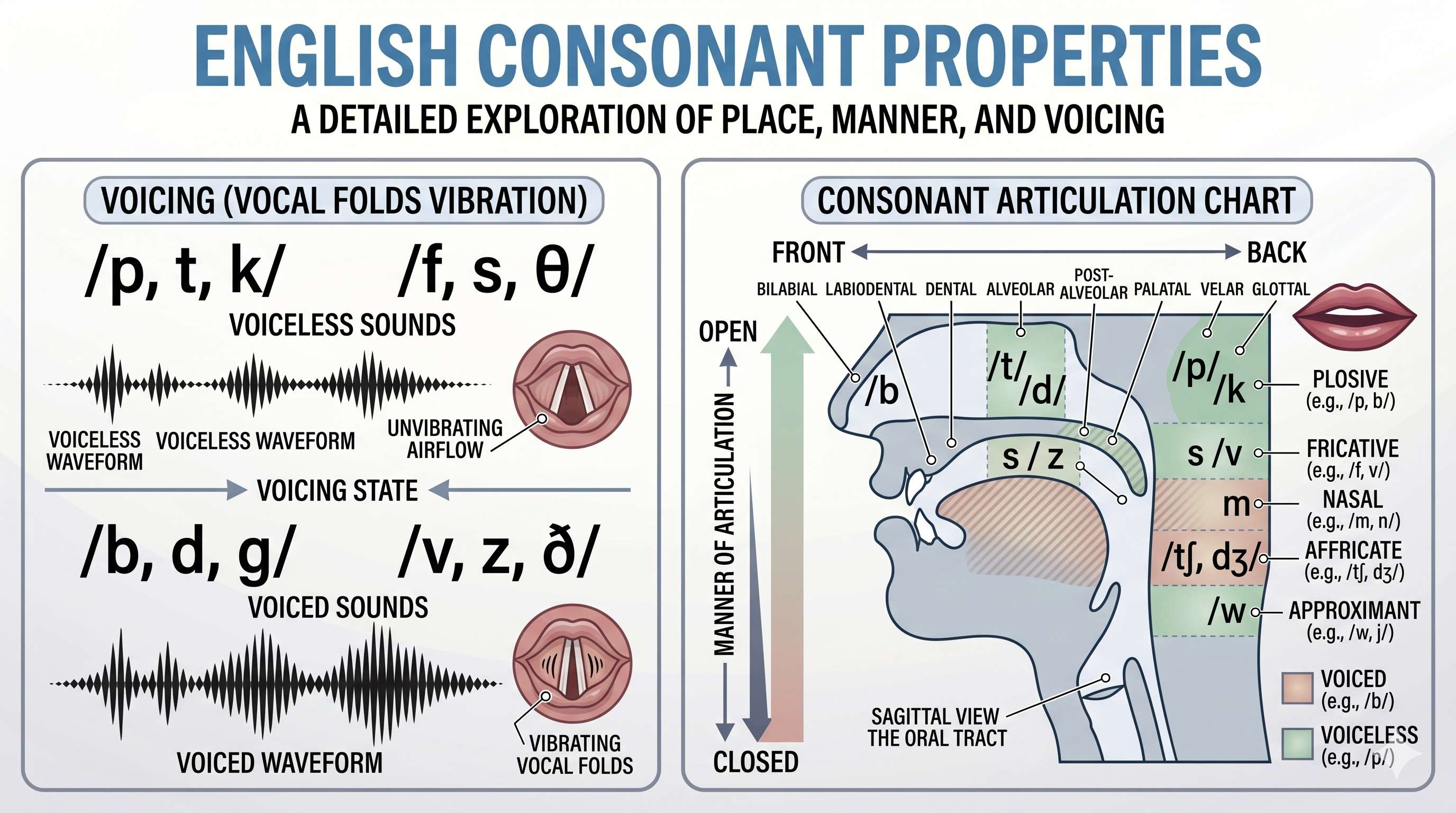
The IPA consonant chart looks like a spreadsheet of strange symbols, and most learners glance at it once and move on. That is a missed opportunity. The chart is really a set of instructions for your mouth, and reading it gives you a precise way to describe, and fix, a consonant you are getting wrong.
Try this: say fan and then van with your fingertips resting lightly on your throat. Your lips and teeth do exactly the same thing both times. The only difference is the buzz you feel on /v/. You have just found one of the chart's three dimensions, voicing. The other two, place and manner, are just as easy to feel once you know what to notice.
Every consonant answers three questions
The IPA consonant chart is a grid, and every cell in it is defined by three parameters. Once you can answer three questions about any sound, you can locate it on the chart and, more usefully, you can describe exactly how your version differs from the target.
- Where is the constriction? This is place of articulation, and it is the horizontal axis, running from the lips on the left to the throat on the right.
- How much does the airflow get obstructed? This is manner of articulation, the vertical axis, running from complete closure at the top to almost no obstruction at the bottom.
- Are the vocal folds vibrating? This is voicing, shown by paired symbols in each cell, voiceless on the left and voiced on the right.
Place: seven positions used by English
| Place | What touches what | English sounds |
|---|---|---|
| Bilabial | Both lips | /p b m w/ |
| Labiodental | Lower lip and upper teeth | /f v/ |
| Dental | Tongue tip and upper teeth | /θ ð/ |
| Alveolar | Tongue tip and the ridge behind the teeth | /t d s z n l/ |
| Post-alveolar | Tongue just behind the ridge | /ʃ ʒ tʃ dʒ ɹ/ |
| Velar | Back of tongue and soft palate | /k ɡ ŋ/ |
| Glottal | The vocal folds themselves | /h/, and the glottal stop /ʔ/ |
Run your tongue slowly from your upper teeth backwards along the roof of your mouth. You will pass the bumpy alveolar ridge, then the hard palate, then the soft palate. Those landmarks are the chart's horizontal axis, and you can locate every one of them by touch.
Manner: how the air gets out
| Manner | Airflow | English sounds | Can it be held? |
|---|---|---|---|
| Plosive | Blocked completely, then released | /p b t d k ɡ/ | No |
| Fricative | Forced through a narrow gap | /f v θ ð s z ʃ ʒ h/ | Yes |
| Affricate | Blocked, then released as friction | /tʃ dʒ/ | No |
| Nasal | Blocked in the mouth, out through the nose | /m n ŋ/ | Yes |
| Approximant | Narrowed, but not enough for friction | /w j ɹ/ | Yes, but it glides |
| Lateral | Blocked centrally, out over the sides | /l/ | Yes |
The manner test. Try to sustain the sound for five seconds. Fricatives, nasals and approximants can be held. Plosives and affricates cannot, because they begin with a complete closure. This single test separates the most commonly confused pairs, including /ʃ/ against /tʃ/ and /ʒ/ against /dʒ/.
Using the three parameters as a diagnostic
The real value of the chart is that it turns "that sounds wrong" into a specific instruction. Describe the target and your own version in all three parameters and the difference tells you what to change.
| Target | Common substitute | What differs | Instruction |
|---|---|---|---|
/θ/ dental fricative | /s/ alveolar fricative | Place only | Move the tongue forward to the teeth |
/θ/ dental fricative | /t/ alveolar plosive | Place and manner | Move forward and stop sealing the airflow |
/v/ labiodental fricative | /b/ bilabial plosive | Place and manner | Teeth on lip, and keep the air flowing |
/ʃ/ fricative | /tʃ/ affricate | Manner only | Remove the initial closure |
/z/ voiced fricative | /s/ voiceless fricative | Voicing only | Start the vocal folds; lengthen the preceding vowel |
/ŋ/ velar nasal | /n/ alveolar nasal | Place only | Move the closure back to the soft palate |
Notice how much more actionable this is than "your th sounds wrong". A difference in one parameter is a small correction; a difference in two requires changing two things at once, which explains why some substitutions take longer to fix than others.
What the empty cells mean
Large parts of the chart are blank, and the blanks are informative. Shaded cells represent articulations judged physically impossible — a velar trill, for instance, since the back of the tongue cannot vibrate against the soft palate. Empty unshaded cells represent sounds that are possible but that no documented language uses, or that simply do not occur in the language being described.
English uses only about twenty-four of the many cells on the full chart. When you learn a sound your first language lacks, you are filling in a cell you already have the anatomy for — which is why adults can and do acquire new consonants successfully, given accurate instructions about place and manner.
Frequently asked questions
What are place, manner and voicing?
They are the three parameters that define every consonant. Place is where the constriction happens, from the lips at the front to the glottis at the back. Manner is how much the airflow is obstructed, from complete closure in a plosive to barely any narrowing in an approximant. Voicing is whether the vocal folds vibrate. Any consonant can be located on the chart by answering those three questions.
How does the consonant chart help me fix a pronunciation error?
It converts a vague impression into a specific instruction. If you substitute /s/ for /θ/, the two differ only in place, so the fix is to move the tongue forward to the teeth. If you substitute /t/ for /θ/, they differ in place and manner, so you must move forward and also stop sealing the airflow. Knowing how many parameters differ also predicts how long the correction will take.
What is the difference between a fricative and an affricate?
A fricative forces air continuously through a narrow gap and can be held for as long as your breath lasts, like /ʃ/ in ship. An affricate begins with a complete closure and releases it into friction, so it cannot be sustained, like /tʃ/ in chip. Trying to hold the sound for five seconds is a reliable test that separates the two.
Why are parts of the IPA chart empty?
Shaded cells mark articulations judged physically impossible, such as a velar trill, since the back of the tongue cannot vibrate against the soft palate. Empty unshaded cells mark sounds that are possible but not used in the language being described, or not documented in any language. English uses only about twenty-four cells of the full chart.
Disclosure: this page links to Preply, a tutoring marketplace. If you book a lesson through that link we may earn a commission, at no extra cost to you. It does not change what is recommended here. See our disclaimer and privacy policy.
Explore the consonant chart
Click each consonant to hear it, then find its place, manner and voicing on the chart.
Open the interactive chart