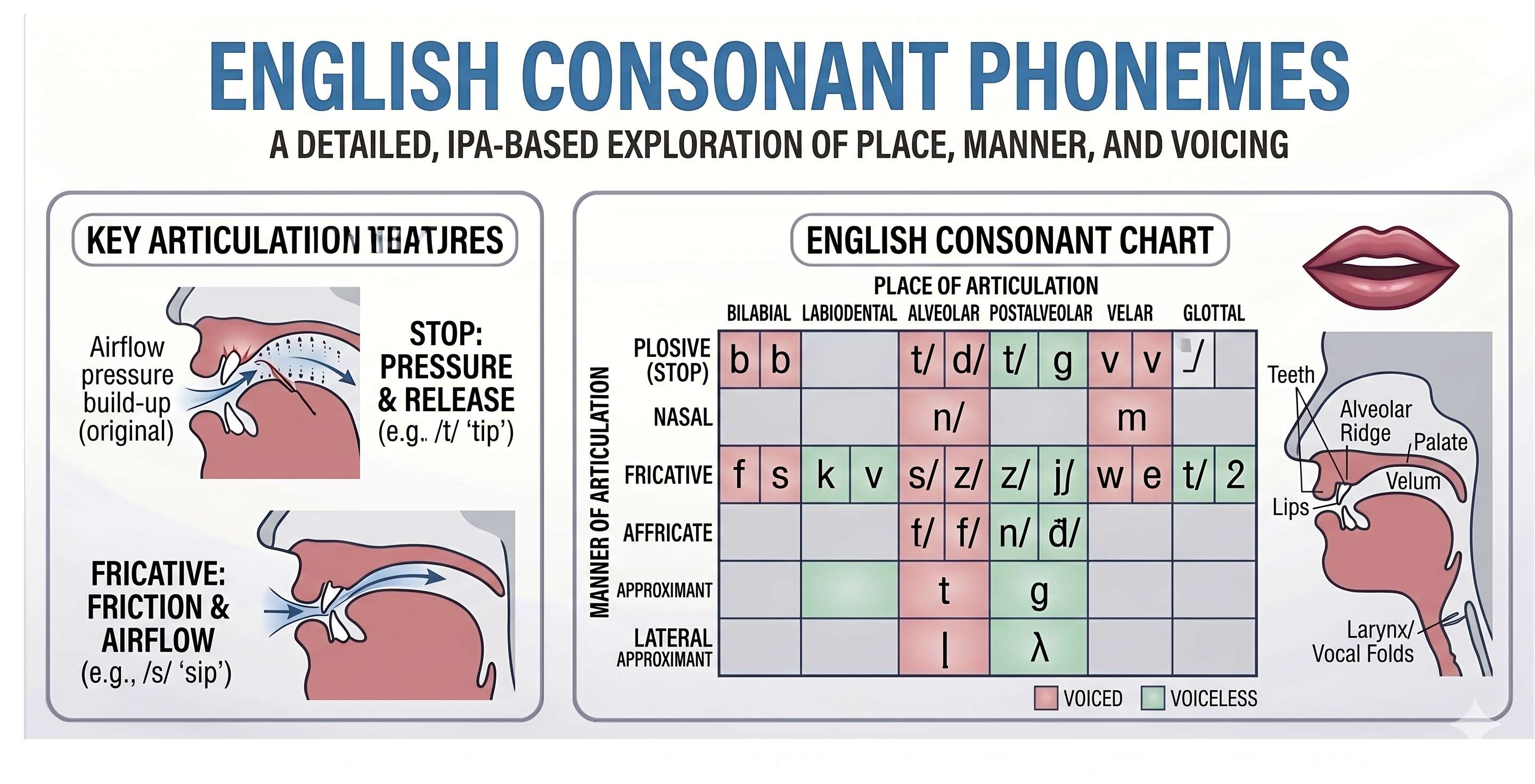
Phoneme by Phoneme: Breaking Down English Consonants Using IPA
English has around 24 consonant sounds, but English spelling uses only 21 consonant letters. This mismatch creates confusion: Does "c" sound like /k/ or /s/? Does "th" represent /θ/ (voiceless) or /ð/ (voiced)? Without understanding the underlying system, learners resort to memorization.
The International Phonetic Alphabet solves this by giving each consonant sound its own symbol. In this comprehensive phoneme-by-phoneme breakdown, we'll explore every English consonant: where it's made in your mouth, how the airflow is shaped, whether your vocal cords vibrate, and how to practice producing it. Think of this as your detailed blueprint for English consonant mastery.
Understanding English Consonants: The Framework
Every English consonant can be described using three characteristics:
1. Place of Articulation (Where?) - Where in your mouth or throat is the sound made?
2. Manner of Articulation (How?) - How does the airflow behave? Is it blocked completely, restricted, or flowing freely?
3. Voicing (Vibration?) - Are your vocal cords vibrating while producing the sound?
Understanding these three aspects lets you predict how a consonant should feel and sound, which dramatically accelerates learning.
Stop Consonants (Plosives / Oral Stops)
A stop consonant completely blocks the airflow, then releases it suddenly. English has six:
/p/ as in "pat" - Bilabial, voiceless stop
Both lips come together, blocking airflow. No vocal cord vibration. Feel your
lips press together and release with a small explosive burst of air.
/b/ as in "bat" - Bilabial, voiced stop
Same lip position as /p/, but with vibrating vocal cords. The vibration is
what makes it "voiced." Compare "pat" and "bat"—notice /p/ feels harder and
lighter, while /b/ feels softer with a buzz.
/t/ as in "tap" - Alveolar, voiceless stop
Your tongue touches the alveolar ridge (the bumpy ridge behind your upper
teeth). Release suddenly. This is perhaps the most familiar English consonant
to most learners.
/d/ as in "dap" - Alveolar, voiced stop
Same tongue position as /t/, but with vocal cord vibration. Compare "time" and
"dime" to feel the difference.
/k/ as in "kit" - Velar, voiceless stop
The back of your tongue contacts the soft palate (velum) at the back of your
mouth. Release. This sound is further back than /t/, so it might feel
different in your mouth.
/g/ as in "git" - Velar, voiced stop
Same position as /k/, but voiced. Compare "kit" and "git."
Practice Strategy: Use an interactive IPA chart to hear all six stops in sequence. Notice the pattern: voiceless stops (/p, t, k/) feel "sharp" and "hard," while their voiced counterparts (/b, d, g/) feel "softer" with a buzzing quality.
Fricative Consonants
Fricatives create a narrow opening through which air flows, creating audible friction (noise). English has nine fricatives:
/f/ and /v/ - Labiodental Fricatives
Your lower lip touches your upper teeth, creating a narrow gap. /f/ is
voiceless (as in "fan"), /v/ is voiced (as in "van"). Try saying "fan" and
"van" slowly—feel how the lip-teeth contact is identical, only the vibration
differs.
/θ/ and /ð/ - Dental Fricatives
Your tongue touches your teeth (dental position). /θ/ is voiceless (as in
"think"), /ð/ is voiced (as in "they"). These sounds are notoriously difficult
for many learners because they don't exist in most languages. Practice placing
your tongue between your front teeth and letting air flow around it.
/s/ and /z/ - Alveolar Fricatives
Your tongue approaches (but doesn't fully touch) the alveolar ridge, creating
a narrow opening for air to flow over. /s/ is voiceless (as in "sit"), /z/ is
voiced (as in "zip"). These are relatively easy for most learners because they
exist in many languages.
/ʃ/ and /ʒ/ - Postalveolar Fricatives
Your tongue is positioned just behind the alveolar ridge, and your lips round
slightly. /ʃ/ is voiceless (as in "ship"), /ʒ/ is voiced (as in "measure").
The lip rounding distinguishes these from /s, z/.
/h/ - Glottal Fricative
The sound is produced by air flowing through the glottis (space between the
vocal cords) while they're slightly open. /h/ is voiceless, as in "hat." In
some positions, especially before vowels, speakers may actually voice this
sound.
Practice Strategy: Fricatives create audible noise, so you can hear when you're producing them incorrectly. Use the interactive chart to compare voiceless-voiced pairs (/f-v/, /θ-ð/, /s-z/, /ʃ-ʒ/). Feel how voicing adds a buzz without changing the mouth position.
Affricates
Affricates are stop consonants followed immediately by friction. English has two:
/tʃ/ as in "chip" - Voiceless affricate
Starts as /t/ (tongue on alveolar ridge, blocking air), then releases into
friction similar to /ʃ/, creating a combined sound. This happens so quickly it
feels like a single sound.
/dʒ/ as in "jump" - Voiced affricate
The voiced version of /tʃ/. Same mouth positioning, but with vocal cord
vibration throughout. Compare "chip" and "jump."
Practice Strategy: Affricates are combination sounds, so practice them by first producing the stop component, then the fricative component slowly, then combining them gradually.
Nasals
Nasals are produced with air flowing through the nose while the mouth is blocked. All English nasals are voiced:
/m/ as in "mat" - Bilabial nasal
Both lips close, blocking mouth airflow. Air escapes through the nose. Your
vocal cords vibrate throughout.
/n/ as in "nap" - Alveolar nasal
Tongue touches the alveolar ridge, blocking mouth airflow. Air escapes through
the nose. Vibrating vocal cords.
/ŋ/ as in "sing" - Velar nasal
Back of tongue contacts the soft palate, blocking mouth airflow. Air escapes
through the nose. This sound doesn't exist in many languages, making it
challenging for some learners. Notice it appears at the end of words ("sing,"
"ring") but rarely at the beginning of English words.
Practice Strategy: All nasals are relatively easy because they naturally produce airflow through the nose. The challenge is the positioning. Use the interactive chart to distinguish /m, n, ŋ/ by place of articulation.
Approximants (Glides/Semi-Consonants)
Approximants have a narrowed vocal tract but less airflow turbulence than fricatives. English has four:
/w/ as in "wet" - Labial-velar glide
Your lips round and your back tongue moves toward the soft palate, creating a
narrowed but unobstructed passage. Voiced.
/j/ as in "yes" - Palatal glide
Your tongue moves toward the hard palate, creating a narrowed passage. Voiced.
This sound is similar in position to /i/ vowel, but articulated with more
constriction.
/l/ as in "let" - Lateral approximant
Your tongue touches the alveolar ridge (like for /t, d, n/), but air flows
around the sides of the tongue instead of over the top. Voiced. Many learners
from non-rhotic languages struggle with this.
/ɹ/ as in "red" - Alveolar approximant
Your tongue approaches (but doesn't touch) the alveolar ridge, with the tip
curled back slightly. Air flows over the top, creating a smooth /r/ sound.
Voiced. This is one of the most difficult English sounds for non-native
speakers.
Practice Strategy: Approximants are characterized by smooth airflow, not turbulence. Compare them to fricatives (which create friction noise) on the interactive chart. The differences become much clearer when you hear them.
Your Complete Consonant Practice Plan
Week 1: Hear and Compare - Spend 10-15 minutes daily on the interactive IPA chart. Listen to all 24 consonants, grouping them by place (bilabial, alveolar, etc.) or manner (stops, fricatives, etc.). Build familiarity.
Week 2: Focus on Difficult Sounds - Identify which consonants challenge you (often /θ, ð, ŋ, ɹ/). Practice these intensively. Record yourself, compare to reference audio.
Week 3-4: Apply to Words - Look up IPA transcriptions of words containing challenging consonants. Practice the words, then phrases, then sentences.
Week 5+: Integration - Use your improved consonant pronunciation in everyday English. Seek feedback from native speakers or use your interactive IPA chart as a reference for specific words.
Common Consonant Challenges by Native Language
Spanish speakers often struggle with: /v, ŋ, θ, ð, ɹ/ (these don't exist in Spanish)
French speakers often struggle with: /θ, ð, ŋ/ (dental fricatives and /ŋ/ are foreign)
Japanese speakers often struggle with: /l, ɹ/ (Japanese distinguishes these poorly; /ŋ/ is also challenging)
Chinese speakers often struggle with: /θ, ð, ŋ, ɹ, l, v/ (several of these don't exist in Mandarin)
If you know which sounds don't exist in your native language, you know exactly where to focus your practice efforts.
Maximize Your Learning with Interactive Tools
A static chart with written descriptions is helpful, but an interactive chart with audio is transformative. With an interactive tool, you can:
- Hear each consonant produced by a native speaker
- Click rapidly between similar sounds to hear their differences
- Record yourself attempting each sound
- Compare your recording to the reference side-by-side
This instant feedback loop is what separates effective practice from ineffective practice.
Master English Consonants Today
English consonants aren't mysterious or innate. They're physically produced sounds based on specific mouth, tongue, and vocal cord positions. By understanding the place, manner, and voicing of each consonant, and by practicing with high-quality audio reference, you can master them all.
Start your consonant breakdown journey with an interactive IPA chart:
https://pronunciationchecker.com/tools/interactive-IPA-sounds.html
Frequently asked questions
How many consonants does English have?
Twenty-four in most descriptions: the plosives /p b t d k ɡ/, the fricatives /f v θ ð s z ʃ ʒ h/, the affricates /tʃ dʒ/, the nasals /m n ŋ/, the approximants /w j ɹ/ and the lateral /l/. Some accounts add the glottal stop, which is an allophone in most varieties rather than a separate phoneme.
Which English consonants are rarest across the world's languages?
The interdental fricatives /θ/ and /ð/, which occur in only a small minority of languages, and the English /ɹ/, which is an unusual approximant quite different from the taps and trills most languages use for r. These two are difficult for structural reasons, not because learners are careless.
What is the difference between an affricate and a fricative?
An affricate begins with a complete closure and releases it into friction, so it cannot be sustained — /tʃ/ in chip. A fricative forces air continuously through a narrow gap and can be held as long as your breath lasts — /ʃ/ in ship. Trying to hold the sound for five seconds reliably separates the two.
Does the same consonant always sound the same?
No. English /p/ is aspirated in pin but not in spin, /t/ becomes a quick tap in American water, /l/ is clear in leaf and dark in feel, and final stops are often unreleased. These are allophones, so they never change which word you said, but using the wrong one is a large part of what makes an accent noticeable.
Disclosure: this page links to Preply, a tutoring marketplace. If you book a lesson through that link we may earn a commission, at no extra cost to you. It does not change what is recommended here. See our disclaimer and privacy policy.
Hear each consonant
Click any consonant on the chart for its sound and example words.
Open the IPA chart