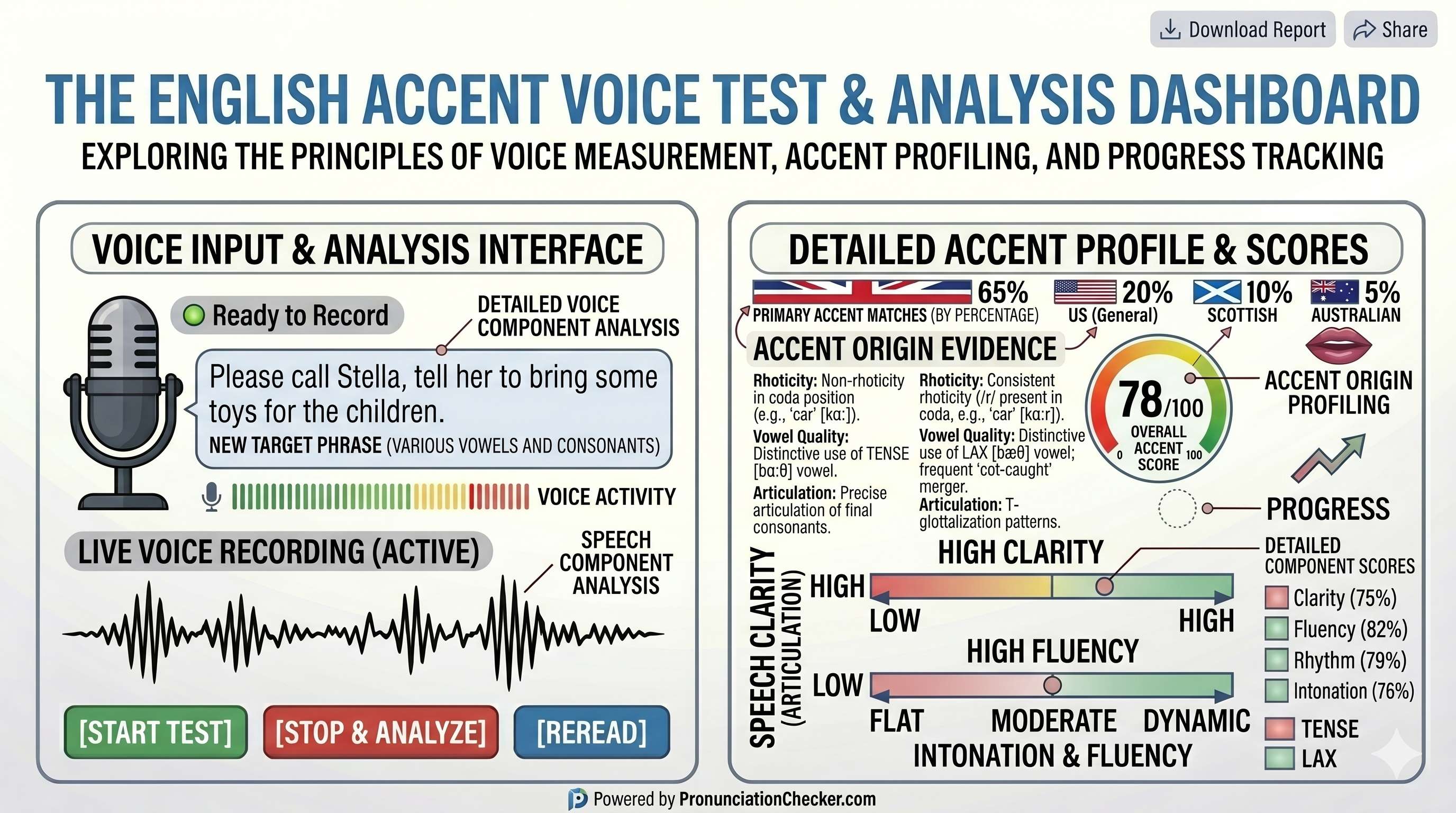
How close is your English accent to perfect? Take the 1-minute voice test
Have you ever wondered how your English accent measures up? Whether you’re a non-native speaker striving for clarity in international meetings or a native speaker curious about your regional quirks, the question lingers: is my accent clear, neutral, and easily understood by everyone?
The pursuit of a "perfect" English accent is a common goal—but what does "perfect" even mean? Is it the crisp Received Pronunciation of a British newsreader? The neutral clarity of General American? Or the easy-to-understand cadence of a proficient global citizen?
This article will debunk the myth of a single "perfect" accent and show you that clarity and confidence are the true goals. Most importantly, you’ll discover how to get an instant, objective answer about your pronunciation strengths and weaknesses with a simple, 1-minute voice test.
Debunking the myth: Is there a "perfect" accent?
Let’s get this out of the way first: there is no single, universally "perfect" English accent. English is a global language with countless beautiful and valid variations.
In a global context, however, "perfection" often means clarity, intelligibility, and neutrality. The goal is not to erase your identity but to ensure your pronunciation doesn’t create barriers to understanding.
So when we ask, “How close is your accent to perfect?” we’re really asking: “How clear and easily understood is your English to a global audience?”
The 3 pillars of clear accent: it's more than just sounds
A clear accent is built on three interconnected pillars:
1. Phonetics: the foundation of sounds
Producing vowel and consonant sounds accurately is essential. Common
challenges include TH
sounds (/ð/ and /θ/), vowel length distinctions (ship vs. sheep), and
mastering the /r/
sound in your target accent.
2. Prosody: the music of speech
This includes rhythm, stress, and intonation. Word stress (record vs. record),
sentence
stress, and natural pitch movement strongly influence intelligibility.
3. Fluency & flow: the connective tissue
Linking words, reducing unstressed syllables, and maintaining natural pacing
all contribute
to smooth, natural speech.
Why a 1-minute test can reveal so much
You might wonder how one minute can assess your accent. The answer lies in smart design. Carefully chosen sentences contain a wide range of sounds, stress patterns, and intonation contours.
By analyzing your recording, speech recognition technology can identify consistent pronunciation patterns and benchmark them against a standard model. In just 60 seconds, it gathers enough data to create a reliable snapshot of your pronunciation profile.
Your quick path to answers: the 1-minute English accent test
If you're ready for an honest and objective assessment, the best step is to take a structured pronunciation test.
This 1-minute English accent test is fast, free, and provides immediate, actionable feedback. Instead of just a score, you receive a breakdown of your strengths and specific areas for improvement—giving you a clear answer to “How close am I?”
What your test results really mean: a guide to interpretation
High score (90–100%): Your accent is highly clear and intelligible. Focus on refining intonation and rhythm for even greater naturalness.
Medium score (70–89%): You’re easily understood most of the time, but certain patterns may stand out. Targeted practice can create noticeable improvement.
Below 70%: Your pronunciation may sometimes hinder clarity. The report will identify specific root causes, giving you a focused roadmap for progress.
From analysis to action: how to improve based on your results
If specific sounds need work (phonetics):
Practice minimal pairs (ship vs. sheep), isolate challenging sounds, and
record yourself for
comparison.
If rhythm and stress need work (prosody):
Try shadowing exercises. Imitate short audio clips and copy the speaker’s
rhythm, stress,
and melody.
For overall flow:
Practice linking words naturally, listen actively to podcasts, and speak
regularly to build
comfort and fluency.
Beyond the test: adopting a mindset for accent clarity
Improving your accent is a marathon, not a sprint. Aim for clarity, not perfection. Your accent reflects your background—and that’s something to value.
Consistency is key. Five minutes of daily focused practice is more powerful than occasional long sessions.
Conclusion: your accent is a journey, not a destination
So, how close is your English accent to "perfect"? The answer is unique to you. Clear, confident communication isn’t about reaching a mythical standard—it’s about continuous improvement.
Stop wondering and start knowing. Take the 1-minute English accent test and get your personalized pronunciation report today.
What an accent test can and cannot measure
Before interpreting any result, it is worth being clear about what is being assessed. Automated accent and pronunciation tests generally evaluate three things well and several things poorly.
| Measured reliably | Measured unreliably |
|---|---|
| Whether individual words are recognisable | Rhythm and timing |
| Consistent phoneme substitutions | Intonation and pitch range |
| Word stress placement | Naturalness as opposed to correctness |
| Missing or inserted syllables | How a human listener would actually react |
A score is therefore a starting point for diagnosis, not a measure of how good your English is. The useful output of a test is not the number but the list of which items failed, because that list has a pattern in it.
Reading the pattern rather than the score
Take your failed items and sort them by what they have in common. Three or four categories usually account for nearly everything:
- All failures share a vowel. If ship, bit, fill, live fail while sheep, beat, feel, leave pass, you have a single merged contrast, not four separate problems.
- All failures are long words. This points to word stress rather than to individual sounds.
- All failures end in a consonant cluster. This points to cluster simplification, either deletion or vowel insertion.
- Failures are scattered with no pattern. This usually indicates a recording problem or an accent-setting mismatch rather than a pronunciation issue.
One test is not data. Speech recognition is probabilistic, and any single attempt can fail for reasons unrelated to your pronunciation. Take the same test three times on three different days and treat only the items that fail consistently as real findings. Items that fail once are noise.
Getting a result worth interpreting
- Quiet room, soft furnishings. Reverberation blurs consonant detail, which is exactly what the recogniser is analysing.
- 20 cm from the microphone, slightly off-axis. Speaking directly into a microphone produces bursts on
/p/and/b/that can mask neighbouring sounds. - Normal speaking rate. Speaking unusually slowly and carefully often lowers scores, because recognisers are trained on ordinary conversational tempo.
- Correct accent setting. A test configured for British English will penalise a consistent American pronunciation, and vice versa. This is one of the commonest causes of a confusingly low score.
- Same conditions each time. Comparing results across weeks only means something if the setup is constant.
Choosing a sensible target
It is worth deciding explicitly what you are aiming at, because the three common goals require quite different amounts of work.
| Goal | What it requires | Realistic timeline |
|---|---|---|
| Intelligibility — being understood without effort | Correct word stress; no merged contrasts in common words; audible rhythm | 6–12 months of consistent work |
| Comfortable listening — listeners stop noticing the accent | The above, plus connected speech, weak forms and pitch range | 1–3 years |
| Native-like — being mistaken for a native speaker | Allophonic detail, regional features, sociolinguistic variation | Rarely achieved after childhood |
Intelligibility is the goal that matters for work, study and daily life, and it is reliably achievable for adult learners. Research on international communication consistently finds that a clear non-native accent poses no barrier to effective communication, whereas misplaced word stress and merged vowel contrasts do. Aiming at intelligibility rather than at sounding native is not lowering the bar; it is aiming at the thing that actually affects outcomes.
What to do with the results
- Identify the single most frequent error pattern from your consistent failures.
- Check whether it is a perception problem: can you hear the contrast when someone else produces it? If not, start with listening.
- Work on that one target for three to four weeks, through isolation, sentences and spontaneous speech.
- Retake the same test under the same conditions and compare the specific items, not the overall score.
- Move to the next pattern.
Comparing item-level results rather than scores matters because overall scores move slowly and noisily, while the disappearance of a specific error pattern is unambiguous and visible within one cycle.
Frequently asked questions
What does an automated accent test actually measure?
Whether a speech recogniser trained largely on native speech produces the expected transcription of what you said. That captures word recognisability, consistent phoneme substitutions, word stress and missing syllables reasonably well, but it captures rhythm, intonation and naturalness poorly. The useful output is the list of items that failed rather than the overall score.
Why did I get a low score when people understand me fine?
Several possible reasons, and only one is your pronunciation. Check the recording conditions first, since reverberation and microphone distance both degrade recognition. Check the accent setting, because a test configured for British English will penalise consistently American pronunciations. Also check your speaking rate, since speaking unusually slowly often lowers scores. Only after those should you treat the result as a pronunciation finding.
How many times should I take a test before trusting the result?
Three times on three different days, under the same conditions. Speech recognition is probabilistic and any single attempt can fail for reasons unrelated to your speech, so only items that fail consistently across attempts are real findings. Items that fail once are noise and should be ignored.
Should I aim to sound like a native speaker?
Intelligibility is the goal that affects work, study and daily life, and it is reliably achievable for adult learners within six to twelve months of consistent work. Research on international communication finds that a clear non-native accent poses no barrier to effective communication, whereas misplaced word stress and merged vowel contrasts do. Being mistaken for a native speaker is rarely achieved after childhood and is not what intelligibility requires.
Disclosure: this page links to Preply, a tutoring marketplace. If you book a lesson through that link we may earn a commission, at no extra cost to you. It does not change what is recommended here. See our disclaimer and privacy policy.
Record your one-minute sample
Read the test passage and get a word-by-word breakdown of what was recognised.
Start the accent test