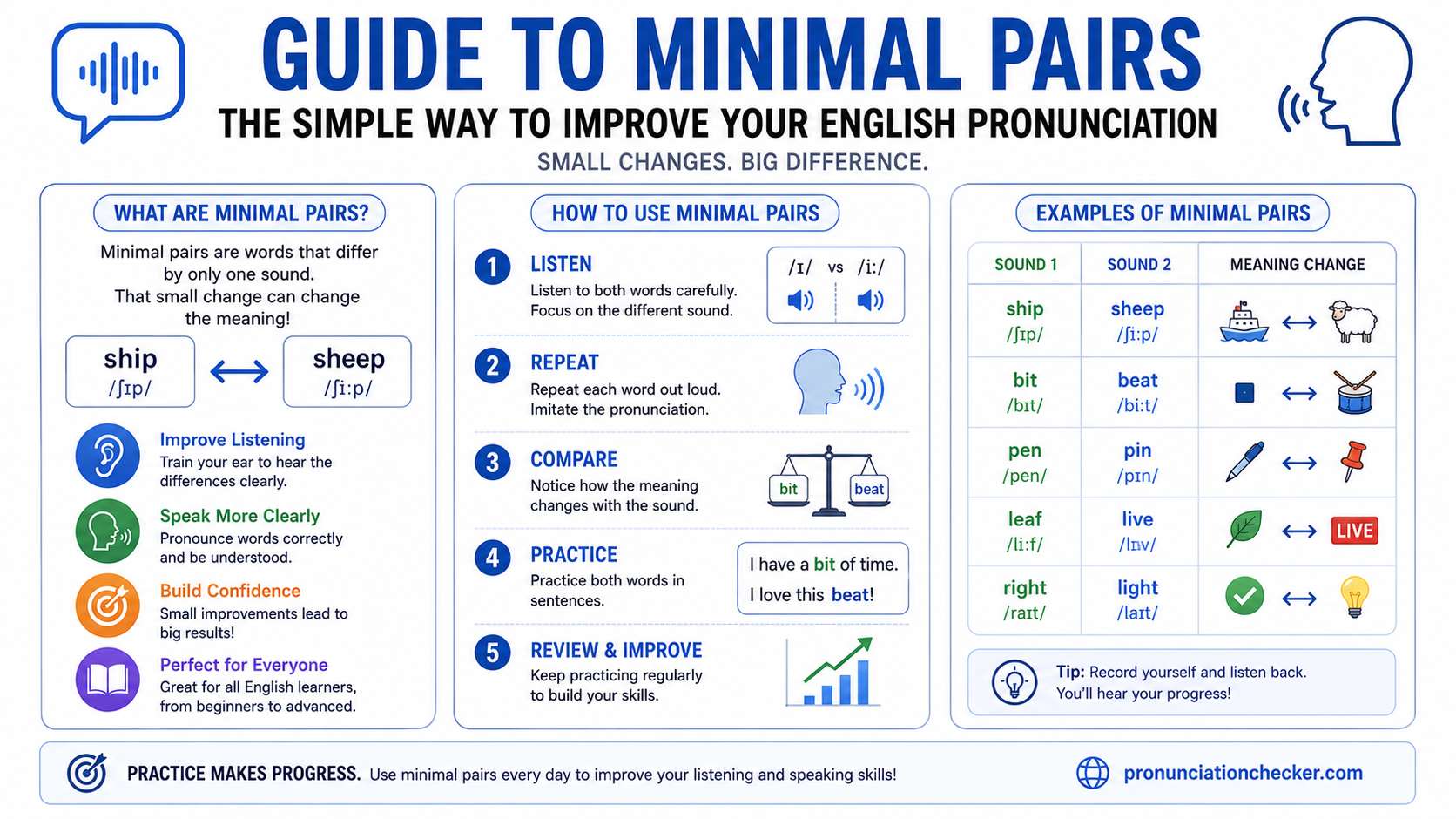
Ship and sheep. Light and right. Fan and van. A minimal pair is two words that differ in exactly one sound. Because everything else is identical, they isolate the one contrast you need to hear and produce, which makes them the most direct pronunciation exercise there is.
They are also often used badly: learners read lists aloud, repeat after a single recording, and stop once the words sound right in isolation. This guide explains what minimal pairs are for, then gives a method based on what research on second-language speech perception actually supports.
What a minimal pair shows
If changing one sound changes the word, those two sounds are separate phonemes in the language. Pat and bat prove that /p/ and /b/ are different phonemes in English. That is the linguistic definition, and it has a practical consequence: every minimal pair is a place where a pronunciation error can turn into a misunderstanding.
| Contrast | Example pairs | Often difficult for speakers of |
|---|---|---|
| /iː/ – /ɪ/ | sheep, ship · leave, live · feet, fit | Spanish, Portuguese, Italian, French, Arabic |
| /l/ – /r/ | light, right · glass, grass · collect, correct | Japanese, Korean, Chinese languages |
| /b/ – /v/ | berry, very · best, vest · boat, vote | Spanish, Korean, Japanese |
| /p/ – /b/ | pat, bat · pie, buy · cap, cab | Arabic |
| /θ/ – /s/, /t/, /f/ | think, sink · three, tree · thin, fin | Almost every learner |
| /v/ – /w/ | vine, wine · vest, west · vet, wet | German, Russian, Hindi, Turkish |
| /e/ – /æ/ | bed, bad · men, man · pen, pan | Most European and Asian languages |
Each of these contrasts has its own detailed guide with articulation tips and drills: short vowels, R and L, P, B, F and V, TH, V and W and SH, CH and J. For long word lists, see the minimal pairs list.
Why some pairs sound identical to you
Babies can distinguish the sounds of every language. During the first year, exposure to one language narrows that ability: contrasts that matter at home sharpen, and contrasts that do not are gradually ignored. By adulthood you have an efficient system that files English sounds into your first language's categories.
When English uses two sounds where your language has one, both get filed together. Ship and sheep then really do sound like the same word to you. This is not a hearing problem or a lack of talent. It is the normal result of learning your first language well, and it is exactly what minimal pair training retunes.
Perception has to come before production
The most common way minimal pair practice fails is that learners begin by speaking. If your brain has categorised two English sounds as a single category, you cannot monitor your own output, because the error is inaudible to you. Speaking practice under those conditions rehearses the mistake.
Research on second-language speech perception, in particular work on perceptual assimilation and on high variability phonetic training, points consistently in one direction: train the ear first, then the mouth. Learners who complete a perception phase before beginning production tend to reach accurate production faster than those who start with production.
A quick self-test. Have someone read twenty words from a pair set in random order while you write down what you hear. Below 70% correct, you have a perception problem and production drills will not help yet. Between 70% and 90%, train both together. Above 90%, the work is motor and you should be recording yourself.
The three-stage protocol
| Stage | Task | Move on when |
|---|---|---|
| 1. Discrimination | Hear two words and decide whether they are the same or different. No labels required. | 95% correct over 20 trials |
| 2. Identification | Hear one word and decide which of the two it is. This requires a stable category. | 90% over 20 trials, three sessions running |
| 3. Production | Say the word, record it, and check against a reference or a speech recogniser. | Correct in sentences, not only in isolation |
Stage two is where most learners plateau, and the plateau is informative rather than discouraging: it means the contrast has not yet become a category, only a difference you can sometimes detect.
Use many voices, not one
This is the finding most learners never hear about. Training with a single speaker produces improvement that does not transfer well: you learn to identify that person's /iː/ rather than the English category. Training with several different voices, including different genders, ages, speaking rates and accents, takes longer to show gains but transfers to new speakers and lasts.
In practice, do not build your practice around one textbook recording. Collect the same pair set from several sources: a dictionary with British and American audio, film clips, podcasts, a text-to-speech tool with several voices, and a conversation partner.
Build the list from your own errors
Generic lists waste time on contrasts you already control. A list built from a recording of your own speech is far more efficient. It takes about forty minutes once, and then serves for months.
- Record yourself speaking freely for three minutes: describe your day, or read a news article aloud.
- Listen back with a transcript and mark every word that sounds unlike your model accent. Do not analyse yet.
- Group the marked words by sound. Usually three or four recurring contrasts account for most of the marks.
- Rank them by how common the sounds are in English, not by how wrong they sound. A small error in /ɪ/ affects far more of your speech than a large error in /ʒ/.
- Build pair sets for the top two contrasts only, and ignore the rest for now.
Move to sentences earlier than feels comfortable
Accuracy in single words is a poor predictor of accuracy in conversation. The contrast has to hold while you also manage grammar, vocabulary and meaning. Build sentences where the wrong sound produces a genuinely different sentence, so the feedback is about meaning rather than sound:
- I need a sheet of paper against I need a ship of paper
- He's living in London against He's leaving in London
- Can you fill the glass? against Can you feel the glass?
- She sat on the bed against She set on the bad
A schedule that fits real life
| Week | Focus | Daily time |
|---|---|---|
| 1 | Discrimination on contrast A, several voices | 10 min |
| 2 | Identification on contrast A; begin production | 10 min + 5 min recording |
| 3 | Contrast A in sentences; begin discrimination on contrast B | 15 min |
| 4 | Contrast A in free speech; identification on contrast B | 15 min |
Fifteen minutes a day beats ninety minutes a week, because perceptual learning consolidates during sleep and benefits from exposure spread across days. Keep a simple score log: the numbers show progress during the weeks when your own ear tells you nothing has changed.
Frequently asked questions
What is a minimal pair?
Two words that differ in only one sound, such as ship and sheep or light and right. They show which sounds are separate phonemes in a language, and they are used to train both listening and pronunciation.
How long does minimal pair training take to work?
Most learners notice better perception of one contrast within two to four weeks of short daily practice. Reliable production in spontaneous speech usually takes longer, often two to three months per contrast.
Should I practise listening or speaking first?
Listening. If two sounds are the same to your ear, you cannot tell whether your own pronunciation is right. Reach about 90 per cent accuracy in identification before focusing on production.
Which minimal pairs should I practise first?
The ones your own speech gets wrong, ranked by how common the sounds are. For most learners that means a vowel contrast such as /iː/ and /ɪ/ before rarer contrasts such as /θ/ and /ð/.
Sources and further reading
- Best, C. T. and Tyler, M. D. (2007). Nonnative and second-language speech perception: Commonalities and complementarities. In Bohn, O.-S. and Munro, M. J. (eds.), Language Experience in Second Language Speech Learning. John Benjamins.
- Logan, J. S., Lively, S. E. and Pisoni, D. B. (1991). Training Japanese listeners to identify English /r/ and /l/: A first report. Journal of the Acoustical Society of America, 89(2), 874–886.
- Thomson, R. I. (2018). High variability [pronunciation] training (HVPT): A proven technique about which every language teacher and learner ought to know. Journal of Second Language Pronunciation, 4(2), 208–231.
- Kuhl, P. K. (2004). Early language acquisition: Cracking the speech code. Nature Reviews Neuroscience, 5(11), 831–843.
Disclosure: this page links to Preply, a tutoring marketplace. If you book a lesson through that link we may earn a commission, at no extra cost to you. It does not change what is recommended here. See our disclaimer and privacy policy.
Try your first minimal pair set
Listen, choose which word you heard, and repeat until the contrast is automatic.
Start minimal pairs