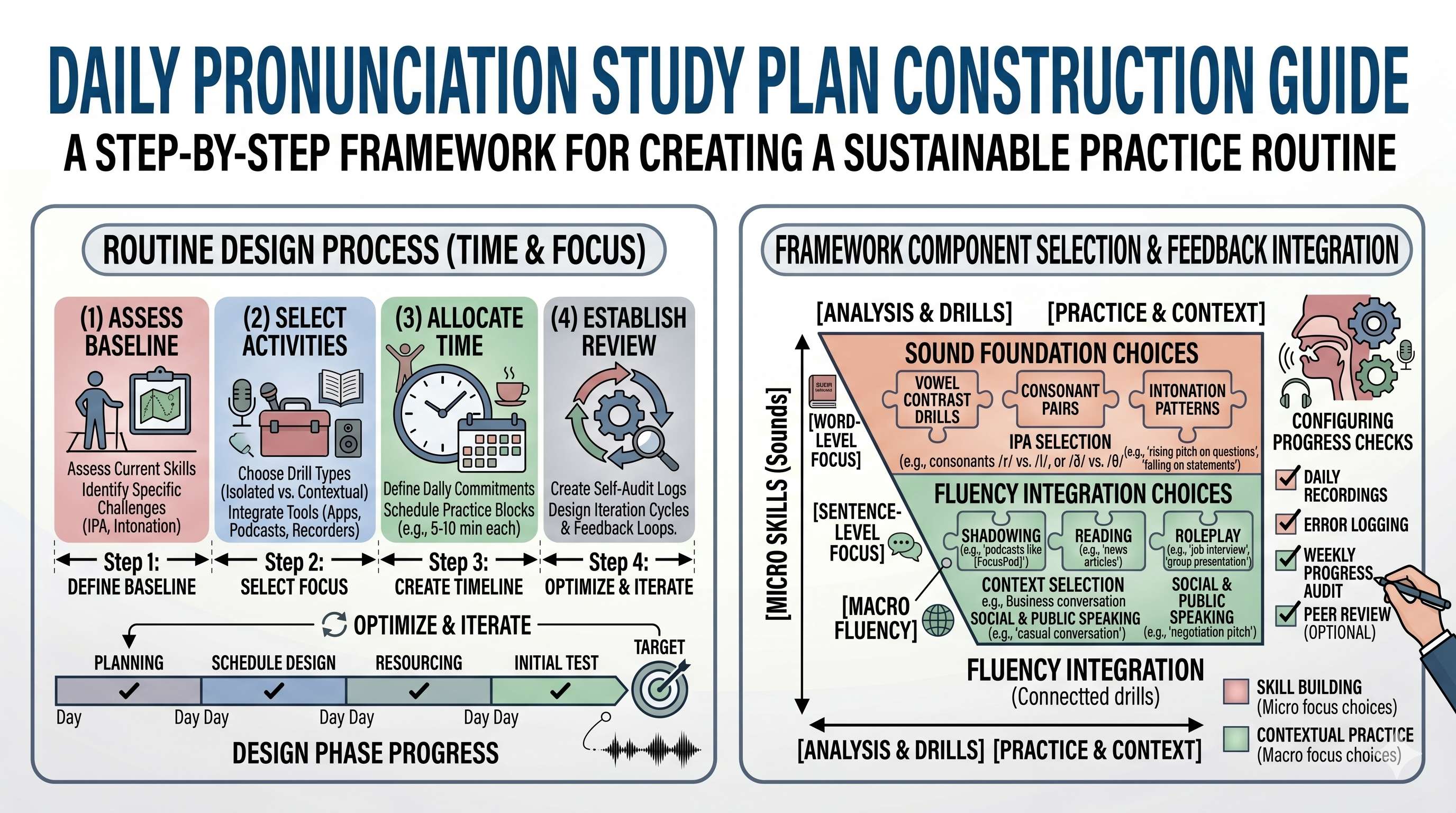
Fifteen focused minutes a day beats a two-hour session on Saturday, and it is not close. Pronunciation is partly a motor skill, and motor skills consolidate between practice sessions, especially during sleep, so frequency matters more than duration.
The hard part is not finding the time. It is knowing what to do with it. Below is a plan that fits in a quarter of an hour, a four-week cycle for each target, and honest estimates of how long change takes. All you need is a phone to record yourself.
The constraint that makes a plan work
The most common reason pronunciation plans fail is that they target everything. A plan that lists vowels, consonants, stress, rhythm and intonation spreads attention so thin that nothing consolidates, and after two months the learner cannot point to a single thing that changed.
Work on one target at a time. A target is a specific contrast or feature — the /iː/ and /ɪ/ distinction, or reducing function words, or aspirating initial /p t k/. Each target takes roughly three to four weeks. That means around a dozen targets a year, which is more than enough to change an accent substantially.
How to choose the first target. Record three minutes of free speech, listen for errors, and rank them by how often the sound occurs in English rather than by how wrong it sounds. A small imprecision in /ə/ or /ɪ/ affects far more of your speech than a large error in /ʒ/. Frequency beats severity when you are choosing where to spend a month.
A fifteen-minute daily structure
| Minutes | Activity | Purpose |
|---|---|---|
| 0–3 | Listening: the target contrast, multiple speakers | Keeps perception ahead of production |
| 3–7 | Isolated practice: words containing the target | Builds the motor pattern |
| 7–11 | Sentences containing the target | Tests survival under grammatical load |
| 11–14 | Shadowing 30 seconds of natural speech | Rhythm and intonation; integrates everything |
| 14–15 | Record and log two lines | Evidence and next-session direction |
Fifteen minutes daily outperforms ninety minutes once a week, and the reason is not motivational. Motor learning and perceptual learning both consolidate during sleep, so the number of nights between practice sessions matters as much as the total hours. Six short sessions across six nights produce more change than one long session, even when the total time is smaller.
What a four-week cycle looks like
| Week | Emphasis | Success criterion |
|---|---|---|
| 1 | Perception. Mostly listening; minimal speaking. | 90% on a 20-item identification test |
| 2 | Production in isolation. Single words, recorded. | Consistently correct in a word list |
| 3 | Production in sentences, reading aloud. | Correct while reading unfamiliar text |
| 4 | Spontaneous speech. Speak freely on a topic. | Correct when attention is on meaning |
Week four is the one learners skip, and skipping it is why drills so often fail to transfer. A sound you can produce while reading a list is not yet a sound you own. The test is whether it survives when you are thinking about what to say rather than how to say it.
Realistic timelines
Being honest about this prevents the disappointment that ends most study plans.
- Days: you can learn to produce a new sound in isolation, sometimes within a single session with clear articulatory instructions.
- Two to four weeks: reliable perception of a new contrast with daily listening.
- One to three months: consistent production of one contrast in connected speech.
- Six to twelve months: a broadly noticeable change in overall intelligibility and rhythm.
- Years, and often never: being mistaken for a native speaker — which is not a sensible goal, and not what intelligibility requires.
What to leave out
Three activities occupy a lot of learner time and produce very little pronunciation change:
- Passive listening. Background podcasts while commuting improve familiarity and vocabulary but do almost nothing for pronunciation, because there is no comparison against your own output.
- Repeating after audio without recording. Without a recording you are evaluating yourself through bone conduction, which is not what listeners hear. You will judge yourself as closer to the model than you are.
- Long lists of unrelated words. Fifty words covering fifteen different sounds produces fifteen shallow exposures. Twenty words on one target produces one deep exposure, and depth is what consolidates.
Planning for interruptions
Every plan gets broken by travel, illness and work. The recovery rule matters more than the plan itself: when you miss days, do not restart the cycle and do not try to compensate with a long session. Resume at the week you were in, at the normal length. Learners who treat a gap as a failure and restart from week one rarely complete a cycle at all, which is the actual failure mode — not the missed days.
Frequently asked questions
How long should I practise pronunciation each day?
Fifteen minutes daily is more effective than ninety minutes once a week, and the reason is physiological rather than motivational. Both motor learning and perceptual learning consolidate during sleep, so the number of nights between sessions matters as much as total hours. Six short sessions across six nights produce more change than one long session even when the total time is smaller.
How many sounds should I work on at once?
One. A single contrast or feature takes roughly three to four weeks to move from perception through to spontaneous speech, which gives you about a dozen targets a year — enough to change an accent substantially. Plans that target vowels, consonants, stress and intonation simultaneously spread attention so thin that nothing consolidates.
How do I choose which sound to work on first?
Record three minutes of free speech, note your errors, and rank them by how frequently the sound occurs in English rather than by how wrong it sounds. A small imprecision in schwa or /ɪ/ affects far more of your speech than a large error in a rare sound such as /ʒ/. Frequency beats severity when you are deciding where to spend a month.
What should I do if I miss several days of practice?
Resume at the week you were in, at the normal session length. Do not restart the cycle and do not attempt to compensate with a long catch-up session. Learners who treat a gap as a failure and start again from the beginning rarely complete a cycle at all, and that is the real failure mode rather than the missed days themselves.
Disclosure: this page links to Preply, a tutoring marketplace. If you book a lesson through that link we may earn a commission, at no extra cost to you. It does not change what is recommended here. See our disclaimer and privacy policy.
Fill your first fifteen minutes
Use the exercise library for the production block and record yourself at the end.
Pick an exercise