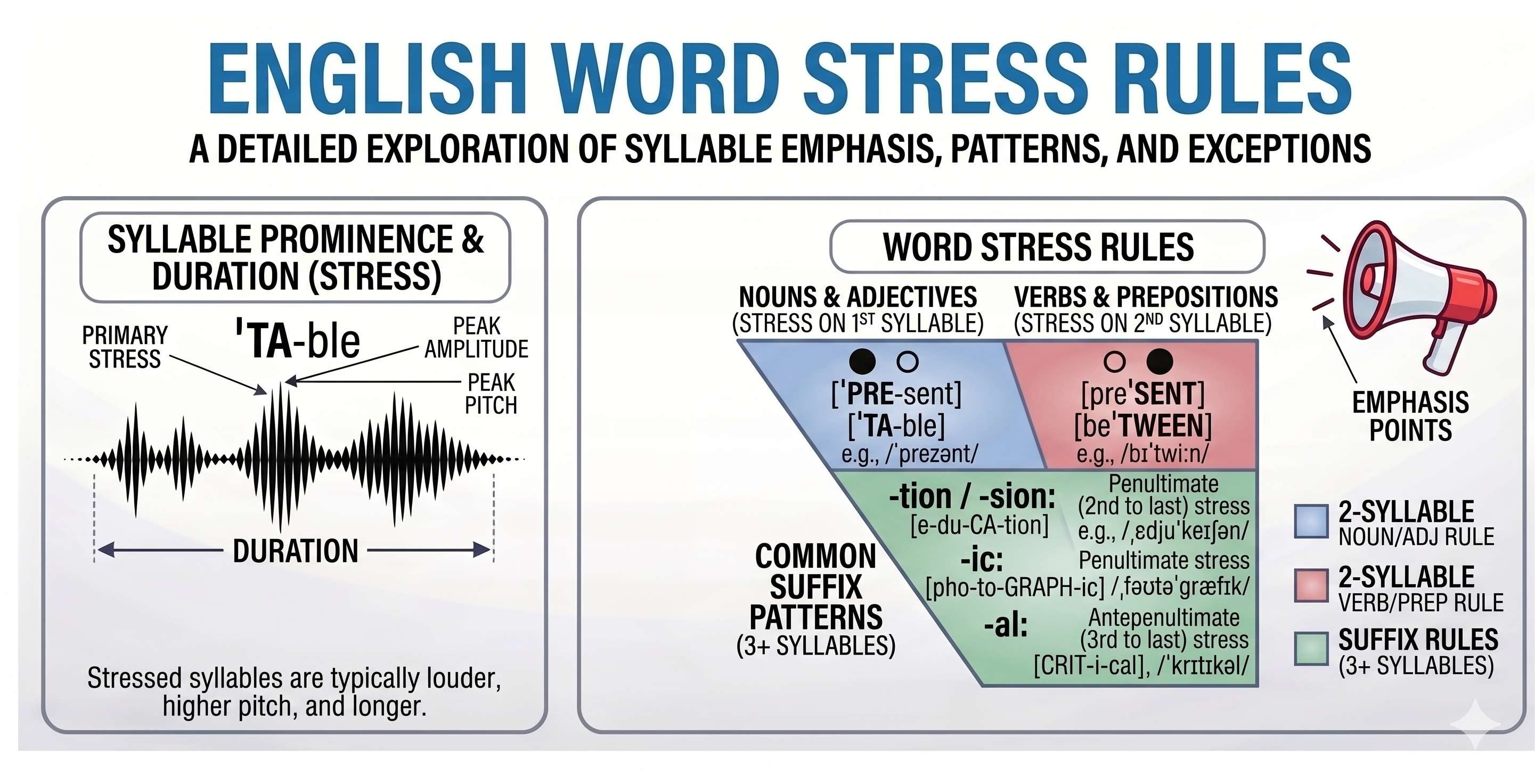
Say photograph, photographer, photographic. The loud syllable moves: PHO-to-graph, pho-TOG-ra-pher, pho-to-GRAPH-ic. And as it moves, the vowels around it change. The first o is a full vowel in photograph but a schwa in photographer.
That is why word stress matters so much. It is not only loudness; it reorganises the vowels of the whole word, and English listeners rely on it to recognise words at all. This guide explains why a stress error costs more than a sound error, the suffixes that predict stress, noun and verb pairs (a REcord, to reCORD), compound nouns, and how to check the stress of a word you do not know.
Stress errors cost more than sound errors
Intelligibility research repeatedly finds that misplacing word stress disrupts comprehension more than substituting an individual consonant or vowel. English listeners appear to use the stressed syllable as the key for retrieving a word from memory, so a word with the wrong stress may not be recognised at all, while a word with a wrong consonant but correct stress usually is.
Say comFORtable instead of COMfortable, or deVElop instead of deVELop, and many listeners will simply not identify the word. That asymmetry means that if you have limited practice time, stress is where it pays off.
What stress consists of. A stressed English syllable is longer, louder, higher in pitch, and has a full undistorted vowel. Of these, length and pitch do most of the work. Learners who stress by volume alone often remain hard to follow, because the rhythmic cue listeners use is duration.
Suffixes that determine stress
English stress is often described as unpredictable. It is more accurate to say that it is predictable from word endings, and a handful of patterns cover a large share of academic and professional vocabulary.
| Ending | Stress falls on | Examples |
|---|---|---|
| -tion, -sion, -cian | Syllable before the ending | eduCAtion, deCIsion, muSIcian, informAtion |
| -ity, -ety | Syllable before the ending | aBILity, uniVERsity, soCIety, posSIbility |
| -ical, -ic | Syllable before the ending | ecoNOMic, hisTORical, phoTOgraphic, sciEntific |
| -ial, -ious, -ual | Syllable before the ending | esSENtial, mySTErious, inteLLECtual |
| -graphy, -logy, -metry, -nomy | Third from the end | phoTOgraphy, bioLOgy, geOMetry, eCOnomy |
| -ee, -eer, -ese, -ette | The ending itself | employEE, engiNEER, JapanESE, cigarETTE |
| -ate (verbs) | Third from the end | COMmunicate, PARticipate, DEMonstrate |
| -ish, -ly, -ful, -ness, -able, -ment | No change — keeps the root's stress | FOOLish, HAPPily, BEAUTiful, deVELopment |
The last row is the most useful one to internalise, because it covers a very large number of derived words. Adding -ment, -ness, -ful, -able or -ly never moves the stress.
The noun and verb pairs
Around a hundred English words function as both a noun and a verb, with stress on the first syllable for the noun and the second for the verb. The unstressed syllable also reduces to schwa, so the two versions differ in more than pitch.
| Word | Noun | Verb | Sentence |
|---|---|---|---|
| record | RE-cord | re-CORD | I'll reCORD a new REcord. |
| present | PRE-sent | pre-SENT | They'll preSENT the PRESent. |
| increase | IN-crease | in-CREASE | We must inCREASE the INcrease. |
| object | OB-ject | ob-JECT | I obJECT to that OBject. |
| contract | CON-tract | con-TRACT | Sign the CONtract to conTRACT the work. |
| permit | PER-mit | per-MIT | They won't perMIT it without a PERmit. |
| conduct | CON-duct | con-DUCT | His CONduct was poor when he conDUCTed it. |
Others in the same family: conflict, contrast, export, import, insult, progress, project, protest, rebel, refuse, subject, suspect, transfer.
Compound nouns against adjective plus noun
This pattern changes meaning and is among the most reliable rules in English. A compound noun — a single concept — takes stress on the first element. An adjective followed by a noun takes stress on the second.
- a GREENhouse (a building for plants) against a green HOUSE (a house painted green)
- a BLACKboard (for writing on) against a black BOARD (a board that is black)
- the WHITE House (the residence) against a white HOUSE
- an ENGLISH teacher (teaches English) against an English TEACHER (a teacher from England)
- a MOVING van (for removals) against a moving VAN (a van in motion)
The pattern extends predictably: BUS stop, POST office, CREDIT card, SWIMMING pool, MOBILE phone, COFFEE shop, TRAFFIC light.
How to check stress on a word you do not know
- Look it up and read the transcription. The mark
ˈprecedes the stressed syllable: photography/fəˈtɑːɡrəfi/. - Find the schwas. Every
/ə/marks an unstressed syllable, so schwas point at the stress by elimination. - Check the ending against the suffix table above.
- Say the word three times with stress on different syllables. The correct one usually sounds obviously right once you have heard the word before — this is your stored representation confirming itself.
When you record a new word in a vocabulary notebook, capital-letter the stressed syllable rather than writing the whole word in lower case. Storing stress alongside spelling from the beginning is far cheaper than correcting it after the word has been learned incorrectly.
Frequently asked questions
Is English word stress predictable?
More than its reputation suggests. Word endings determine stress in a large share of vocabulary: -tion, -ity, -ic and -ial all place stress on the syllable immediately before them, -graphy and -logy place it third from the end, and -ee and -eer place it on the ending itself. Endings such as -ment, -ness, -ful, -able and -ly never move the stress from the root.
Why do listeners misunderstand me when my sounds are correct?
Very often it is word stress. Research on intelligibility finds that misplaced stress disrupts comprehension more than a substituted consonant or vowel, because English listeners use the stressed syllable to retrieve the word from memory. Comfortable said as comFORtable may not be recognised at all, while a word with a wrong consonant but correct stress usually is.
What is the rule for words like record that are both a noun and a verb?
Stress the first syllable for the noun and the second for the verb: a REcord, but to reCORD. The unstressed syllable also reduces to schwa, so the two forms differ in vowel quality as well as pitch. About a hundred words follow this pattern, including present, increase, object, contract, permit, conduct, export, import, protest and suspect.
How do I stress a syllable correctly?
Make it longer and higher in pitch, with a full undistorted vowel, and let the surrounding syllables shorten and reduce. Length and pitch do most of the work. Learners who stress mainly by increasing volume often remain hard to follow, because the cue English listeners actually track is duration relative to the neighbouring syllables.
Disclosure: this page links to Preply, a tutoring marketplace. If you book a lesson through that link we may earn a commission, at no extra cost to you. It does not change what is recommended here. See our disclaimer and privacy policy.
Check the stress on any word
Look up a word to see its primary stress mark and hear where the beat falls.
Open the IPA dictionary