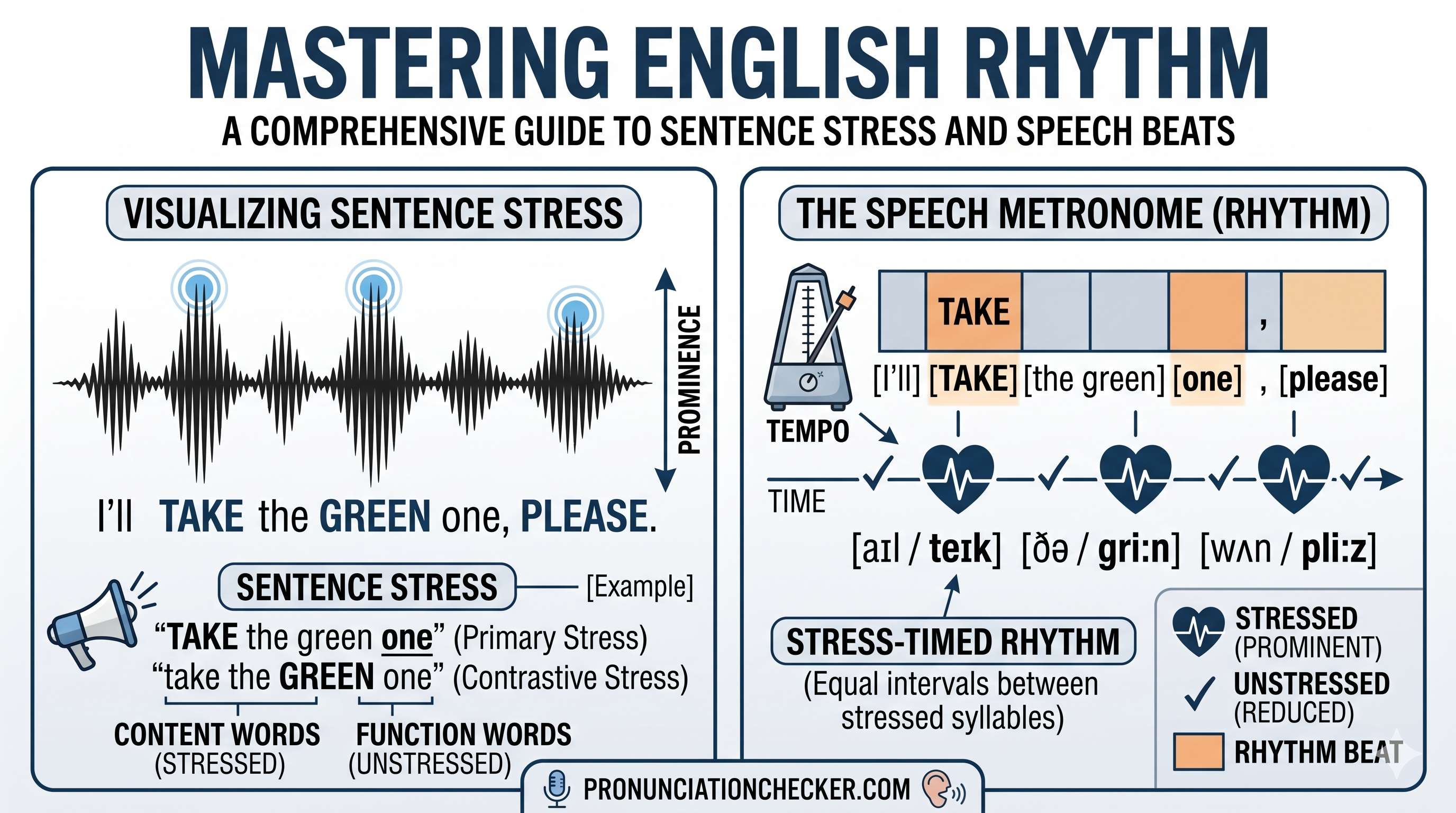
Listen to a native speaker say "I'm going to the shop to get some bread." You will hear four clear beats—GO, SHOP, GET, BREAD—and a quick, blurred stream of everything else. Many learners give all ten syllables equal weight. Every word is then correct, but the sentence is harder to follow.
This article explains which words carry sentence stress and why, how stress moves to signal contrast or new information, and how to practise rhythm directly. Try this first: the words below never change, but the meaning does, depending on which word is stressed.
- "I didn't say he took it." Someone else said it.
- "I didn't say he took it." Someone else took it.
- "I didn't say he took it." Perhaps he only borrowed it.
The division that generates English rhythm
English sentences are not spoken with every word given equal weight. Words fall into two classes, and the distinction determines almost everything about how a sentence sounds.
| Content words — stressed | Function words — unstressed | |
|---|---|---|
| Types | Nouns, main verbs, adjectives, adverbs, question words, negatives | Articles, prepositions, auxiliaries, pronouns, conjunctions |
| Examples | book, running, beautiful, quickly, what, not | the, of, is, can, he, and, to, a |
| Vowels | Full quality, long | Reduced to /ə/ or /ɪ/, very short |
| Pitch | Higher, with movement | Flat and low |
Take the sentence The doctor has arrived at the hospital. Four content words carry the beat — DOCtor, aRRIVED, HOSpital — while the, has, at and the compress into the gaps. A native speaker takes about the same total time whether those function words are there or not.
Why English sounds rushed in the middle
English is traditionally described as stress-timed: stressed syllables tend to occur at roughly regular intervals, and whatever falls between them is compressed to fit. Measurements show the regularity is far from perfect, but the compression effect is real and it is what learners actually need to reproduce.
Consider these four sentences. They contain two, four, five and seven syllables, yet a native speaker produces them in almost the same amount of time, because each has exactly two stresses:
| Sentence | Syllables | Stresses |
|---|---|---|
| CATS chase MICE | 3 | 2 |
| The CATS chase the MICE | 5 | 2 |
| The CATS will have chased the MICE | 7 | 2 |
| The CATS would have been chasing the MICE | 9 | 2 |
Say all four aloud while tapping a steady beat on the two stressed words. The middles must speed up dramatically. That compression is not sloppiness; it is the mechanism of English rhythm.
If your first language is syllable-timed
Spanish, French, Italian, Portuguese, Turkish and Cantonese give each syllable roughly equal duration. Speakers of these languages tend to produce English with even timing, which native listeners describe as machine-gun-like or as sounding careful and slow even at high speed.
The correction is counterintuitive: rather than speeding up overall, exaggerate the difference between syllables. Make stressed syllables considerably longer than feels comfortable and unstressed ones considerably shorter. Learners consistently under-produce this contrast, so deliberate exaggeration during practice usually lands close to the natural target.
Stress carries meaning, not just rhythm
Moving the stress within an identical sequence of words changes what the sentence asserts. Read each of these aloud with heavy emphasis on the capitalised word and note that the implied contrast changes every time:
- I didn't say she stole the money. — Someone else said it.
- I didn't say she stole the money. — I deny saying it.
- I didn't say she stole the money. — I implied it, or wrote it.
- I didn't say she stole the money. — Someone else stole it.
- I didn't say she stole the money. — She borrowed it.
- I didn't say she stole the money. — She stole some other money.
- I didn't say she stole the money. — She stole something else.
Learners who place stress randomly are not merely accented; they are unintentionally asserting contrasts, which is one reason why fluent but poorly-stressed English can be harder to follow than slower, correctly-stressed English.
The default rule: stress the new information
In a neutral sentence the main stress falls on the last content word. When something is already known from context, stress moves earlier to whatever is new.
- What's that? — It's a new PHONE. (everything is new; stress falls at the end)
- Is that your old phone? — It's a NEW phone. (phone is known; new is the new information)
- Whose phone is it? — It's MY phone.
Practice that targets rhythm specifically
- Tapping. Read a paragraph while tapping a steady beat, one tap per stressed syllable only. The unstressed material has to fit between taps.
- Backchaining. Build a long sentence from the end: the hospital → at the hospital → arrived at the hospital → has arrived at the hospital → The doctor has arrived at the hospital. This preserves the rhythm of the ending, which is where it most often collapses.
- Humming. Hum a recorded sentence using only its pitch and length pattern, then speak it. If the hum does not match, the words will not either.
- Limericks and nursery rhymes. These have a fixed stress pattern that forces correct compression, which is why they remain standard material in pronunciation teaching.
Frequently asked questions
What is the difference between content words and function words?
Content words carry the meaning — nouns, main verbs, adjectives, adverbs, question words and negatives — and they are stressed, with full vowels and higher pitch. Function words are grammatical glue — articles, prepositions, auxiliaries, pronouns and conjunctions — and they are unstressed, with vowels reduced to schwa and flat low pitch. This division is what produces English rhythm.
What does stress-timed actually mean?
It means stressed syllables tend to occur at roughly regular intervals and whatever falls between them is compressed to fit. The sentences Cats chase mice and The cats would have been chasing the mice have three and nine syllables but both have two stresses, and a native speaker says them in close to the same time. The middle of the longer sentence is heavily compressed.
Why does my English sound flat even when my individual sounds are correct?
Most likely because your first language is syllable-timed, giving each syllable roughly equal length. Spanish, French, Italian, Portuguese, Turkish and Cantonese all work this way. English listeners rely on the contrast between long stressed syllables and very short unstressed ones to parse a sentence. The fix is to exaggerate that difference rather than to speak faster overall.
How do I know which word in a sentence to stress?
The default is the last content word in the sentence. If part of the sentence is already known from the context, the stress moves earlier onto whatever is new. Compare the answers to What's that, which gives It's a new PHONE, and Is that your old phone, which gives It's a NEW phone. Placing stress randomly does not just sound accented — it signals contrasts you did not intend.
Disclosure: this page links to Preply, a tutoring marketplace. If you book a lesson through that link we may earn a commission, at no extra cost to you. It does not change what is recommended here. See our disclaimer and privacy policy.
Shadow a sentence for rhythm
Speak along with native audio, matching the strong beats.
Start shadowing