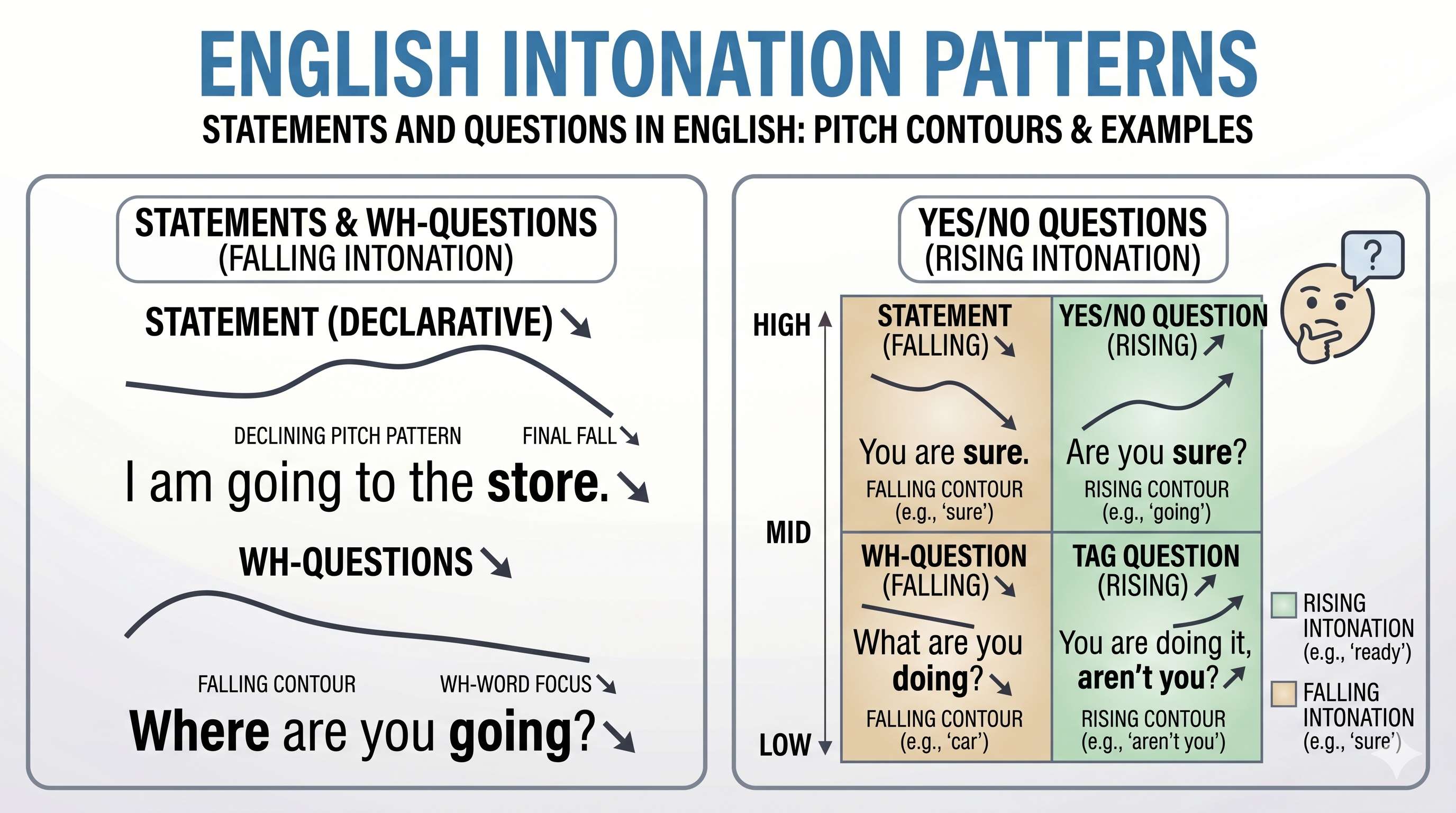
"You're coming?" with a rising tune is a question. "You're coming." with a falling tune is a statement. "You're coming?!" with a high, steep rise signals surprise. The words are the same; the pitch of the voice carries the difference.
Learners are usually taught a single rule: questions rise and statements fall. As the next section shows, that rule is mostly wrong, since most wh-questions in English fall, and relying on it produces speech that sounds either uncertain or oddly insistent. Below you will find what really decides the tune, where in the sentence the pitch movement happens, and how to widen a pitch range that is too flat.
The rule you were taught is mostly wrong
Almost every course teaches that statements fall and questions rise. The first half is broadly right; the second half is wrong often enough to cause real problems.
In English, wh- questions normally fall, exactly like statements. Where do you live? ends low. What's your name? ends low. A rising wh- question is not neutral — it signals surprise, disbelief or a request to repeat something. Asking Where do you LIVE? with a rise sounds either incredulous or like you did not hear the answer.
Only yes/no questions take the rising pattern reliably: Do you live here? Are you coming? Can you help?
| Sentence type | Normal pattern | Example |
|---|---|---|
| Statement | Fall | I live in Lisbon. ↘ |
| Wh- question | Fall | Where do you live? ↘ |
| Yes/no question | Rise | Do you live here? ↗ |
| Command | Fall | Close the door. ↘ |
| Unfinished list item | Rise | We need bread, ↗ milk, ↗ and eggs. ↘ |
| Question tag — genuine question | Rise | You're coming, aren't you? ↗ |
| Question tag — seeking agreement | Fall | Lovely day, isn't it? ↘ |
Intonation attaches to one syllable, not the whole sentence
This is the point at which most learners' intonation practice goes wrong. English intonation is not a melody spread evenly across a sentence. The main pitch movement happens on a single syllable — the tonic or nuclear syllable — which is the stressed syllable of the last content word by default. Everything after it simply continues in the same direction.
In I'm going to the ciNEma, the fall begins on NE and continues through ma. Practising the fall across the whole sentence produces the sing-song quality learners often notice in their own recordings without being able to diagnose it.
The same words, four different meanings
Take the single word really and vary only the pitch:
- Falling ↘ — neutral acknowledgement. I see.
- Rising ↗ — genuine question. Is that true?
- Fall-rise ↘↗ — doubt or polite disagreement. I'm not sure about that.
- High fall ↘↘ — strong surprise. That's astonishing.
The fall-rise is the pattern learners most often lack, and its absence has social consequences rather than merely phonetic ones. English uses fall-rise for reservation, partial agreement and politeness. It's a good idea said with a flat fall is straightforward approval; the same words with a fall-rise on good mean but there's a problem.
Why this matters more than it sounds. Speakers whose first language uses a narrower pitch range — including Russian, Polish, Korean and several varieties of Chinese — are frequently perceived by English listeners as blunt, bored or annoyed. The impression comes entirely from pitch range, not from grammar or vocabulary, and it is one of the most consequential features of an accent because it affects how you are judged socially rather than how well you are understood.
Widening your pitch range
English uses a wider pitch range than most languages. Learners typically need to extend theirs, and the exercises below target that directly.
- Extremes. Say hello at the top of your comfortable range, then at the bottom, then glide between them. Repeat with oh really, are you sure, that's amazing.
- Hum first. Take a recorded English sentence and hum its melody, ignoring the words. Then speak it. Humming reveals whether you have actually copied the pitch pattern or only the words.
- Draw the contour. Write a sentence and draw a line above it showing the pitch. Then read while tracing the line with your finger. The physical tracking helps a great deal in the early stages.
- Exaggerate deliberately. Produce the pattern with more movement than feels reasonable. Learners almost always under-produce pitch range, so the exaggerated version usually lands close to natural.
A note on rising statements
You will hear many younger speakers, particularly in Australia, California and increasingly across the UK, ending statements with a rise. This is a genuine feature of contemporary English and not an error. However, it is stylistically marked, and in formal or professional contexts a learner using it consistently may be heard as tentative or unsure. Until your intonation is comfortable, the falling statement pattern is the safer default.
Frequently asked questions
Do all English questions end with rising intonation?
No, and this is one of the most widely taught errors. Only yes/no questions rise reliably — Do you live here, Are you coming, Can you help. Questions beginning with a wh- word normally fall, exactly like statements, so Where do you live ends low. A rising wh- question is not neutral: it signals surprise, disbelief, or a request to repeat what was just said.
What is the fall-rise pattern and why does it matter?
The fall-rise is a pitch movement that drops and then lifts again, and English uses it to signal reservation, partial agreement or politeness. It's a good idea said with a plain fall is straightforward approval; the same words with a fall-rise on good mean there is a problem coming. Learners who lack this pattern often sound more blunt than they intend, which affects how they are perceived socially rather than how well they are understood.
Why do people think I sound bored or annoyed in English?
Usually pitch range rather than anything in your words. English uses a wider pitch range than many languages, including Russian, Polish, Korean and several varieties of Chinese. When a speaker transfers a narrower range into English, listeners interpret the flatness as disengagement or irritation. Deliberately exaggerating pitch movement during practice generally lands close to the natural English target.
Where in the sentence does the intonation actually happen?
On a single syllable, not across the whole sentence. The main pitch movement falls on the stressed syllable of the last content word by default, and everything after it simply continues in the same direction. Trying to apply a fall across an entire sentence produces the sing-song quality many learners hear in their own recordings without being able to identify the cause.
Disclosure: this page links to Preply, a tutoring marketplace. If you book a lesson through that link we may earn a commission, at no extra cost to you. It does not change what is recommended here. See our disclaimer and privacy policy.
Practise falls and rises
Guided intonation examples with speaking practice.
Open intonation practice