Introduction
Have you ever been in an English conversation and nodded along, only to realize a moment too late that you completely misunderstood what was said? You thought your friend said they loved the "beach," but they were actually talking about a "peach" they ate. You heard the pilot say you’re "flying over the sea," but you were confused because you were clearly "flying over the city."
If this sounds familiar, you’re not alone. This common frustration is at the heart of mastering a new language, and it all comes down to a tiny, powerful linguistic concept: the minimal pair.
In this comprehensive guide, we’ll explore what minimal pairs are, why they are the ultimate key to unlocking both your listening comprehension and your pronunciation, and how you can use them to train your ears and mouth to finally hear and speak English right.
What exactly are Minimal Pairs? The secret code of English
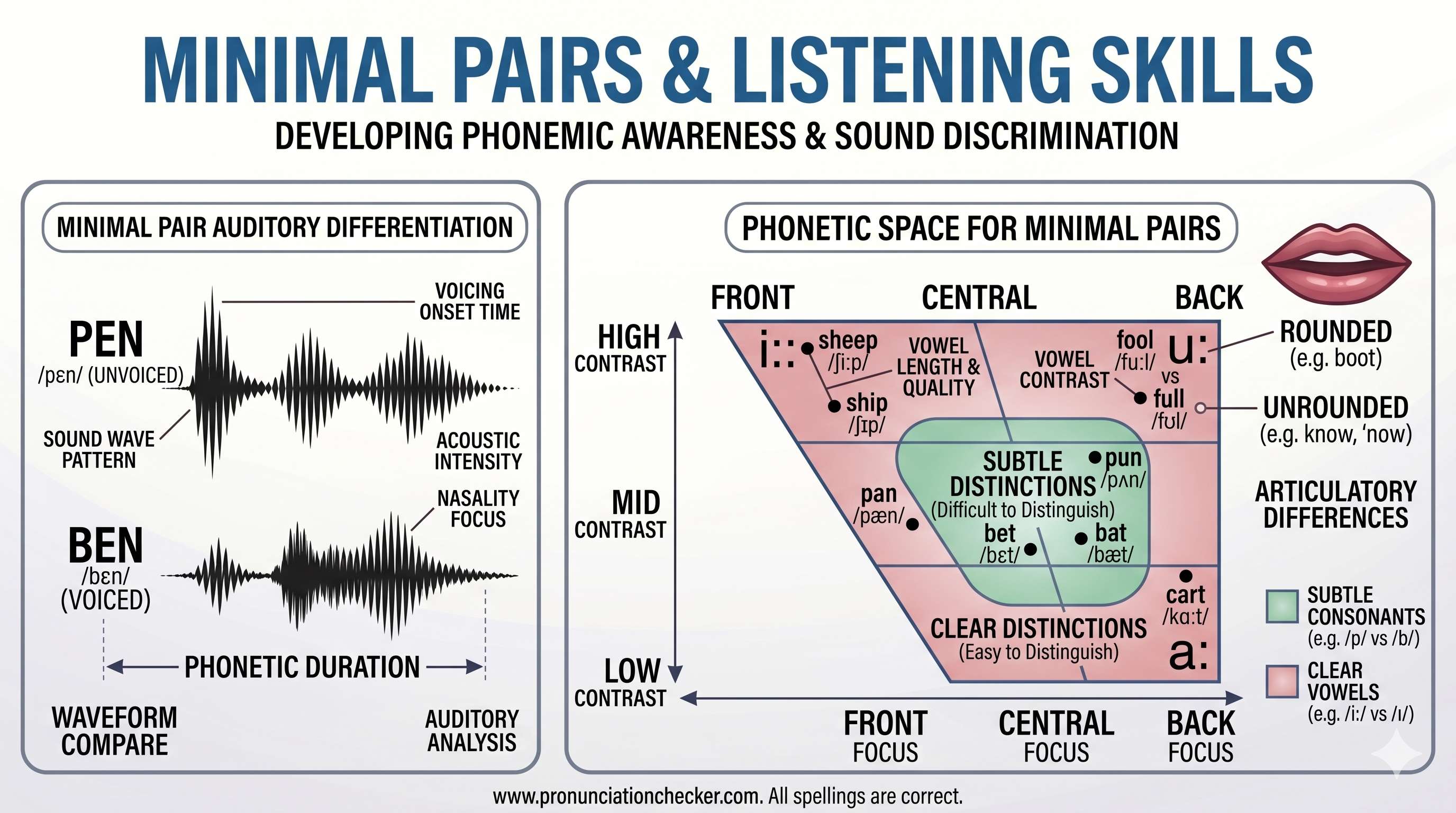
Let's start with a simple definition. Minimal pairs are two words that are identical in every way except for one sound. This single sound difference occurs in the same position in each word and changes the word's entire meaning.
Think of them as linguistic twins with one distinct feature that sets them apart.
Classic examples include:
Ship / Sheep: The only difference is the vowel sound (`ɪ` vs. `iː`). Mishearing this could lead to a very confusing conversation about maritime vehicles and farm animals.
Bat / Pat: The only difference is the initial consonant sound (`b` vs. `p`). One is a piece of sports equipment or a flying mammal, the other is a gentle touch.
Rock / Lock: The only difference is the initial consonant sound (`r` vs. `l`). This is a notorious pair for speakers of many Asian languages.
These tiny differences are the building blocks of English meaning. Native speakers use and recognize them effortlessly, but for language learners, distinguishing them is a skill that must be consciously developed.
Why your brain struggles: The science of "Sound Blindness"
This isn't a matter of intelligence or effort. It’s about neuroscience. From a young age, our brains are wired to recognize the distinct sounds (or phonemes) of our native language. Sounds that don't exist in our mother tongue are effectively filtered out or categorized as "the same" as a familiar sound. This is known as phonemic categorization.
For example, the English sounds `/l/` and `/r/` are distinct phonemes. But in Japanese, they are considered variations of the same sound. To a native Japanese speaker, hearing the difference requires retraining the brain to create a new "category" for that new sound. This phenomenon is often called "sound blindness" – you literally can't hear what you haven't learned to listen for.
This is why minimal pair training is so powerful. It forces your brain to pay attention to these subtle distinctions, breaking down your native language filters and building new ones for English.
From listening to speaking: The two-way street of comprehension
You might think this is just about understanding others, but the connection between listening and speaking is inseparable. If you can't hear a sound correctly, you almost certainly can't pronounce it correctly.
Your pronunciation is guided by your mental representation of a word. If your brain registers "ship" and "sheep" as the same word, you will use the sounds interchangeably, making your speech harder for others to understand. By sharpening your listening skills with minimal pairs, you simultaneously create a clearer, more accurate model in your mind for how to produce the sounds yourself.
It’s a virtuous cycle: Better listening → Better mental sound models → Better pronunciation → Increased confidence → More practice → Even better listening.
How to train your Ears: A Minimal Pair workout routine
Ready to start training? Here’s a step-by-step workout plan for your ears. You'll need a good list of minimal pairs to work with. A fantastic and extensive resource is this Complete English Minimal Pairs List from Pronunciation Checker (https://pronunciationchecker.com/tools/minimal-pair/english-minimal-pair-list.html). Bookmark it—it will be your best friend throughout this process.
Step 1: Isolation & Identification (The Basics)
Start by focusing on one sound pair at a time. The most common starting points are:
- `/ɪ/` (as in ship) vs. `/iː/` (as in sheep)
- `/θ/` (as in thin) vs. `/s/` (as in sin) vs. `/t/` (as in tin)
- `/r/` (as in right) vs. `/l/` (as in light)
- `/b/` (as in bet) vs. `/v/` (as in vet) vs. `/w/` (as in wet)
The Activity:
- Go to the minimal pairs list (https://pronunciationchecker.com/tools/minimal-pair/english-minimal-pair-list.html) and pick a category.
- Find a video on YouTube (search for "minimal pairs [sound] vs [sound]") where a native speaker clearly pronounces the words.
- Close your eyes and just listen. Don't look at the words. Your only job is to identify which sound you hear. Is it the "short i" (`ship`) or the "long e" (`sheep`)?
- Repeat this until you can consistently identify the sound correctly.
Step 2: Discrimination (The "same or different?" test)
- Get a partner or use an app/website that provides audio quizzes.
- Listen to a pair of words (e.g., "ship - ship" or "ship - sheep").
- Force yourself to decide: Same or Different?
- This is brutal but effective training for your brain. It moves beyond identification to active comparison.
Step 3: Controlled practice (The "choose the right word" game)
- Look at a minimal pair: "He lives on a boat" vs. "He voted both."
- Have a partner say one of the sentences (or use pre-recorded audio).
- You must choose which sentence you heard. This adds a layer of meaning, which is the ultimate goal of listening.
Step 4: Production (The "say it right" challenge)
- Record yourself saying minimal pairs from the list (e.g., "beat" and "bit").
- Listen back to your recording and compare it to a native speaker's recording.
- Be brutally honest with yourself. Do they sound the same? Can you hear the difference in your own speech?
- This self-awareness is critical for improving pronunciation.
Top 10 Minimal Pairs that cause the most confusion
While you should explore the full list (https://pronunciationchecker.com/tools/minimal-pair/english-minimal-pair-list.html), here are some of the most common and troublesome pairs to prioritize:
- Sheep / Ship
- Beach / Bitch
- Tree / Three
- Light / Right
- Vest / West
- Cat / Cut
- Fan / Van
- Sink / Think
- Bet / Bat
- Can / Can
Conclusion: your journey to crystal-clear English
Mastering minimal pairs is not a one-weekend project; it's a fundamental part of your lifelong journey with the English language. It requires patience, consistent practice, and a willingness to be uncomfortable as you retrain your brain.
But the reward is immense. The moment you effortlessly understand the difference between "I need to leave" and "I need a reef" (okay, that's a weird one, but you get the point!), you’ll feel a new level of confidence. The fog of confusion will lift, and you'll not only hear English more clearly—you'll be able to speak it with the clarity you've always wanted.
So, are you ready to finally hear it right? Start with one sound pair today. Dive into that comprehensive list (https://pronunciationchecker.com/tools/minimal-pair/english-minimal-pair-list.html), press play, and begin sharpening your most important language tool: your ears.
Ready to perfect your pronunciation?
Type any word into our free tool to hear exactly how it sounds in American, British, Australian, and Indian English.
Try PronunciationChecker Now