How to Use an Interactive IPA Chart to Improve Your English Pronunciation
Many English learners struggle with pronunciation because they rely solely on spelling to guide their speech. This approach often backfires: think of words like "read" (present vs. past), "live" (verb vs. adjective), or "tough" (rhymes with "buff," not "through"). The International Phonetic Alphabet (IPA) is the solution, but understanding IPA symbols is one thing—using them effectively to improve pronunciation is another.
In this guide, we'll walk you through how to harness the power of an interactive IPA chart to transform your English pronunciation. Whether you're a beginner or an advanced learner, this practical approach will help you hear, understand, and produce English sounds with confidence.
Why Interactive IPA Charts Matter
Traditional IPA resources are often static—charts with symbols and descriptions, but no audio. This creates a critical gap: you can memorize what a symbol represents, but you might not actually recognize or produce the sound correctly. Interactive IPA charts solve this problem by combining visual learning with audio feedback.
The advantages are clear:
Audio Reference: Hear exactly how native speakers produce each sound.Instant Feedback: Click and listen as many times as needed without judgment.
Engagement: Active participation makes learning stick better than passive reading.
Accessibility: Learn at your own pace, on any device, any time.
Getting Started: Your First Steps
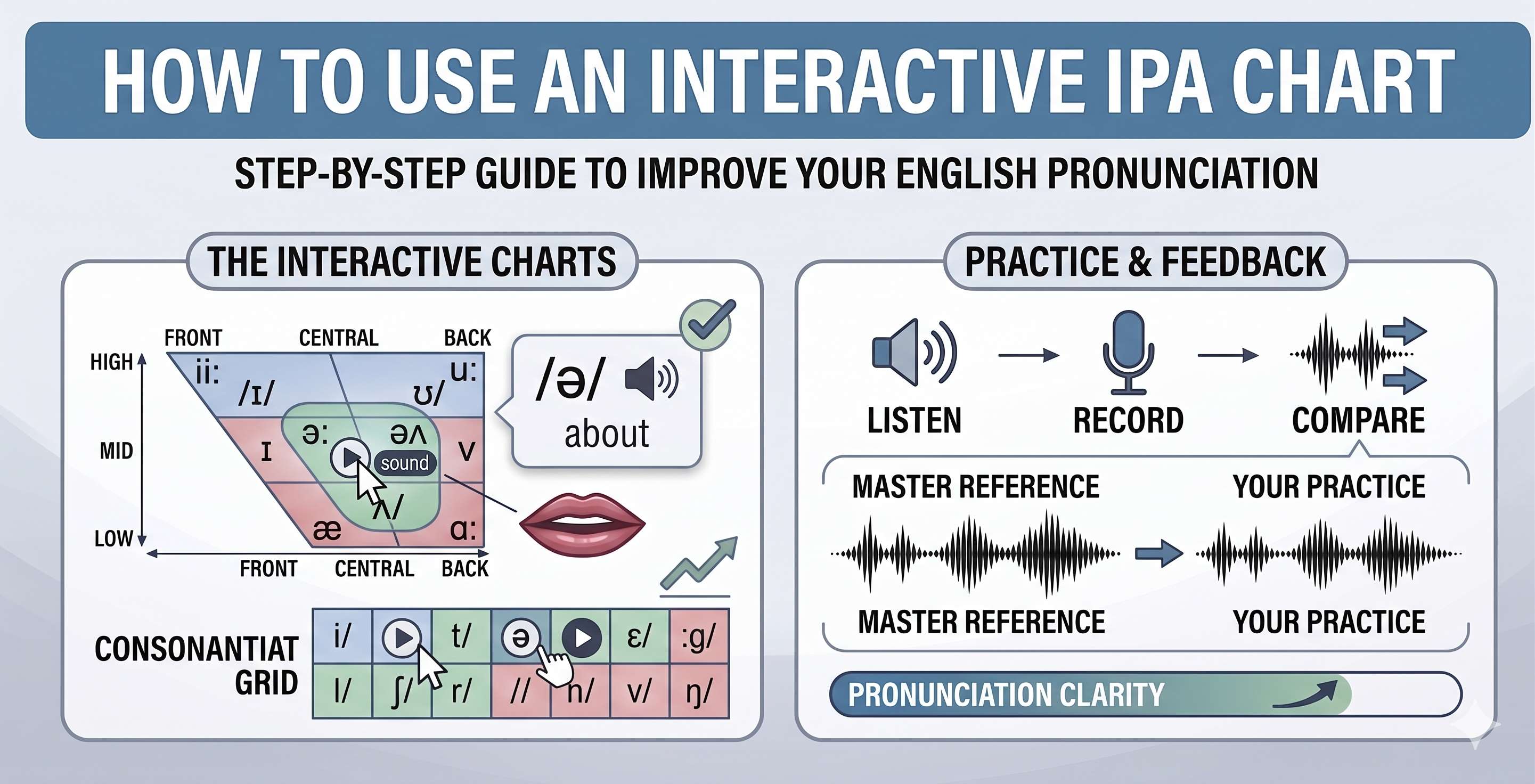
Step 1: Familiarize Yourself with the Chart Layout
When you open an interactive IPA chart, you'll see it organized into two main sections: consonants and vowels. The consonant chart is arranged in a grid where:
- Columns represent place of articulation (where in your mouth the sound is made)
- Rows represent manner of articulation (how you're blocking or shaping the airflow)
- Shading or labels indicate voicing (whether your vocal cords are vibrating)
The vowel chart looks different—it's a trapezoid representing the vowel space of your mouth (high/low, front/back, rounded/unrounded). Don't be intimidated—you'll get the hang of it quickly.
Step 2: Start with Familiar Sounds
Begin by clicking on sounds you already know. If you're an English speaker, try sounds like /p/, /t/, /k/ (voiceless stops), or /m/, /n/, /ŋ/ (nasals). Listen and compare them to your own production. Do you make the same sound? This builds confidence and creates a reference point.
Step 3: Move to Challenging Sounds
Once you're comfortable, tackle the sounds that give you trouble. For example, many Spanish speakers struggle with /θ/ (think) because it doesn't exist in Spanish. Many French speakers find /ŋ/ (sing) challenging. By using the interactive chart, you can target your weak spots with precision.
Active Learning Strategies
The Mimic-and-Compare Method
Don't just listen passively. Use your phone's voice recorder or a language app to record yourself producing a sound, then compare it to the reference. This active feedback loop is incredibly powerful for muscle memory development.
The Minimal Pairs Approach
After learning individual sounds, practice distinguishing similar sounds. For instance, /l/ and /r/ are notoriously difficult for many learners. Listen to the interactive chart's examples of both, then practice saying minimal pairs like "light" vs. "right," "lea" vs. "rea." The interactive chart lets you switch back and forth instantly.
The Slow-Motion Listening Technique
Some sounds are very short and easy to miss. Use the interactive chart's audio controls to slow down playback if available. Slowed audio helps you hear every detail of the sound articulation.
Integrating IPA into Your Daily Practice
Once you understand how to read IPA symbols and associate them with sounds, use your interactive IPA chart as a reference tool:
- When you encounter a new word: Look up its phonetic transcription and use the chart to practice each sound.
- When you listen to English: Try to identify IPA symbols in what you hear, then verify on the interactive chart.
- During shadowing practice: Pause the audio, look up the IPA transcription of challenging words, and compare your pronunciation to the chart.
Common Mistakes to Avoid
Mistake 1: Memorizing Without Producing - Knowing what a symbol means is not the same as being able to make the sound. Always practice pronouncing, not just memorizing.
Mistake 2: Ignoring Vowel Distinctions - English vowels are tricky because there are more vowel sounds than vowel letters. The interactive chart shows all of them. Use it.
Mistake 3: Focusing Only on Individual Sounds - In real speech, sounds blend and vary. After mastering individual phonemes, practice how they connect in words and sentences.
Your Next Steps
The best way to improve your pronunciation with IPA is to start practicing today. Open the interactive IPA chart and spend 15-20 minutes clicking through sounds that challenge you. Record yourself trying to match the reference, then listen back. This daily habit, even for short sessions, compounds into noticeable improvement within weeks.
Start here: https://pronunciationchecker.com/tools/interactive-IPA-sounds.html
Treat the chart as an instrument, not a poster
A printed IPA chart is a reference. An interactive one is a measuring instrument, and the difference lies in what you can do with it: hear a sound in isolation, compare two sounds immediately, and move systematically through a dimension rather than jumping between unrelated symbols.
Most learners use an interactive chart by clicking symbols at random, which produces familiarity but little learning. The methods below are structured around the chart's two axes, because those axes correspond to physical actions you can perform.
Walk the axes
The most valuable exercise is to move along one dimension while holding the other constant, which isolates a single articulatory variable.
- Front vowels, top to bottom. Play
/iː/then/ɪ/then/e/then/æ/in order, then produce the same sequence yourself. You are lowering the jaw progressively while keeping the tongue forward. Doing this as a sequence makes the gradient audible in a way that comparing two isolated vowels does not. - The top edge, front to back.
/iː/to/uː/, feeling the tongue slide back and the lips round. - Tense against lax at each height.
/iː/against/ɪ/, then/uː/against/ʊ/. The pattern is the same movement towards the centre in both cases, and hearing it twice establishes what laxness sounds like as a category rather than as two unrelated facts.
The comparison that diagnoses your own system. Find the vowel in your first language that you substitute for an English one. Play the English vowel, produce your version, then play the English vowel again. The gap is usually obvious in that alternation and inaudible without it, because you are comparing against a fresh memory rather than a stored category.
Locate your own vowels on the chart
Before correcting anything, find out where your vowels actually sit. Take eight English words covering the vowel space — sheep, ship, bed, cat, cup, hot, foot, food — record yourself saying them, then use the chart to find the symbol that most closely matches each of your productions.
The result is a map of your own system against the English one, and it typically shows two things: which English vowels you have merged, and in which direction each of your vowels is displaced. That is a far more useful starting point than a generic list of difficult sounds, because it is specific to you.
Use the consonant chart as a diagnostic grid
For consonants, the chart's value is that it lets you find the sound you are actually producing and read the difference in parameters.
- Play the target, for example
/θ/. - Produce your version and find it on the chart — perhaps
/s/. - Compare the two cells.
/s/is alveolar,/θ/is dental; both are voiceless fricatives. Only place differs. - The correction is therefore a single change: move the tongue forward to the teeth, keeping everything else identical.
This converts "my th sounds wrong" into one specific physical instruction, and it also tells you how difficult the correction will be. One parameter differing is a quick fix; two parameters differing takes longer, because you must change two things simultaneously.
Build a personal sound inventory
Work through the chart once and mark every symbol in one of three categories:
- Exists in my first language — no work needed, though check the allophones.
- Similar but not identical — the most dangerous category, because similarity prevents you from noticing the difference. Spanish
/t/is dental; English/t/is alveolar. The Spanish speaker's/t/is intelligible and permanently accented. - Absent entirely — requires new motor learning, but is often easier than the second category, because there is no existing habit competing with it.
That middle category is where most long-term accent features live, and it is exactly the group that never gets attention, because nothing sounds obviously wrong. Identifying it deliberately is the main advantage of working systematically through a chart rather than reacting to errors as they appear.
Where to stop
An interactive chart gives you isolated sounds, and isolated sounds are not speech. Once you can produce a target in isolation, the chart has done its job and the work moves to words, then sentences, then spontaneous speech. Learners who stay at the chart stage can produce a beautiful /æ/ on demand and still not use it in conversation, because the transfer step was never practised.
Frequently asked questions
What is the best way to use an interactive IPA chart?
Move along one axis at a time rather than clicking symbols at random. Play the front vowels in order from /iː/ down to /æ/ and produce the same sequence yourself: you are lowering the jaw progressively while keeping the tongue forward, and the gradient becomes audible in a way that comparing two isolated vowels never achieves. Then do the same across the top edge from /iː/ to /uː/.
How can I find out which English vowels I get wrong?
Record yourself saying eight words that cover the vowel space — sheep, ship, bed, cat, cup, hot, foot, food — then use the chart to find the symbol closest to each of your own productions. The result maps your system against the English one and shows which vowels you have merged and in which direction each is displaced, which is far more useful than a generic list of difficult sounds.
How does the chart help with consonants?
It lets you locate the sound you actually produce and read off the difference in parameters. If you say /s/ for /θ/, both are voiceless fricatives and only place differs, so the correction is a single change: move the tongue forward to the teeth. Knowing how many parameters differ also predicts the difficulty, since two differences require changing two things at once.
Which sounds should I worry about most?
The ones that are similar to a sound in your first language but not identical, because similarity prevents you from noticing the difference. Spanish /t/ is dental while English /t/ is alveolar, and the Spanish speaker's version is intelligible but permanently accented. Sounds that are completely absent from your first language are often easier, since no existing habit competes with the new one.
Disclosure: this page links to Preply, a tutoring marketplace. If you book a lesson through that link we may earn a commission, at no extra cost to you. It does not change what is recommended here. See our disclaimer and privacy policy.
Open the chart and start clicking
Every symbol plays its sound with example words, in American English.
Open the IPA chart