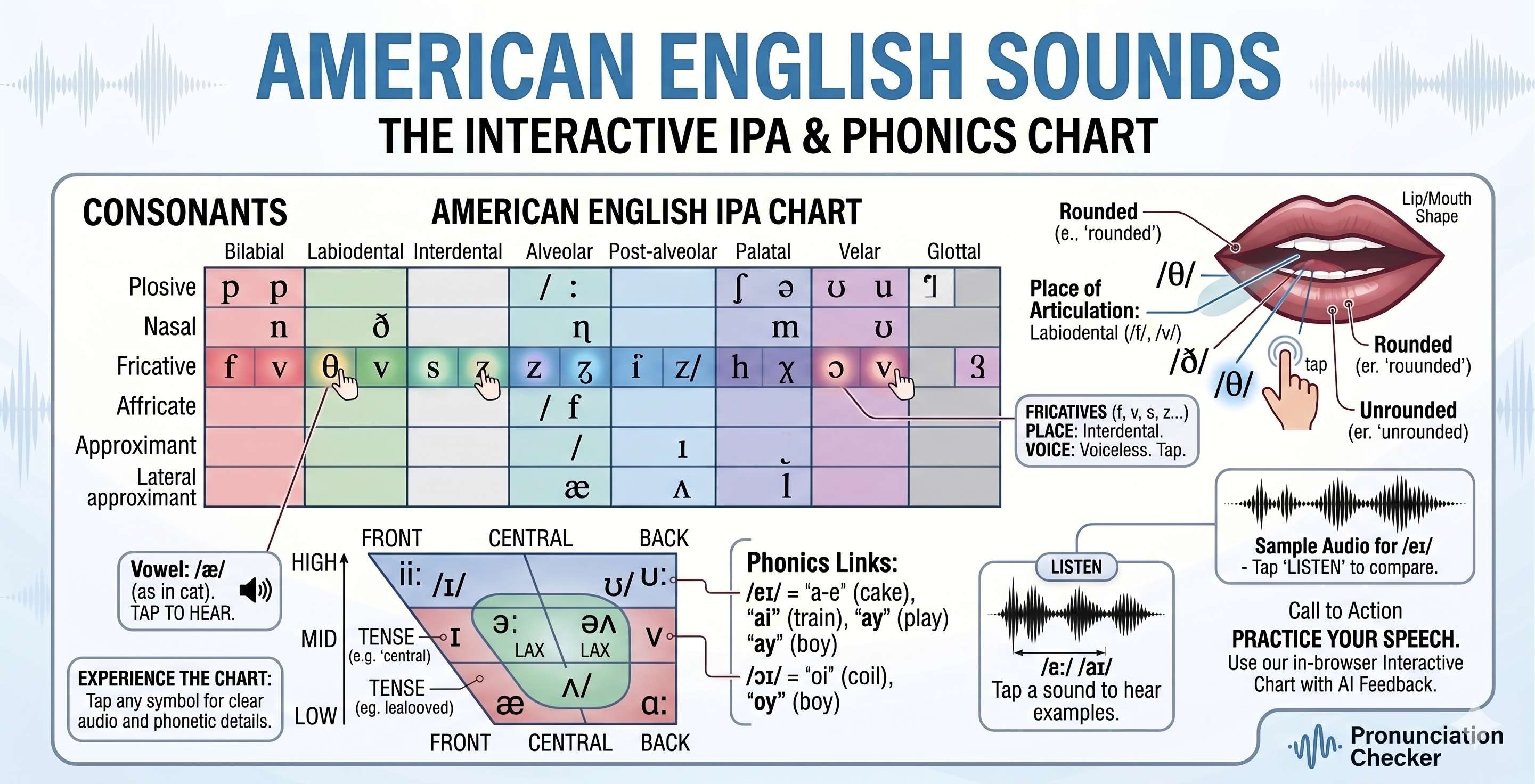
Master american English sounds: Your interactive IPA phonics chart guide
Have you ever wondered how some people speak American English with such remarkable clarity? It’s not just about learning vocabulary and grammar; it’s about mastering the very building blocks of the language: the sounds. For learners, pronouncing words like "ship" and "sheep" or "think" and "this" correctly can feel like a monumental challenge.
What if you had a map—a precise, scientific guide—to every sound in American English? That map exists, and it’s called the International Phonetic Alphabet (IPA).
In this definitive guide, we will demystify the IPA and show you how to use an interactive IPA chart to transform your accent, boost your confidence, and finally achieve the clear, natural American English pronunciation you've been working towards. This guide works hand-in-hand with the powerful, interactive tool available at Pronunciation Checker's American English Sounds IPA Chart, which will bring these sounds to life.
Why mastering sounds is more important than you think
Many English learners focus intensely on grammar and vocabulary, which is fantastic. However, they often neglect pronunciation, assuming it will come naturally. Unfortunately, this can lead to a "fossilized accent," where mistakes become ingrained and harder to fix over time.
Here’s why focusing on sounds from the beginning is a game-changer:
- Clarity and comprehension: The primary goal of language is to be understood. Mispronouncing a single sound can change the meaning of a word entirely (e.g., "beach" vs. "bitch," "full" vs. "fool").
- Confidence: When you know you are pronouncing words correctly, you speak with more confidence and are more willing to engage in conversations.
- Listening skills: Learning to produce sounds correctly trains your ear to hear them. You'll start to understand native speakers more easily because you're tuned into the specific sounds they are using.
What is the International Phonetic Alphabet (IPA)?
The International Phonetic Alphabet (IPA) is a system of phonetic notation designed to represent every sound used in spoken human language accurately and uniquely. Think of it as a universal decoder ring for pronunciation.
Unlike English spelling, which is famously inconsistent (consider "ough" in "through," "cough," "bough," and "rough"), the IPA is 100% consistent. One symbol always represents one sound, and one sound is always represented by one symbol.
For example, the English word "phone" is spelled with a 'p' and an 'h,' but it's pronounced with an /f/ sound. In IPA, it's written as /foʊn/, which tells you exactly how to say it.
Your guide to the interactive american English IPA chart
An IPA chart can look intimidating at first—a grid of strange symbols. But once you understand its organization, it becomes an incredibly powerful tool. The best way to learn is not from a static image but from an interactive IPA chart where you can click on each symbol to hear the sound.
For this guide, we will be referencing the interactive chart on Pronunciation Checker, which provides clear audio examples for each phoneme. The chart is divided into two main sections: Vowels and Consonants.
Section 1: Demystifying american English vowels
Vowels are sounds produced with an open vocal tract. The key to mastering American vowels is understanding the position of your tongue and the shape of your lips.
The vowel section of the IPA chart is arranged based on two factors:
- Tongue height: Is your tongue high (close to the roof of your mouth) or low (jaw open)?
- Tongue position: Is the highest part of your tongue toward the front or the back of your mouth?
Let's break down the most critical vowel sounds for American English.
Front vowels
These are produced with the tongue positioned forward in the mouth.
/i/ as in "beat": A long, tense vowel. Smile widely! Your tongue is high and front.
/ɪ/ as in "bit": A short, relaxed vowel. This is the most common confusion for learners. Your tongue is slightly lower and more relaxed than for /i/. Practice: "beat" vs. "bit."
/ɛ/ as in "bet": Your jaw drops a little more. The tongue is mid-height.
/æ/ as in "bat": This is the "short a" sound. Your jaw is open, and your tongue is low and front. Think of a doctor asking you to say "ah," but with a wider, flatter tongue.
Central vowels
/ə/ as in "about" (the first sound): This is the schwa. It is the most common vowel sound in English! It only appears in unstressed syllables and is a very short, neutral, relaxed sound.
/ʌ/ as in "but": Often confused with the schwa, but it typically appears in stressed syllables. It's a bit more defined than the schwa.
Back vowels
These are produced with the tongue positioned toward the back of the mouth.
/u/ as in "boot": A long, tense vowel. Round your lips tightly. Tongue is high and back.
/ʊ/ as in "book": A short, relaxed vowel. Lips are less rounded than for /u/. Practice: "pool" vs. "pull."
/oʊ/ as in "boat": This is a diphthong, a combination of two vowel sounds (/o/ gliding into /ʊ/). It's not a pure vowel.
/ɔ/ as in "thought": This vowel is less common in many American accents (often merging with /ɑ/ in words like "cot" and "caught"). It requires open, rounded lips.
/ɑ/ as in "father": A deep, open "ah" sound. The tongue is low and back.
Diphthongs: The gliding vowels
Diphthongs are a crucial feature of American English. They are single syllables that glide from one vowel sound to another.
/aɪ/ as in "price": Glides from /a/ (like in "father") to /ɪ/ (like in "bit"). "I."
/aʊ/ as in "mouth": Glides from /a/ to /ʊ/ (like in "book"). "How now, brown cow."
/ɔɪ/ as in "choice": Glides from /ɔ/ (like in "thought") to /ɪ/. "Boy."
Action step: Go to the interactive vowel chart on Pronunciation Checker and click on each of these symbols. Listen carefully and try to mimic the sound exactly. Pay attention to the subtle differences between pairs like /i/ and /ɪ/.
Section 2: Conquering american English consonants
Consonants are sounds produced by obstructing airflow in the vocal tract. They are categorized by three things:
- Place of articulation: Where is the obstruction happening? (lips, teeth, etc.)
- Manner of articulation: How is the airflow being obstructed? (complete stop, friction, etc.)
- Voicing: Are your vocal cords vibrating?
Let's look at some of the most challenging consonant pairs for learners.
The "TH" Sounds: /θ/ and /ð/
These sounds are rare in world languages but essential in English.
/θ/ as in "think": Voiceless. Stick the tip of your tongue gently between your teeth and blow air. No voice.
/ð/ as in "this": Voiced. Same tongue position, but this time add your voice. Feel the vibration in your throat.
Practice: "thick" vs. "this," "breath" (noun, voiceless) vs. "breathe" (verb, voiced).
The "S" and "Z" Sounds: /s/ and /z/
The difference is solely in voicing, but it's critical for grammar (e.g., plural and possessive endings).
/s/ as in "sip": Voiceless. A sharp, hissing sound.
/z/ as in "zip": Voiced. The same position, but with vocal cord vibration.
Practice: "Sue" vs. "zoo," "bus" (noun, voiceless) vs. "buzz" (verb, voiced).
The "SH" and "ZH" Sounds: /ʃ/ and /ʒ/
/ʃ/ as in "ship": Voiceless. Round your lips and create friction with the tongue further back than for /s/.
/ʒ/ as in "measure": Voiced. This is the sound in the middle of "pleasure," "treasure," and "vision." It's much less common than /ʃ/.
Practice: "pressure" (/ʃ/) vs. "pleasure" (/ʒ/).
The "P," "T," "K" aspiration: /p/, /t/, /k/
In English, these sounds are aspirated (a puff of air is released) at the beginning of a stressed syllable. This is the key difference between "pin" and "bin." Say "pin" with your hand in front of your mouth; you should feel a strong puff of air for the /p/. This aspiration is what distinguishes them from their voiced counterparts /b/, /d/, /g/.
Action Step: Head over to the interactive consonant chart on Pronunciation Checker. Click on the symbols for the pairs above. Listen for the voicing difference and practice feeling the vibration in your throat for voiced sounds versus the air puff for voiceless, aspirated sounds.
How to use an interactive IPA chart for daily practice
An interactive chart is useless without a practice plan. Here’s how to integrate it into your routine.
- Start with awareness (5 minutes): Each day, pick just 2-3 sounds you find difficult. Go to the chart, click the symbols, and just listen. Don't even try to speak yet. Train your ears first.
- Mirror the audio (10 minutes): Now, try to mimic the sound. Use a mirror to check your lip shape and tongue position (for consonants you can see, like /θ/). Record yourself on your phone and compare it to the audio example. Be patient and precise.
- Find Example words (5 minutes): The chart provides examples. Practice saying those words, ensuring you are producing the target sound correctly.
- Practice in context: Use a dictionary that provides IPA transcriptions (like Merriam-Webster online). Look up common words you use and see their IPA form. Practice saying them correctly.
Beyond the chart: Integrating IPA into your overall learning
The interactive IPA chart is your foundation, but true mastery comes from application.
- Use a Pronunciation Checker Tool: After practicing a sound, use a tool like the ones featured on Pronunciation Checker to record yourself saying words and get instant feedback. This closes the loop between theory and practice.
- Learn the IPA of new vocabulary: When you learn a new word, don't just memorize the spelling. Look up its IPA transcription. This will save you from future pronunciation mistakes.
- Be patient and consistent: Changing muscle memory in your mouth takes time. Five to ten minutes of focused, daily practice is far more effective than one hour once a week.
Conclusion: Your path to pronunciation mastery starts now
Mastering the sounds of American English is not a mystery reserved for a lucky few. It is a skill that can be systematically learned using the right tools. The International Phonetic Alphabet provides the map, and an interactive IPA chart gives you the audio guide to follow it.
By understanding the difference between vowels and consonants, practicing tricky pairs, and integrating this knowledge into your daily study routine, you are equipping yourself with the most effective strategy for accent reduction. You are moving from guessing how words sound to knowing exactly how to produce them.
Stop struggling with inconsistent English spelling. Embrace the clarity of the IPA. Visit the interactive American English IPA Chart now, click on a sound that challenges you, and take the first step on your journey to clear, confident, and accurate American English pronunciation.
Frequently asked questions
How many sounds does American English actually have?
About 39 to 44 depending on how diphthongs and r-coloured vowels are counted: roughly 24 consonants and 15 to 20 vowels. The 26 letters of the alphabet cannot represent that many sounds, which is the whole reason a phonetic alphabet is needed. General American also merges some contrasts that British English keeps, such as cot and caught for many speakers.
What makes American vowels different from British ones?
Three features. American English pronounces r after a vowel, so bird and car contain r-coloured vowels written /ɝ/ and /ɑr/. It uses an unrounded /ɑ/ in hot where British English uses rounded /ɒ/. And it uses /æ/ in bath, laugh, dance and class, where southern British English uses the long back vowel /ɑː/.
Why does American t sound like d in words like water?
When /t/ or /d/ falls between two vowels and the following syllable is unstressed, American speakers produce a quick tap of the tongue instead. It affects a very large set of common words including better, city, party, little, bottle and twenty, and it makes pairs such as latter and ladder nearly identical. Learning this single rule changes how natural a great deal of your speech sounds.
How should I use an interactive sound chart?
Move along one axis at a time rather than clicking at random. Play the front vowels in order from /iː/ down to /æ/ and copy the sequence, feeling the jaw lower progressively while the tongue stays forward. Then compare each English sound with the nearest sound in your own language, alternating between the two, since the difference is usually obvious in direct alternation and inaudible without it.
Disclosure: this page links to Preply, a tutoring marketplace. If you book a lesson through that link we may earn a commission, at no extra cost to you. It does not change what is recommended here. See our disclaimer and privacy policy.
Hear every American sound
Click any symbol on the interactive chart to hear it in isolation and in example words.
Open the IPA chart