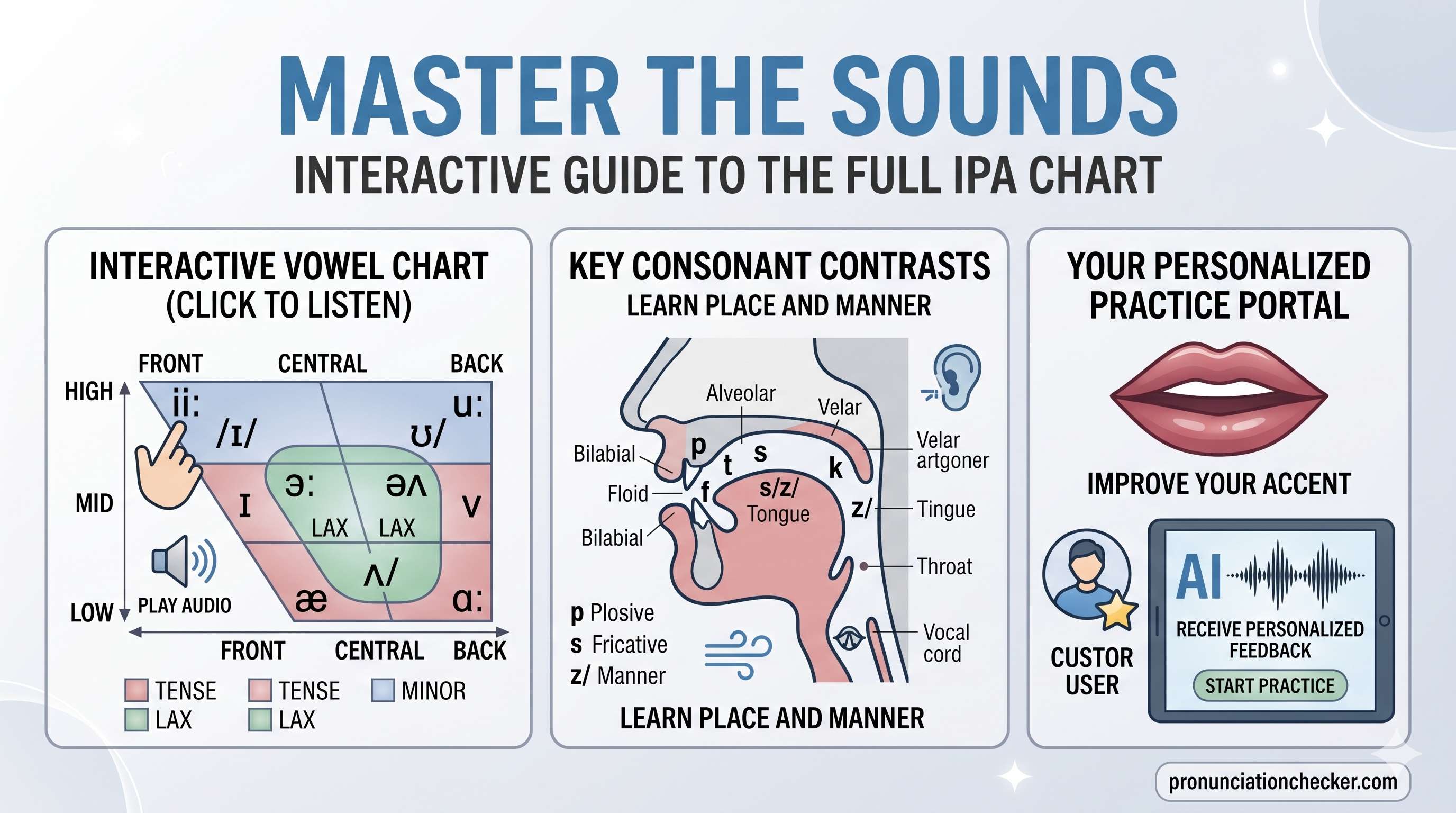
Master the sounds: An interactive guide to the full IPA chart
Have you ever struggled to pronounce a word correctly after only seeing its written form? English is notorious for its spelling inconsistencies. Think about the "gh" in "tough," "through," and "though"—it's a recipe for confusion. Or perhaps you're learning a new language and want to capture the authentic accent of a native speaker. How can you be sure you're producing the right sounds?
The secret key to unlocking accurate pronunciation in any language lies in a powerful, universal tool: the International Phonetic Alphabet (IPA). Far from being a dusty academic concept, the IPA is a practical map to the world of human speech sounds. And the best way to learn it? By getting interactive.
In this comprehensive guide, we will demystify the full IPA chart. We won't just show you symbols; we'll help you understand how to produce each sound and, most importantly, we’ll connect you directly to an interactive resource that lets you hear and practice every one of them. Get ready to master the sounds.
What is the International Phonetic Alphabet (IPA)?
The International Phonetic Alphabet is a standardized system of phonetic notation designed to represent the precise sounds of spoken language. Created by linguists in the late 19th century, its core mission is to provide a one-to-one correspondence between a sound and a symbol. Unlike English spelling, where one letter can represent multiple sounds (like 'c' in 'cat' and 'city'), each IPA symbol represents one distinct sound, or phoneme.
Why is this so revolutionary?
Universal application:
The IPA can transcribe any language in the world. Linguists, language learners, actors, singers, and speech pathologists all use it as a common reference.Accuracy: It removes the guesswork from pronunciation. If you know the IPA transcription for a word, you can pronounce it correctly every time, regardless of its conventional spelling.
Clarity: It allows us to make clear distinctions between subtle sound differences that are often ignored in regular writing.
Decoding the map: a tour of the IPA chart
The full IPA chart can look intimidating at first glance—a grid of strange symbols organized with geometric precision. But once you understand its logic, it becomes an incredibly intuitive and powerful tool. The chart is organized based on the specific way we produce sounds in our vocal tract.
The three primary questions the chart answers for each consonant are:
How is the sound made? (Manner of Articulation)
Are the vocal cords vibrating? (Voicing)
For vowels, the questions are:
How far forward or back is your tongue? (Vowel Backness)
Are your lips rounded or spread? (Lip Rounding)
Let's break it down section by section.
The consonants pulmonic chart
This is the main consonant chart, featuring sounds made by pushing air from the lungs (pulmonic).
Place of articulation (the "where")
This refers to the two points of contact or proximity in your mouth. The columns on the chart are organized from the front of the mouth (lips) to the back (throat):
Bilabial:
Both lips come together (e.g., /p/ as in pat, /b/ as in bat, /m/ as in mat).Labiodental: Lower lip touches upper teeth (e.g., /f/ as in fan, /v/ as in van).
Dental: Tongue touches the teeth (e.g., /θ/ as in thin, /ð/ as in then).
Alveolar: Tongue touches the alveolar ridge (the bumpy ridge behind your teeth) (e.g., /t/ as in tap, /d/ as in dap, /s/ as in sip, /z/ as in zip).
Postalveolar: Tongue is just behind the alveolar ridge (e.g., /ʃ/ as in ship, /ʒ/ as in measure, /tʃ/ as in chip, /dʒ/ as in jump).
Retroflex: Tongue tip is curled back (common in languages like Hindi; the "r" sound in some English dialects).
Palatal: Body of the tongue touches the hard palate (e.g., /j/ as in yes).
Velar: Back of the tongue touches the soft palate (velum) (e.g., /k/ as in kit, /g/ as in git, /ŋ/ as in sing).
Uvular: Back of the tongue touches the uvular (far back in the throat, like the French "r").
Pharyngeal: Constriction in the pharynx (found in Arabic).
Glottal: Sound is made at the glottis (space between vocal cords) (e.g., /h/ as in hat, the glottal stop /ʔ/ as in the pause in "uh-oh").
Manner of articulation (the "how")
This describes how the airflow is restricted. The rows on the chart represent this:
Plosive:
A complete closure is made, and air pressure builds up and is released in a small "explosion" (e.g., /p, b, t, d, k, g/).Nasal: The velum is lowered, allowing air to flow through the nose (e.g., /m, n, ŋ/).
Trill: An articulator vibrates against another (like the rolled "r" /r/ in Spanish).
Tap or Flap: A single, quick touch (like the "tt" in American English "water," which is a flap /ɾ/).
Fricative: A narrow constriction is made, creating a turbulent, hissing sound (e.g., /f, v, θ, ð, s, z, ʃ, ʒ/).
Approximant: The articulators approach each other but not enough to create turbulence (e.g., English /ɹ/ as in red, /j/ as in yes, /w/ as in wet).
Lateral Approximant: Airflow is directed over the sides of the tongue (e.g., /l/ as in let).
Voicing (the "vibration")
This is the simplest distinction. Place your fingers on your throat and make a "ssss" sound. Now make a "zzzz" sound. Feel the vibration for /z/? That's voicing.
Voiceless: Vocal cords are apart, no vibration (/p, t, k, f, θ, s,
ʃ/).
Voiced: Vocal cords are close together, vibrating (/b, d, g, v, ð, z, ʒ/).
The vowel quadrilateral
Vowels are charted on a trapezoid shape representing the mouth, viewed from the left side. The vertical axis represents tongue height (how close your tongue is to the roof of your mouth), and the horizontal axis represents tongue backness (which part of your tongue is raised).
Close vowels (high tongue): /i/ as in beet, /u/ as in boot.
Close-mid vowels: /e/ as in bait (in many languages), /o/ as in boat.
Open-mid vowels: /ɛ/ as in bet, /ɔ/ as in bought.
Open vowels (low tongue): /æ/ as in bat, /ɑ/ as in father.
Lip rounding is also crucial. In English, front vowels like /i/ and /ɛ/ are usually unrounded (lips spread), while back vowels like /u/ and /ɔ/ are rounded (lips circled).
The power of interaction: hearing the difference
Reading about the sounds is one thing; hearing and feeling them is another. This is where static charts fall short. The true path to mastery is through active listening and imitation.
For instance, can you hear and feel the difference between the two 'th' sounds?
/θ/ (Voiceless dental fricative): thin, thank, path
/ð/ (Voiced dental fricative): this, that, mother
Or the subtle but critical difference in vowel length and quality that can change a word?
/ɪ/ (Near-close near-front unrounded vowel): sit, bin
/i:/ (Close front unrounded vowel): seat, bean
Your gateway to mastery: the interactive IPA chart
This is the core of our guide. To truly master the IPA, you need to hear it in action. We highly recommend using the comprehensive tool available at Pronunciation Checker's Interactive IPA Sounds page.
Why is this interactive chart so effective?
Instant audio feedback: Simply click on any symbol on the full IPA chart,
and you will
immediately hear the sound pronounced in isolation. This connects the visual symbol directly
to the auditory experience.
Word examples: For most sounds, especially those used in English, the tool
provides example
words, putting the sound into a meaningful context. You can hear the sound at the beginning,
middle, and end of words.
Side-by-side comparison: The interactive nature allows you to quickly click
between similar
sounds (like /ɪ/ and /i:/ or /s/ and /ʃ/) to train your ear to hear the subtle
differences.
A complete reference: It presents the entire IPA chart as designed by the
International
Phonetic Association, ensuring you are learning from an accurate and authoritative source.
How to use the interactive chart for effective practice
Don't just listen passively. Engage with the tool using these steps:
Step 1: isolate the sound. Click on a symbol, such as /ʒ/ (the sound in measure). Listen to it several times. Try to mimic the sound exactly. Pay attention to the position of your tongue (postalveolar, approximant) and feel the voicing in your throat.
Step 2: practice in words. Use the example words provided. Listen to "pleasure," "measure," and "vision." Repeat them slowly, focusing on maintaining the correct /ʒ/ sound.
Step 3: Minimal Pair training. Use the chart to find pairs of words that
differ by only one
sound. This is the ultimate test of your perception and production. For example, practice
with the interactive sounds for:
/b/ vs /v/: "berry" vs "very"
/æ/ vs /ɛ/: "bat" vs "bet"
/l/ vs /r/: "light" vs "right" (crucial for many learners)
Step 4: tackle your problem dounds. Identify sounds that are difficult for you, either in English or another language you're learning. Spend focused time with the interactive chart on those specific symbols. For example, a French speaker might practice the English /θ/ and /ð/, while an English speaker might use the chart to master the French uvular /ʁ/ or the nasal vowels /ɑ̃/, /ɔ̃/, /ɛ̃/.
Beyond English: the IPA for language learning
While our examples are English-heavy, the power of the IPA is its universality. Are you learning Spanish? Use the interactive chart to master the trilled /r/. Learning German? Practice the front rounded vowels /y/ (as in über) and /ø/ (as in öffnen). Learning Arabic? The tool provides the sounds for emphatic consonants like /sˤ/ and pharyngeals like /ħ/.
The interactive IPA chart is your passport to authentic pronunciation in any language, allowing you to bypass the often misleading conventional spelling systems.
Conclusion: from theory to confident speech
The International Phonetic Alphabet is not just for linguists; it's a practical skill for anyone who cares about clear and accurate communication. By understanding the logic of the IPA chart and, most importantly, by using an interactive tool like the one at Pronunciation Checker, you move from passive knowledge to active mastery.
You are no longer guessing at pronunciation. You have a map and a guide. You can deconstruct any word, in any language, into its fundamental sounds and reproduce them with confidence. So, dive in. Click, listen, and practice. Master the sounds, and unlock a new level of linguistic precision.
Ready to begin? Open the interactive IPA chart and start exploring: https://pronunciationchecker.com/tools/interactive-IPA-sounds.html
Ready to perfect your pronunciation?
Type any word into our free tool to hear exactly how it sounds in American, British, Australian, and Indian English.
Try PronunciationChecker Now