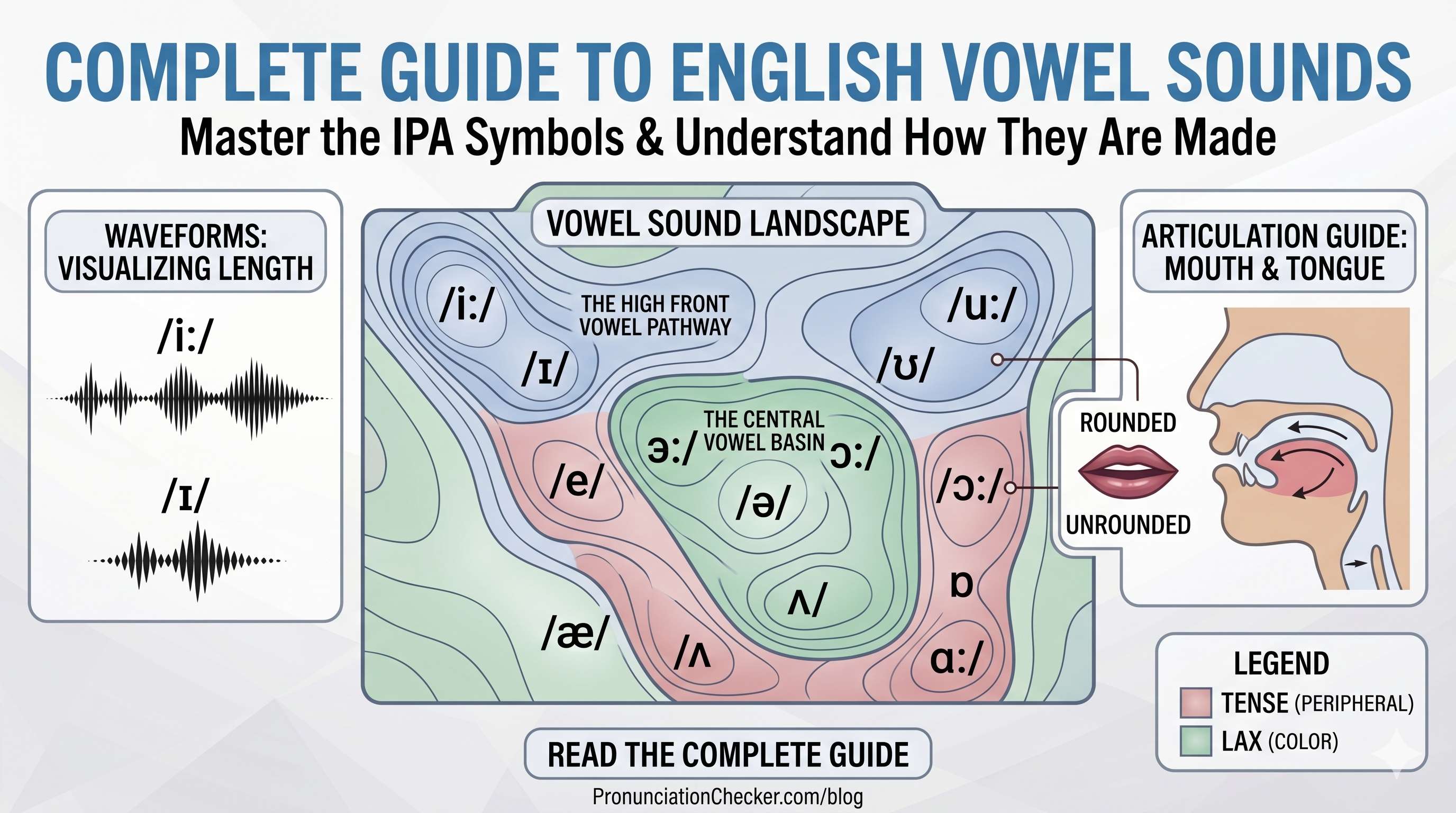
The Complete Guide to English Vowel Sounds: Master Every IPA Symbol
English has a reputation for having chaotic spelling, and much of that chaos stems from vowels. The letter "a" alone represents different sounds in "cat," "make," "care," "bar," and "want." Meanwhile, the sound /ɪ/ can be spelled with "i," "e," "y," or "u." This inconsistency confuses learners and makes pronunciation by spelling nearly impossible.
The solution? Understanding English vowel sounds through the International Phonetic Alphabet. Unlike English spelling, IPA gives each vowel sound its own unique symbol, making the phonetic landscape clear and manageable. In this comprehensive guide, we'll explore all English vowel sounds, their IPA symbols, how to pronounce them, and how to practice them using an interactive IPA chart.
Why Vowels Matter So Much
Consonants are like the skeleton of English—they provide structure and clarity. Vowels, by contrast, are the music. They carry stress, set the rhythm, and often determine intelligibility. Mispronounce a consonant slightly, and people usually understand you anyway. Mispronounce a vowel, and you might get a completely different word: "sit" becomes "set," "come" becomes "cam," "ship" becomes "sheep."
This is why mastering vowel sounds directly impacts how clearly you speak English and how easily native speakers understand you.
Understanding English Vowel Types
Monophthongs (Pure Vowels)
A monophthong is a single vowel sound with no change in quality. English has around 14 monophthongs, depending on accent:
Front Vowels (tongue toward the front):
- /i/ as in "fleece" - high, front, unrounded (beat, see, believe)
- /ɪ/ as in "kit" - near-high, front, unrounded (bit, sit, printed)
- /e/ as in "dress" - mid, front, unrounded (bed, said, etch)
- /ɛ/ as in "face" - mid-high, front, unrounded (better, weather)
- /æ/ as in "trap" - low, front, unrounded (cat, bad, plan)
Back Vowels (tongue toward the back):
- /ɑ/ as in "start" - low, back, unrounded (father, calm, art)
- /ɔ/ as in "thought" - mid, back, rounded (caught, saw, law)
- /o/ as in "goat" - high-mid, back, rounded (boat, toad, mode)
- /ʊ/ as in "foot" - near-high, back, rounded (book, look, bush)
- /u/ as in "goose" - high, back, rounded (food, blue, through)
Central Vowels (tongue in the middle):
- /ə/ (schwa) as in "about" - mid, central, unrounded (sofa, better, comma)
- /ʌ/ as in "strut" - low-mid, central, unrounded (cup, love, done)
Diphthongs (Complex Vowels)
A diphthong is a single vowel sound that glides from one vowel quality to another within the same syllable. English has around 8 diphthongs:
- /eɪ/ as in "face" - starts at /e/, glides to /ɪ/ (day, make, say)
- /aɪ/ as in "price" - starts at /a/, glides to /ɪ/ (my, like, buy)
- /ɔɪ/ as in "choice" - starts at /ɔ/, glides to /ɪ/ (boy, noise, joy)
- /oʊ/ as in "goat" - starts at /o/, glides to /ʊ/ (go, show, know)
- /aʊ/ as in "mouth" - starts at /a/, glides to /ʊ/ (now, how, cow)
- /ɪə/ as in "near" - starts at /ɪ/, glides to /ə/ (beer, ear, fear)
- /eə/ as in "square" - starts at /e/, glides to /ə/ (care, hair, bear)
- /ʊə/ as in "cure" - starts at /ʊ/, glides to /ə/ (pure, sure, tour)
How to Pronounce Each Sound
Reading descriptions of how to pronounce vowels is one thing; hearing them and feeling how to produce them is entirely different. This is where an interactive IPA chart becomes invaluable. When you click on each vowel symbol, you'll hear native speaker audio, allowing you to:
- Train your ear to recognize the exact sound
- Feel the positioning and movement of your tongue
- Compare similar sounds that you tend to confuse
For example, if you struggle with /ɪ/ versus /e/, the interactive chart lets you listen to both repeatedly until the distinction becomes clear. Then you can practice producing each one and refine your pronunciation.
The Vowel Chart: A Visual Map
The IPA vowel chart is shaped like a quadrilateral (trapezoid) and represents the vowel space of your mouth. The four corners represent the extreme positions your tongue can take:
- Top-left: High, front vowel (/i/)
- Top-right: High, back vowel (/u/)
- Bottom-left: Low, front vowel (/æ/)
- Bottom-right: Low, back vowel (/ɑ/)
All other vowels fall somewhere within this space. Rounded vowels (where your lips are rounded) are marked differently than unrounded vowels. This visual representation makes it much easier to understand vowel relationships and practice moving between similar sounds.
Common Vowel Challenges for Non-Native Speakers
The /ɪ/ vs /i/ Confusion - These are both high, front vowels, but /i/ (fleece) is higher and longer than /ɪ/ (kit). Many learners miss this distinction.
The /ʌ/ vs /ɑ/ Mix-up - The "uh" sound /ʌ/ (strut) is often confused with the "ah" sound /ɑ/ (start). They're both low vowels but positioned differently.
Diphthong Gliding - Beginning learners often produce diphthongs as two distinct vowels instead of one smooth glide. Listening to native English on the interactive chart reveals this gliding motion.
Schwa Overuse - The schwa /ə/ is the most common vowel sound in English, but many learners add excessive schwa sounds or miss them when they appear in unstressed syllables.
Your Vowel Practice Strategy
Phase 1: Recognition (Week 1) - Spend 10 minutes daily on the interactive IPA chart, clicking through all vowel sounds and building familiarity with each one.
Phase 2: Differentiation (Weeks 2-3) - Focus on vowel pairs that sound similar in your native accent. Listen intensively to the chart, then record yourself trying to match the distinction.
Phase 3: Integration (Weeks 4+) - Start looking up IPA transcriptions of new words, identify their vowel sounds on the chart, then practice the entire word in context.
Ready to Master English Vowels?
The interactive IPA chart is your perfect companion for this journey. Open it now and start exploring English vowel sounds with audio reference and visual guidance:
https://pronunciationchecker.com/tools/interactive-IPA-sounds.html
Frequently asked questions
How many vowel sounds does English have?
Far more than the five vowel letters suggest: around fourteen in General American and around twenty in British English including diphthongs. Speakers of five-vowel languages such as Spanish, Italian, Japanese and Greek are therefore not learning a few extra sounds but subdividing regions of vowel space their first language treats as single categories.
What is the difference between tense and lax vowels?
Tense vowels are produced with greater muscular effort and the tongue further from the centre of the mouth, and they can end a stressed syllable alone — see, too, day, go. Lax vowels are relaxed and more central, and no English word ends in a stressed lax vowel, which is why you cannot end a word with the vowel of ship, full, let or cup.
Is the difference between sheep and ship really about length?
No. They differ mainly in tongue position: /iː/ is tense with the tongue high and forward, /ɪ/ is lax with the tongue lower and more central. Duration is secondary and can even reverse, since the vowel in beat is physically shorter than the vowel in bid because English clips vowels before voiceless consonants. Lengthening /ɪ/ produces a long /ɪ/, not /iː/.
Which vowel should I learn first?
Schwa, /ə/, because it is the most frequent vowel in spoken English — roughly one vowel in nine — and it appears in every unstressed syllable regardless of spelling. Correcting it changes a far larger proportion of your speech per hour of practice than any individual contrast, and it also improves your rhythm, since schwa is what makes stressed syllables stand out.
Disclosure: this page links to Preply, a tutoring marketplace. If you book a lesson through that link we may earn a commission, at no extra cost to you. It does not change what is recommended here. See our disclaimer and privacy policy.
Train your ear on the vowels
Click through the vowel symbols and train your ear on the contrasts before you produce them.
Start ear training