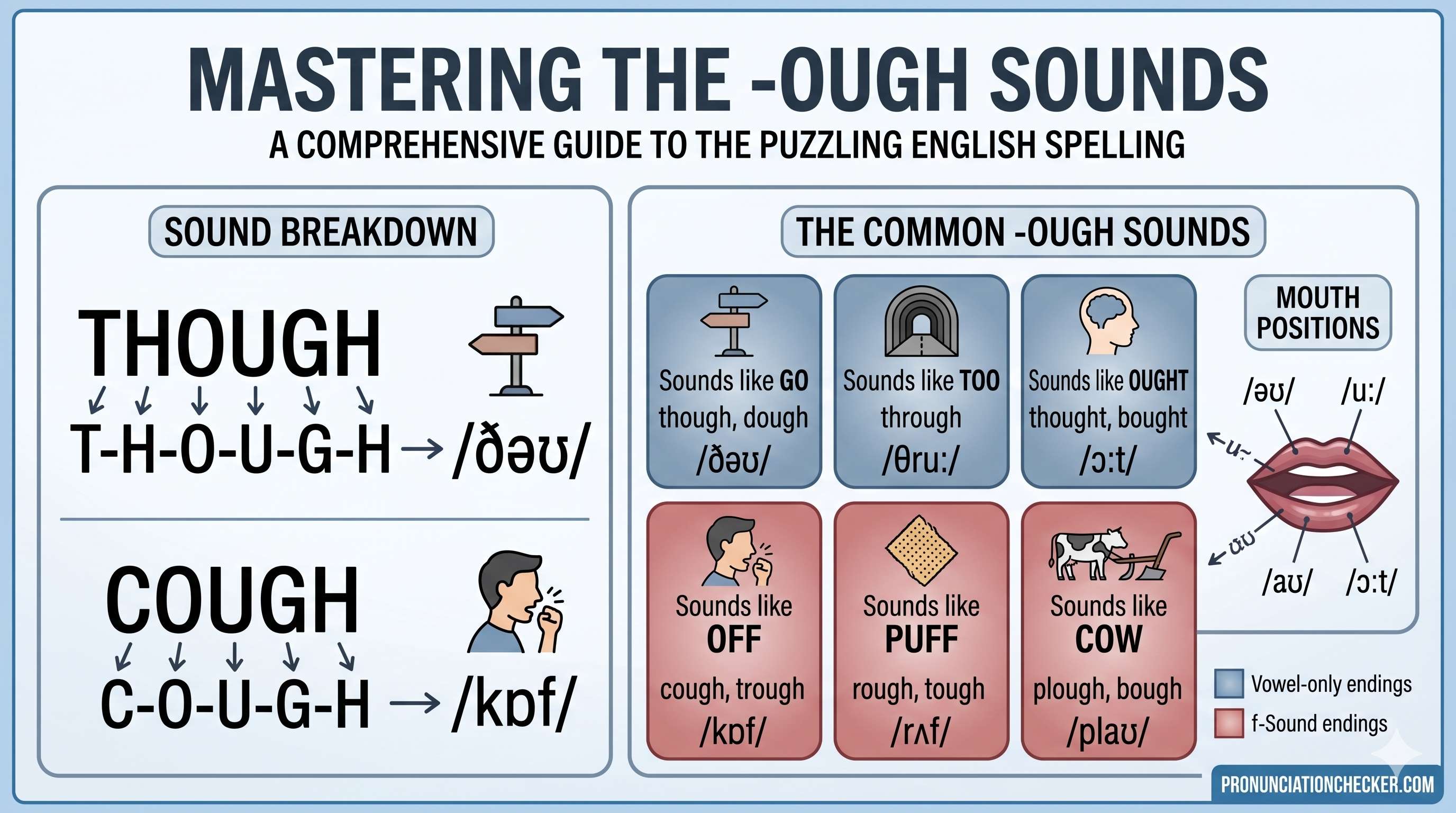
Though, through, tough, thought, bough, cough, thorough. Seven words, one spelling and six different pronunciations. Even native speakers hesitate over rarer members of the family, such as slough or hough.
No rule predicts the sound from the spelling, so the useful approach is different: understand why the spelling is so inconsistent, then learn the words in sound groups. Most learners need only about twenty -ough words, and grouping them turns a frustrating list into a few sets you can remember.
Why one spelling has so many pronunciations
Ough is the most notorious spelling in English, and for a specific historical reason. The gh once represented a real consonant, a velar or palatal fricative similar to the sound in German Bach or Scottish loch. Between roughly 1400 and 1700 that consonant disappeared from most English dialects, but it disappeared in different ways depending on the surrounding vowel and the regional dialect that happened to supply the modern standard form of each word.
The result is not a rule with exceptions. It is a set of individual historical outcomes frozen into the spelling. The practical consequence is that these words must be learned individually — but there are only about thirty of them in common use, which makes the task finite.
The sentence that contains most of them. A rough-coated, dough-faced, thoughtful ploughman strode through the streets of Scarborough, coughing and hiccoughing. Every ough in that sentence is pronounced differently.
The eight pronunciations
| Sound | IPA | Words | Rhymes with |
|---|---|---|---|
| uff | /ʌf/ | rough, tough, enough | stuff |
| off | /ɒf/, /ɔːf/ | cough, trough | scoff |
| oh | /oʊ/ | though, dough, although, thorough (US) | go |
| oo | /uː/ | through | true |
| ow | /aʊ/ | bough, plough, drought (spelled -ought) | now |
| aw | /ɔː/ | thought, bought, fought, ought, sought, brought, nought | law |
| uh | /ə/ | borough, thorough (UK), Edinburgh, Scarborough | unstressed ending |
| up | /ʌp/ | hiccough (a variant spelling of hiccup) | cup |
Learn them in groups, not alphabetically
The single most useful observation is that the -ought group is large, completely regular and contains very common words. Learning it as a unit disposes of a third of the problem in one step.
Group 1 — -ought and -aught, all /ɔːt/: thought, bought, brought, fought, sought, ought, nought, caught, taught, daughter, naughty, slaughter. Note that -aught joins the same group, which is why taught and thought rhyme.
Group 2 — the short /ʌf/ set: rough, tough, enough. Only three common words, and they all rhyme with stuff. Add slough when it means to shed skin.
Group 3 — the /oʊ/ set: though, although, dough, doughnut. All rhyme with go.
Group 4 — the singletons: through /θruː/, cough /kɒf/, plough /plaʊ/, bough /baʊ/. Four words, each its own pattern, and all worth memorising individually because they are frequent.
Group 5 — unstressed endings: in borough, thorough, Edinburgh, Peterborough, Scarborough the ough is an unstressed syllable and reduces to /ə/ in British English, /oʊ/ in American English. This is a stress effect rather than a spelling effect.
The pairs that actually cause errors
Some ough words look almost identical and sound completely different. These are where mistakes concentrate:
- though
/ðoʊ/against thought/θɔːt/against through/θruː/against thorough/ˈθʌrə/— four words, four sounds, and the first also has/ð/rather than/θ/. - tough
/tʌf/against though/ðoʊ/— one letter apart. - cough
/kɒf/against rough/rʌf/— same ending, different vowel. - bough
/baʊ/against bought/bɔːt/.
The set though, thought, through, thorough deserves dedicated practice. Write the four transcriptions on a card and read them aloud in random order until the mapping is automatic. These are frequent enough in academic and professional English that hesitating over them is costly.
The wider gh pattern
Understanding that gh once represented a real consonant explains several other spelling groups at the same time:
- Silent gh after i, giving
/aɪ/: night, light, right, might, high, sigh, flight, bright, fight. This group is completely regular. - gh as
/f/: laugh, cough, rough, tough, enough — the same historical fricative resolving as a labial sound. - Silent gh elsewhere: straight, weight, eight, neighbour, daughter, caught, bright.
Once you see that every one of these traces back to a lost consonant, the spelling stops looking arbitrary. It is not predictive, but it is comprehensible, and words that make sense are easier to retain than words that appear random.
Frequently asked questions
How many ways can ough be pronounced?
Eight in common use: /ʌf/ in rough and tough, /ɒf/ in cough, /oʊ/ in though and dough, /uː/ in through, /aʊ/ in plough and bough, /ɔː/ in thought and bought, /ə/ in borough and thorough, and /ʌp/ in the variant spelling hiccough. There are only about thirty such words in ordinary use, so the task is finite even though no rule predicts them.
Why does ough have so many pronunciations?
The gh once represented a real consonant, a velar fricative like the sound in Scottish loch. Between roughly 1400 and 1700 that consonant disappeared, but it disappeared differently depending on the surrounding vowel and on which regional dialect supplied the standard form of each word. The modern spellings preserve those separate historical outcomes rather than following a single rule.
What is the easiest way to learn these words?
Learn them in groups rather than alphabetically. The -ought and -aught group is large, completely regular and full of common words: thought, bought, brought, fought, caught, taught and daughter all rhyme. That single group disposes of about a third of the problem. Then handle rough, tough and enough as a second group, and memorise through, cough, plough and bough individually.
Which ough words do learners confuse most?
The set though, thought, through and thorough, which look almost identical and share no pronunciation — /ðoʊ/, /θɔːt/, /θruː/ and /ˈθʌrə/ respectively, with the first also beginning with a voiced /ð/ rather than /θ/. These four are frequent in academic and professional English, so they are worth drilling from transcription cards until the mapping is automatic.
Disclosure: this page links to Preply, a tutoring marketplace. If you book a lesson through that link we may earn a commission, at no extra cost to you. It does not change what is recommended here. See our disclaimer and privacy policy.
Hear all the -ough words
Type though, through, tough and thought one after another and listen to each in American and British English.
Look up a word