Why Number Pronunciation Matters in English
Numbers are everywhere in English: phone numbers, addresses, prices, dates, times, measurements. Getting number pronunciation wrong can lead to serious misunderstandings—imagine giving someone the wrong phone number or prices.
While number pronunciation seems simple, there are specific rules, stress patterns, and contextual variations that make it more complex than most learners realize. This guide covers everything you need to pronounce English numbers correctly and confidently.
Basic Numbers 0-10
The foundation for all number pronunciation starts here:
- 0 — "zero" (ZEE-ro) or "oh" (used in phone numbers and addresses)
- 1 — "one" (WUN)
- 2 — "two" (TOO)
- 3 — "three" (THREE)
- 4 — "four" (FOUR)
- 5 — "five" (FIVE)
- 6 — "six" (SIX)
- 7 — "seven" (SEV-un)
- 8 — "eight" (ATE)
- 9 — "nine" (NINE)
- 10 — "ten" (TEN)
Important Notes
"One" vs "On": Pronounce the vowel clearly: WUN, not "on." Many learners shorten it too much.
"Two" vs "To/Too": These sound identical when pronounced correctly (TOO). Write the number to avoid confusion in written communication.
"Zero" vs "Oh": In phone numbers and sequences, native speakers often say "oh" instead of "zero." For example, a phone number 555-0101 might be "five five five oh one oh one."
Teen Numbers 11-19
Teen numbers have a distinctive pattern: stress on the SECOND syllable (the "teen" sound):
- 11 — "eleven" (e-LEV-un)
- 12 — "twelve" (TWELV)
- 13 — "thirteen" (thir-TEEN)
- 14 — "fourteen" (for-TEEN)
- 15 — "fifteen" (fif-TEEN)
- 16 — "sixteen" (sik-STEEN)
- 17 — "seventeen" (sev-un-TEEN)
- 18 — "eighteen" (ay-TEEN)
- 19 — "nineteen" (nine-TEEN)
Critical Stress Pattern
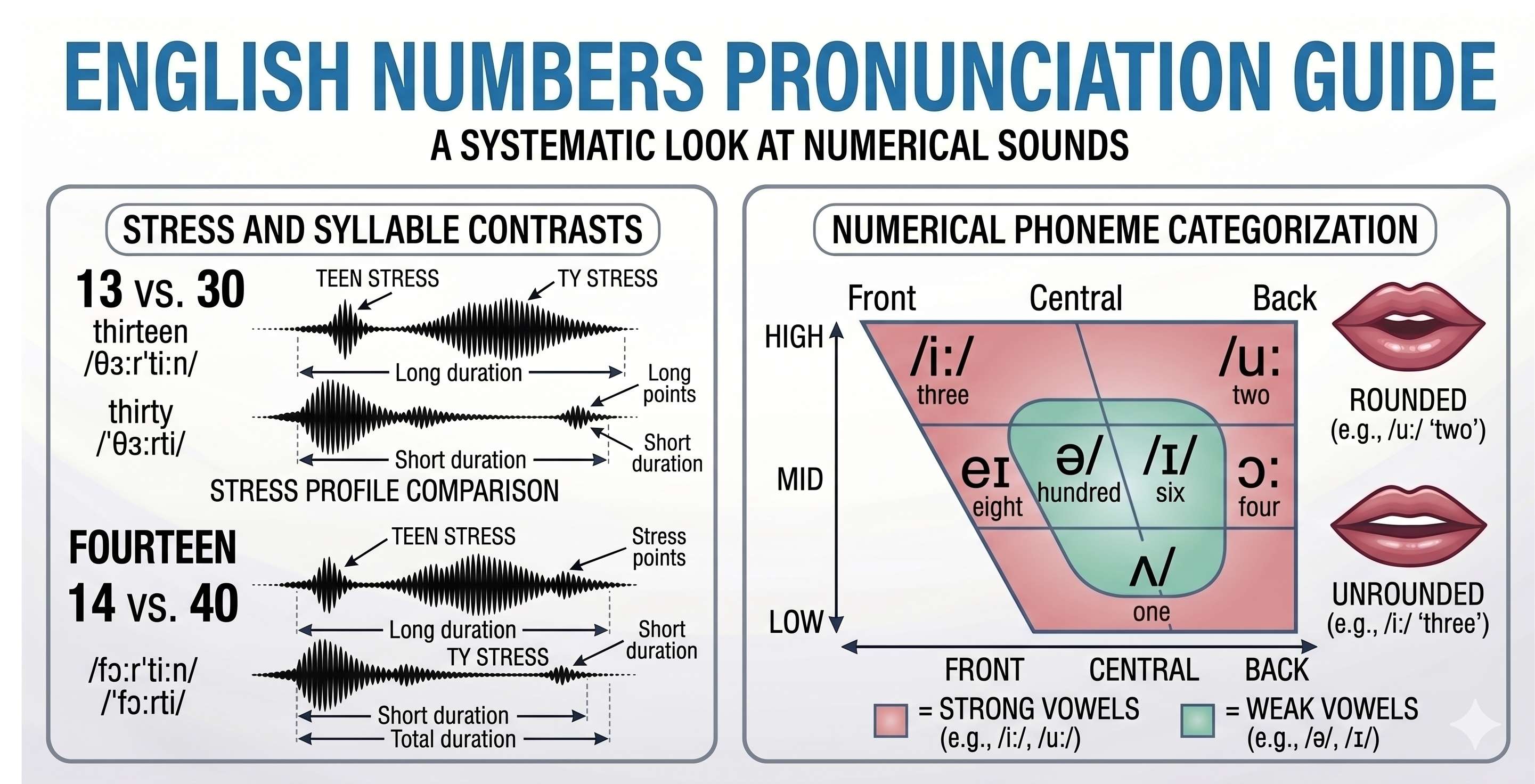
The STRESS is the key difference between teens (13-19) and tens (30-90). Teens have stress on the "teen" sound: thir-TEEN, four-TEEN, fif-TEEN.
Tens Numbers 20-90
Tens have stress on the FIRST syllable (the opposite of teens):
- 20 — "twenty" (TWEN-ty)
- 30 — "thirty" (THIR-ty)
- 40 — "forty" (FOR-ty)
- 50 — "fifty" (FIF-ty)
- 60 — "sixty" (SIX-ty)
- 70 — "seventy" (SEV-un-ty)
- 80 — "eighty" (AY-ty)
- 90 — "ninety" (NINE-ty)
The Most Confusing Distinction
This is the most important rule: TEENS have stress on the second syllable; TENS have stress on the first:
- 13 = thir-TEEN ✓ (stress on "teen")
- 30 = THIR-ty ✓ (stress on "thir")
- 14 = for-TEEN ✓
- 40 = FOR-ty ✓
Getting this wrong is the most common error for non-native speakers.
Compound Numbers 21-99
Compound numbers (21, 35, 97, etc.) combine tens and ones:
- 21 = "twenty-one" (emphasis on TWEN-ty)
- 35 = "thirty-five" (emphasis on THIR-ty)
- 97 = "ninety-seven" (emphasis on NINE-ty)
- 48 = "forty-eight" (emphasis on FOR-ty)
The stress falls on the TENS digit (the first part), not the ones digit.
Hundreds, Thousands, and Larger Numbers
Hundreds
- 100 = "one hundred" or "a hundred"
- 250 = "two hundred fifty" or "two hundred and fifty"
- 999 = "nine hundred ninety-nine"
Thousands
- 1,000 = "one thousand" or "a thousand"
- 5,500 = "five thousand five hundred"
- 10,000 = "ten thousand"
Millions, Billions, and Beyond
- 1,000,000 = "one million"
- 1,000,000,000 = "one billion" (in American English; British English uses "milliard" for intermediate values)
- 1,000,000,000,000 = "one trillion"
Years and Dates
Reading Years
Years are typically read as two-digit numbers:
- 1984 = "nineteen eighty-four" (not "one thousand nine hundred eighty-four")
- 1776 = "seventeen seventy-six"
- 1066 = "ten sixty-six"
Years in the 2000s
- 2000 = "two thousand"
- 2008 = "two thousand eight" or "twenty oh eight"
- 2015 = "twenty fifteen"
- 2024 = "twenty twenty-four"
- 2026 = "twenty twenty-six"
Complete Dates
- May 23, 2026 = "May twenty-third, twenty twenty-six"
- December 25, 1995 = "December twenty-fifth, nineteen ninety-five"
- January 1, 2000 = "January first, two thousand"
American Format: Month, Date, Year → "May 23" = "May twenty-third"
British Format: Date, Month, Year → "23 May" = "the twenty-third of May"
Times and Clock Numbers
Basic Times
- 3:00 = "three o'clock"
- 3:15 = "three fifteen" or "quarter after three"
- 3:30 = "three thirty" or "half past three"
- 3:45 = "three forty-five" or "quarter to four"
24-Hour Format
- 13:00 = "thirteen hundred" or "one p.m."
- 15:30 = "fifteen thirty" or "three thirty p.m."
- 23:45 = "twenty-three forty-five"
Time Abbreviations
- a.m. = "ay em" (morning)
- p.m. = "pee em" (afternoon/evening)
- AM = "ay em" (morning)
- PM = "pee em" (afternoon/evening)
Prices and Money
Basic Prices
- $5 = "five dollars"
- $9.99 = "nine ninety-nine" or "nine dollars and ninety-nine cents"
- $100.50 = "one hundred dollars and fifty cents"
- £15.30 = "fifteen pounds thirty" (British)
- €20.75 = "twenty euros seventy-five"
Understanding Decimals
When reading prices or numbers with decimals, read each digit after "point":
- 3.14 = "three point one four" (not "three point fourteen")
- $9.99 = "nine ninety-nine" (special usage for money)
- 2.5 = "two point five"
Phone Numbers and Addresses
Phone Numbers
- (555) 123-4567 = "five five five, one two three, four five six seven"
- +1 (555) 123-4567 = "plus one, five five five, one two three, four five six seven"
Special Phone Number Rules
Use "oh" instead of "zero": 555-0101 = "five five five, oh one, oh one"
Doubled numbers: Some people say doubled numbers as units. 4455 might be "double four, double five" or "four four five five."
Addresses
- 123 Main Street = "one two three Main Street"
- Apartment 4B = "Apartment four B"
- P.O. Box 789 = "P.O. Box seven eight nine"
Common Number Pronunciation Mistakes
Mistake 1: Wrong Teen/Ten Stress
❌ Wrong: Say "THIR-teen" (stress on first syllable)
✓ Correct: Say "thir-TEEN" (stress on second syllable)
Mistake 2: Unclear Vowels in Teens
❌ Wrong: Say "fir-teen" (unclear vowel)
✓ Correct: Say "FIF-teen" (clear vowel) or "fif-TEEN"
Mistake 3: Pronunciation of "Zero" as "Oh"
In some contexts (phone numbers, addresses), use "oh" instead of "zero." Know when each is appropriate.
Mistake 4: Wrong Year Reading Format
❌ Wrong: Say "two thousand twenty-six" for 2026
✓ Correct: Say "twenty twenty-six"
Mistake 5: Unclear Pronunciation of Compound Numbers
Make sure the stress falls on the TENS digit: TWEN-ty ONE, THIR-ty FIVE, not TWEN-ty-ONE or THIR-ty-FIVE with equal stress.
Interactive Number Practice
Ready to master English numbers? Use our interactive number pronunciation exercises where you can:
- Listen to native speakers pronounce various numbers
- Practice different number formats: basic numbers, dates, times, prices, phone numbers
- Record yourself and get instant accuracy feedback
- Focus on stress patterns and vowel clarity
- Build muscle memory through repetitive practice
Conclusion
While number pronunciation might seem straightforward, there are specific rules, stress patterns, and contextual variations that take practice to master. The most important rule to remember is the TEENS vs TENS distinction: teens have stress on the second syllable, while tens have stress on the first.
Practice consistently with our interactive exercises, and within a week or two you'll be pronouncing all types of numbers correctly and confidently. Clear number pronunciation is essential for business, traveling, and everyday English communication.
Frequently asked questions
Why do thirteen and thirty sound so similar?
They differ in stress and in the final consonant, and both cues are easy to miss. Thirteen is stressed on the second syllable and ends in /n/; thirty is stressed on the first and ends in a flapped /t/ in American English. In careful speech the stress difference is the reliable cue, which is why native speakers often say one-three or three-zero when a number must be unambiguous.
How do I say years and dates in English?
Years before 2000 are normally split into two pairs: 1984 is nineteen eighty-four, and 1905 is nineteen oh five. Years from 2000 to 2009 are usually said in full as two thousand and nine. From 2010 onwards both patterns occur, so twenty twenty-four and two thousand twenty-four are both current, with the first more common in speech.
Where does the stress fall in numbers like fourteen?
It moves depending on context, which is unusual. Said alone, the teens are stressed on the second syllable: four-TEEN. Before a noun the stress often shifts forward to avoid two stresses in a row, giving FOUR-teen students. This is called stress shift and it applies to other compounds too, which is why it sounds wrong to keep the stress fixed.
How are decimals and fractions pronounced?
Decimals are read digit by digit after the point: 3.14 is three point one four, not three point fourteen. Simple fractions use ordinal numbers — a half, a third, two thirds, three quarters — and larger denominators follow the same pattern, so 7/8 is seven eighths. Phone numbers and card numbers are also read digit by digit, with zero often said as oh.
Disclosure: this page links to Preply, a tutoring marketplace. If you book a lesson through that link we may earn a commission, at no extra cost to you. It does not change what is recommended here. See our disclaimer and privacy policy.
Practise numbers out loud
Hear numbers, dates and quantities spoken aloud, then say them yourself.
Practise numbers