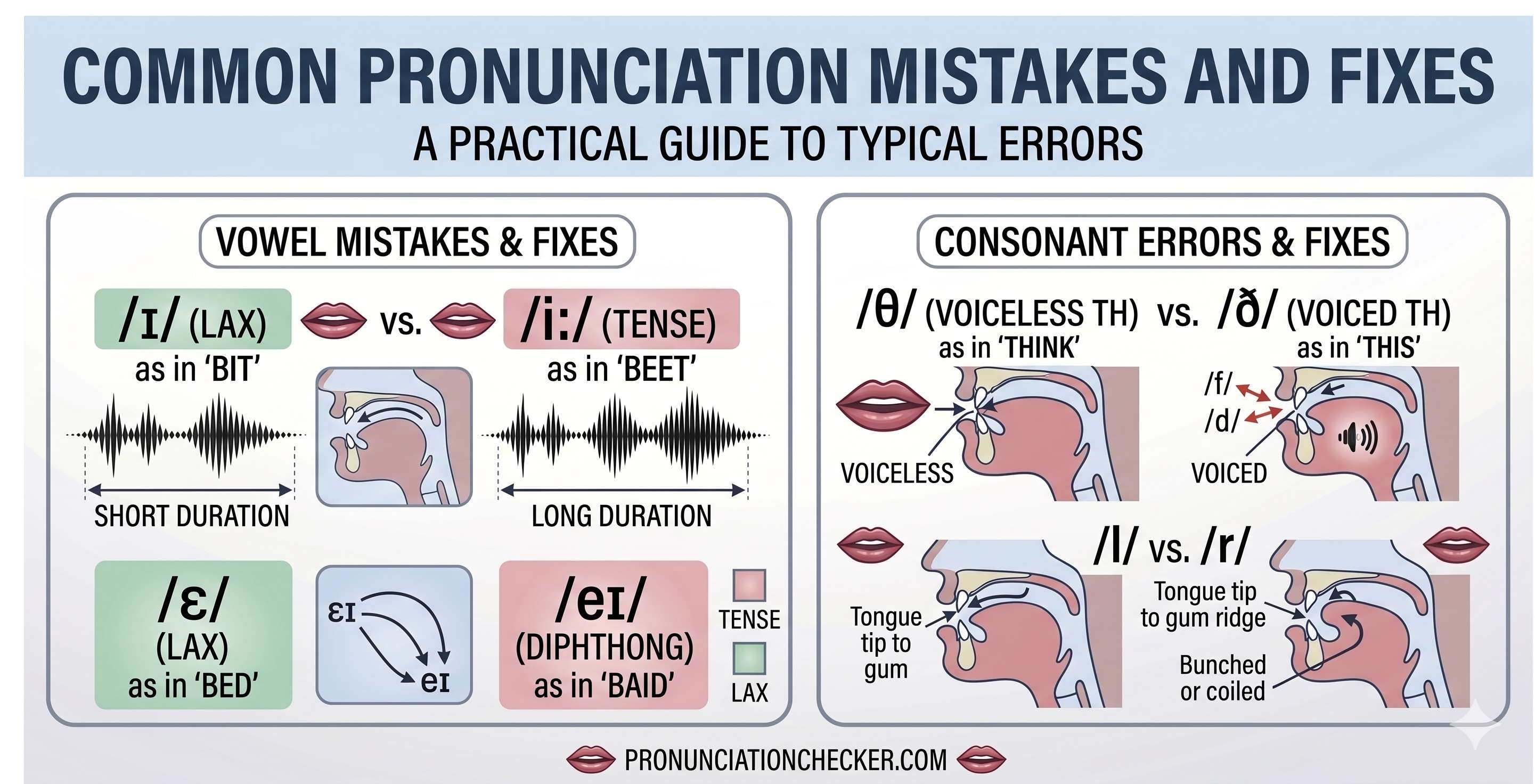
Most lists of "common pronunciation mistakes" treat every error as equally serious. They are not. A learner who says sink for think is nearly always understood from context. A learner who says com-FOR-ta-ble for comfortable often is not. This guide sorts errors by what they cost you with listeners, then gives a specific fix for each.
A two-minute self-check before you start
Record yourself reading these four lines, then play them back. Each line tests a different kind of error, so the line that sounds worst tells you where to begin.
- Vowels: "Did you leave or live here? I saw a sheep on the ship." Are the words in each pair clearly different?
- Word endings: "He stopped, asked and missed the bus." Can you hear a /t/ at the end of each verb?
- Word stress: "The photographer took a photograph for the photography class." Does the loud syllable move: PHO-to-graph, pho-TOG-ra-pher, pho-TOG-ra-phy?
- Rhythm: "I want to go home for the weekend." Does it sound like nine equal beats, or like three strong ones (WANT, HOME, WEEK) with quick words between them?
Not all errors cost the same
Pronunciation errors are usually presented as a flat list. They are not equivalent. Some cause listeners to misunderstand a word; others merely mark you as non-native. Sorting your own errors by cost is the single most useful thing you can do before choosing what to practise.
| Cost | Type of error | Examples |
|---|---|---|
| High — breaks understanding | Word stress on the wrong syllable | comFORtable, deVElop, PHOtographer |
| High | Merging two phonemes that distinguish common words | ship / sheep, full / fool, bad / bed |
| Medium | Deleting or inserting sounds in clusters | estreet, nex for next |
| Medium | Even syllable timing with no reduction | Every syllable equally long |
| Low — marks an accent only | Substituting a similar consonant | think as sink, unaspirated /p/ |
| Low | Wrong allophone | Clear /l/ in milk, no flapping in American English |
The ordering surprises many learners. A misplaced stress is worse than a wrong th, because English listeners use the stressed syllable to retrieve the word from memory, whereas a substituted consonant usually leaves enough information for the word to be recovered from context.
Six errors worth checking in your own speech
1. Pronouncing every written syllable
English deletes syllables in normal speech. Comfortable has three syllables, not four. Vegetable has three. Chocolate has two. Interesting has three. Every has two. Producing the full written form is one of the clearest signals that a word was learned by reading. Check yourself on these eight: comfortable, vegetable, chocolate, interesting, every, different, business, temperature.
2. Using strong forms of function words
About fifty common words have a reduced form used in nearly all connected speech. To is /tə/, of is /əv/, for is /fər/, and is /ən/, can is /kən/. Using the full form everywhere is grammatically correct but destroys the rhythm listeners use to locate the content words.
3. Adding a vowel to the -ed ending
Walked is one syllable. So are stopped, laughed, washed, passed, helped, watched. The extra syllable appears only after /t/ or /d/: wanted, needed, decided, started. This error comes directly from the spelling and is very common at all levels.
4. Missing the vowel length cue before final consonants
Learners who cannot voice a final /d/, /z/ or /v/ often push harder on the consonant. The effective fix is to lengthen the vowel instead: the difference between bat and bad is carried mainly by vowel duration, not by the consonant.
5. Flat pitch range
English uses a wider pitch range than most languages. Transferring a narrower range produces speech that native listeners describe as bored, blunt or annoyed — a social cost rather than a comprehension one, and therefore easy to miss because nobody mentions it.
6. Consistent stress on the wrong syllable in your own technical vocabulary
Professional and academic words are usually learned by reading, so stress errors concentrate there. These are also the words you most need listeners to catch first time. Auditing the twenty words you use most at work is unusually high-value.
A three-minute self-audit. Record yourself describing your job. Then check four things specifically: do you delete the syllables in comfortable and interesting; do you reduce to, of and and; is walked one syllable; and does your pitch move. Those four checks catch more real problems than a general listen-through, because a general listen-through mostly finds what you already know about.
Why old errors are harder to fix
Errors that have been repeated for years become automatic, which means they run without conscious attention and therefore reappear the moment attention moves elsewhere. This is why learners can produce a sound perfectly in a drill and lose it immediately in conversation.
The implication for practice is specific: correct production in isolation is not the finishing point, it is the starting point. The work that changes conversational speech is production under load — while reading unfamiliar text, while speaking spontaneously, while thinking about content. Plan for that phase rather than assuming the drill was the whole job.
Frequently asked questions
Which pronunciation errors matter most?
Word stress errors and merged vowel contrasts, because both can prevent a word from being recognised at all. English listeners use the stressed syllable to retrieve words from memory, so comFORtable may not be identified, while a substituted consonant such as sink for think usually leaves enough information for context to recover the word. Sorting your errors by cost before choosing what to practise saves considerable time.
Is walked one syllable or two?
One. So are stopped, laughed, washed, passed, helped and watched. The -ed ending only adds a syllable after /t/ or /d/, as in wanted, needed, decided and started. Pronouncing walk-ed is a very common error at all levels and comes directly from reading the spelling rather than applying the rule.
Why do I lose a sound in conversation that I can produce perfectly in practice?
Because the old pattern is automatic and the new one is not. Automatic behaviour runs without conscious attention, so it reappears the moment your attention shifts to grammar, vocabulary or meaning. Correct production in isolation is the starting point rather than the finish; what changes conversational speech is practice under load, such as reading unfamiliar text aloud or speaking spontaneously.
How do I find my own pronunciation errors without a teacher?
Record three minutes describing your job, then check four specific things rather than listening generally. Do you delete the middle syllable in comfortable and interesting; do you reduce to, of and and to schwa; is walked one syllable; and does your pitch actually move across a sentence. Targeted checks find far more than a general listen-through, which tends to surface only what you already suspected.
Disclosure: this page links to Preply, a tutoring marketplace. If you book a lesson through that link we may earn a commission, at no extra cost to you. It does not change what is recommended here. See our disclaimer and privacy policy.
Find out which errors you actually make
Read a short passage aloud and get word-by-word feedback on what was recognised.
Take the voice test